
Websites for appliance repair
Appliance Repair Website Design: Brand Pages, Model-Number Booking and Honest Fees
A customer with a dead dishwasher wants to know three things in ten seconds: do you fix this brand, what does the visit cost, and when can you come. An appliance repair site that answers those on the first screen books the visit. One that opens with a stock photo of a smiling technician does not.
November 6, 2026 · 9 min read
- 19:02 booking started: dishwasher, not draining
- 19:03 data plate photo uploaded
- 19:03 brand and model read from the plate photo
- 19:04 likely part: drain pump, stocked on van 2
- 19:04 $89 diagnostic fee shown, credited if repaired
- 19:05 booked: Tuesday, 1 to 4 pm
The short answer
An appliance repair website should be organized by brand, appliance type and common failure, state the diagnostic fee and whether it is credited, show parts and labor warranty and EPA refrigerant certification, and let customers book with the model number or a photo of the data plate. DataCram's custom appliance sites start at $1,500, priced before work begins, and include Athena CMS; 0% financing is available.
On this page
- What the site must accomplish before dispatch
- A page map organized by brand, appliance and symptom
- Booking that captures the data plate
- Credentials and warranty language on the page
- Speed, phones and error codes a person can read
- Brand pages that search engines and assistants can cite
- Athena agents behind an appliance shop's site
- The fixed price and the four-step build
- The one-tech shop that can wait on a custom build
What the site must accomplish before dispatch
Appliance repair is a scheduling business with a technical front door. The site's work is to send the right tech, to the right address, with a decent guess at the part. Five jobs, in rough order of how much money they move:
Book with the model number
A booking form that asks for the brand, the appliance, the symptom and a photo of the data plate, so the tech arrives knowing what they are looking at.
Settle the fee question
The diagnostic fee, what it covers and whether it is credited toward the repair, said once and plainly. It filters out free-estimate hunters and prevents angry reviews.
Match the brand to the shop
A page for every brand you service, so the customer sees their brand named and the search engine sees it too.
Set parts expectations
A short explanation of how parts orders and return visits work, so a second trip reads as normal rather than as a failure.
Serve the landlord
A page for property managers and landlords: unit access, tenant scheduling, invoicing to the owner.
A page map organized by brand, appliance and symptom
| Page or feature | Why it matters | What it includes |
|---|---|---|
| Brand pages | Customers search by brand first | Appliance types you service for that brand, common failures, any factory authorization you actually hold |
| Appliance type pages | Covers 'dryer repair' and 'ice maker repair' searches | Common problems, what a visit includes, related brand pages |
| Symptom and error code articles | Wins the long, specific searches and earns AI citations | Plain explanations, safe checks a homeowner can do, when to call |
| Diagnostic fee and warranty page | The two questions that decide whether someone books | Fee, credit policy, parts and labor warranty in months, what voids it |
| Repair or replace guide | Builds trust by giving honest advice | Age, part cost, availability and energy use as factors, no scare tactics |
| Booking with data plate photo | Gets the right part on the first trip more often | Brand, appliance, symptom, model photo, preferred window, address |
| Installation page | Hardwired installs carry a Texas license requirement | What you install, your TDLR residential appliance installation license if you hold one |
| Service area pages | Searches and maps reward local relevance | Towns you truly serve, typical arrival windows; see the guide to service area pages |
Start with the brands that make up most of your tickets and add the rest over time. A shop that services only high-end built-in brands needs fewer pages and deeper ones. The general contractor website checklist covers what every trade site needs on top of this.
Booking that captures the data plate
The booking flow does three things a phone call often cannot: it collects the model number accurately, it records the symptom in the customer's words, and it lets the customer choose a window at 10 p.m. when the oven quits mid-dinner. We validate every request on the server, filter spam, and queue and retry anything that fails to send, so no booking disappears.
- ServiceTitan shops: ServiceTitan lists appliance repair among the trades it serves, and our ServiceTitan integration section explains how a custom site can feed it.
- Housecall Pro shops: Housecall Pro's help center describes an embeddable 'Book online' button that opens over your site, a hosted booking link and Reserve with Google (as of November 2026). See our Housecall Pro online booking page.
- Jobber shops: Jobber's help center says its booking forms, on select plans, have a shareable link and embed code. Our Jobber online booking page covers the options.
- A deeper connection: the build price already covers one connection to an outside system through its API, so a booking can arrive in your software as a proper record rather than an email someone retypes.
Credentials and warranty language on the page
Appliance repair has no general state license in Texas, so the site carries trust in other forms. Three are specific to this trade. EPA requires Section 608 certification for technicians who work on equipment that could release refrigerant, and its small appliance category covers home refrigerators, freezers, room air conditioners and dehumidifiers. TDLR licenses residential appliance installation, which Texas law defines as connecting or disconnecting an appliance to an existing circuit other than by plugging it in. And manufacturer authorizations, where you hold them, are proof the customer can check on the brand's own locator.
Warranty language needs care. The FTC explains that a warrantor generally cannot void coverage solely because an independent shop did the work or a third-party part was used, unless it provides that service free, though it can refuse coverage for damage the outside work caused. A site that says 'using us never affects your warranty' claims more than that. Reviews must be real: the FTC's 2024 rule bans fake and AI-written testimonials.
Speed, phones and error codes a person can read
Customers often read an appliance repair site while standing in front of the broken machine, trying to match a blinking code to an article. That means a phone, sometimes poor signal in a laundry room, and no patience. Our Next.js builds render each page ahead of time and serve it from nearby servers, so the error code article and the booking button appear fast. The site speed service describes the standard, and the Core Web Vitals guide explains the measurements.
Accessibility is built in rather than bolted on: strong contrast for a dim laundry room, buttons sized for a thumb, labels a screen reader can announce, and a photo field that goes straight to the camera for the data plate. Our accessibility service handles a formal review when a company wants one.
Brand pages that search engines and assistants can cite
When someone asks an AI assistant why a dryer runs without heat, the engine looks for a page that explains it. When they ask who repairs that brand nearby, it looks for a business that says so and a set of listings that agree. Brand and symptom pages written as server-rendered text give both kinds of answer something to cite. Schema markup is written to describe only what the page shows, and the shop's name, number and hours are kept letter for letter the same as on Google.
The listings, locator cleanup and question tracking are on our GEO for appliance repair page, and the ads, follow-up on unapproved quotes and review program are in the appliance repair marketing plan.
Athena agents behind an appliance shop's site
Athena CMS ships with every custom site we build, so adding a brand or changing the fee is a form, not a developer request. Its AI agents draft and you approve. The ones that suit an appliance shop:
- Calliope drafts symptom and error code articles from your techs' notes, in plain language, for your review.
- Iris writes titles, descriptions and structured data for each brand and appliance page, so the right page shows for the right search.
- Hestia checks that your phone number, hours and address read the same on the website, Google, Apple and Bing, and updates them together when a holiday closure comes up.
- Echo drafts review replies, puts unhappy reviews about parts delays at the top of the queue, and places good review quotes on matching brand pages.
- Ares watches competing repair shops and flags when one starts targeting your brands or towns.
The fixed price and the four-step build
The price depends on how many pages the site needs, and it is set before we start. A brand-by-brand appliance site tends to land in the larger tiers, which is no accident: page depth is what gives a new site its best start in organic search. Every tier carries the same inclusions: design, writing, SEO, Athena CMS, online booking, lead capture, one API connection to outside software, and twelve months of support (web design pricing).
- Up to 10 pages, $1,500: a single-tech shop with a few brands.
- 11 to 20 pages, $2,250: core brands plus appliance type pages.
- 21 to 50 pages, $3,750: brands, appliance types, a fee and warranty page and the first symptom articles.
- 51 to 70 pages, $5,750: our recommendation, with room for service areas and a real library of error code articles. On 0% financing it is $1,437.50 down, then $359.38 a month for twelve months.
- Extras: a repair-cost estimator beyond booking is web app work from $575, depending on complexity; hosting and maintenance is from $55 a month.
- 1
A mockup on the house
Tell us your brands, towns and fee, and we design your home page at no charge and with no obligation.
- 2
A quote that holds
One price for the pages and features we agree on.
- 3
Brand pages, booking and connections
We write the brand and appliance pages and wire the booking flow to dispatch, by text, email or your field-service software. Then you book a fake repair yourself to prove it works.
- 4
Go live with rankings protected
Every old URL with traffic or links is redirected to its new page, so existing search visibility carries over.
The one-tech shop that can wait on a custom build
A single technician with a full schedule from referrals and a home warranty company or two may not need a custom site yet. A clean Wix or Squarespace site with the brands listed, the fee stated and a call button can work. Our Wix versus custom guide marks the point where a builder runs out of road. The usual signs are wanting brand pages that rank, booking that feeds dispatch software, a second or third tech, or a site too slow to hold a visitor standing at a broken washer.
When you get there, ask for the free mockup. For more, see website design by industry, the appliance repair industry page, the broader home services website guide, and nearby trades such as garage door websites and the HVAC website page.
Questions owners ask before a new website
At DataCram the price follows the page count and is fixed up front: $1,500 buys up to 10 pages, and $5,750 buys the 51 to 70 pages we recommend for a shop with a page per brand. Booking and an API connection to your software come in every tier, and 0% financing spreads payment over up to a year after 25% down.
Yes. State the fee, what the visit includes and whether it is credited if the customer approves the repair. Customers decide whether to book on this, and a fee they did not expect is a common reason for an unhappy first conversation at the door.
Yes. We build booking that asks for the brand, appliance and symptom and lets the customer upload a photo of the data plate. The tech sees it before the visit, which helps bring the right part on the first trip.
For the brands that make up most of your work, yes. Customers search by brand, and a page that names the brand, the appliance types and the common failures is what search engines and AI assistants match. Smaller brands can share a page until there is enough to say.
Describe the law carefully. The FTC says a warrantor generally cannot void coverage solely because an independent shop or third-party part was used, unless it provides that service free, but it can deny coverage for damage the outside work caused. Your attorney should approve the final wording.
Yes. Housecall Pro and Jobber offer booking that can be embedded or linked, and if you want bookings written straight into the software, the API connection included in our packages covers it, subject to what your subscription permits, which we check first.
Field-service software
Run on ServiceTitan?
Your website should hand every lead, booking and ad click straight to the software that runs your trucks, not to an inbox somebody retypes from. We connect the site to the system you already use.
ServiceTitan
Larger shops with dispatchers and memberships
Housecall Pro
Owner-operators and small crews
Let visitors book without a phone call
Kairos, our AI chat and booking widget, answers from your own pages and books the appointment in the chat, day or night, on WordPress, Wix, GoDaddy or any site. Booking straight into ServiceTitan, Housecall Pro, Jobber, FieldEdge and more is rolling out.
Related home service work
Built for neighboring trades with the same jobs to do as a appliance repair business: answer fast, quote plainly and fill the schedule.
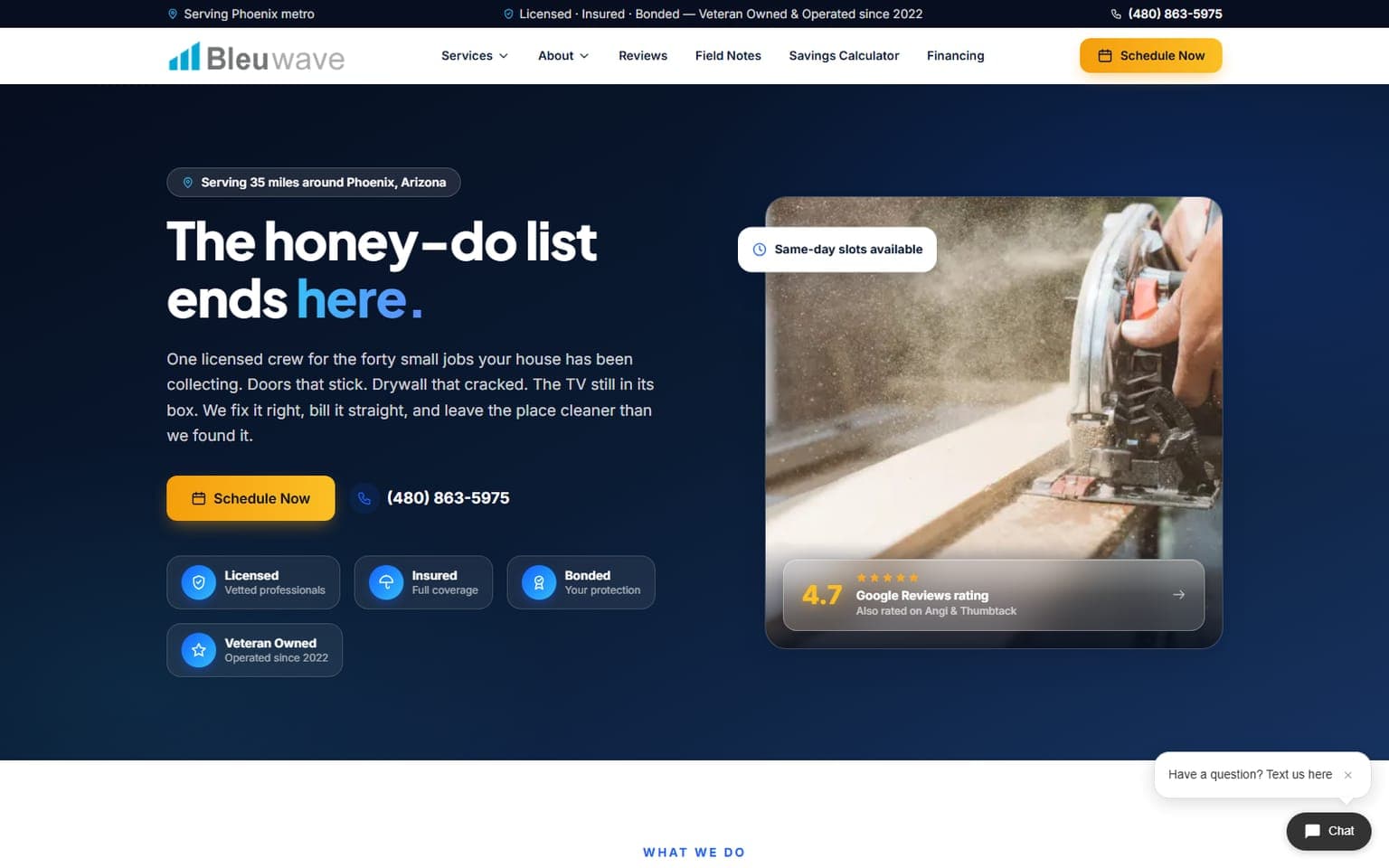 Bleuwave Handyman: Redesign & Savings CalculatorPhoenix, AZ · MetroA full redesign for a Phoenix handyman crew, rebuilt on React, Next.js, and TypeScript with a PostgreSQL back end and organized around the forty small jobs a house collects. The centerpiece is a savings calculator that stacks a bundled visit against hiring four separate trades and shows the homeowner the difference in dollars — the argument for booking everything at once, made arithmetically instead of rhetorically. A geofenced service radius, same-day slot availability, financing paths, and a Field Notes content engine run off the same typed schema.
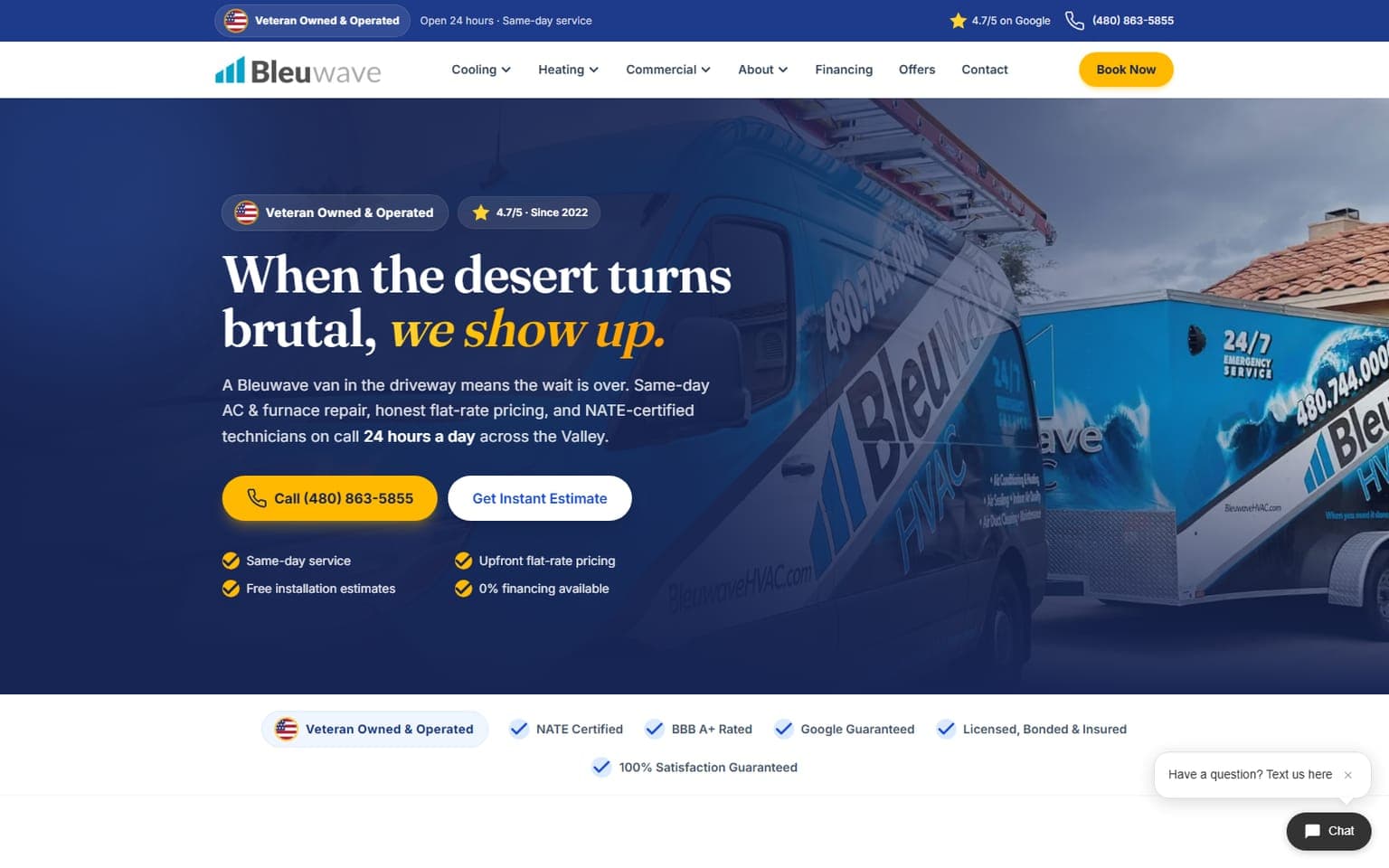 Bleuwave HVAC: Redesign & Instant EstimatePhoenix, AZA ground-up redesign that turns a 2 a.m. air-conditioning failure into a booked job before a competitor's phone even rings. The centerpiece is the Instant Estimate — a real-time pricing engine that hands a homeowner an honest flat-rate number in seconds instead of a promise to call back. Rebuilt on Next.js and React with a Neon Postgres backend, it marries a fast, conversion-first design to the kind of dynamic tooling most HVAC sites only advertise.
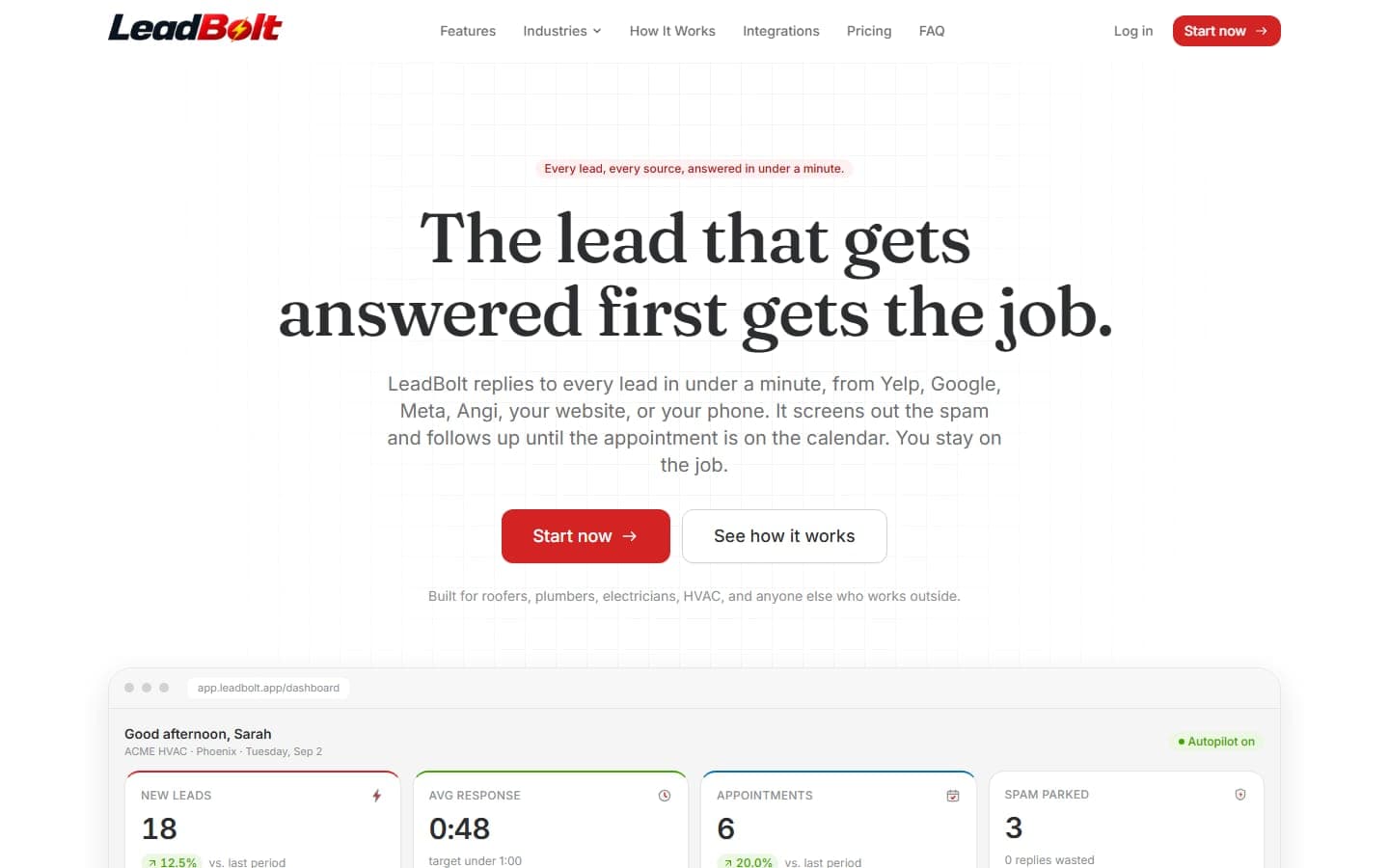 LeadBolt: Speed-to-Lead Software for ContractorsSan Antonio, TX · NationwideA software product, not a brochure: LeadBolt answers every Yelp, Google, Meta, Angi, website and phone lead in under a minute, screens out the spam, and follows up until the appointment is on the calendar, so a roofer or plumber on a job still wins the lead that came in while they were on the roof. The marketing site carries the same discipline — one promise on the first screen, the live dashboard shown rather than described, pricing published, and a start button on every page.
Keep reading
- AI search for appliance techsGEO for Appliance Repair: Get Named When the Fridge Quits and Someone Asks AIHow appliance repair companies get recommended by ChatGPT, Gemini and Siri: brand locators, EPA and Texas license facts, warranty answers and a GEO plan.
- Marketing for appliance repairAppliance Repair Marketing: Turn Diagnostic Visits Into Approved RepairsAppliance repair marketing built on brand and symptom searches, Maps, reviews and follow-up on unapproved quotes. Local plans from $575 a month.
- Contractor websitesHome Services Website Design That Turns Visits Into CallsCustom websites for HVAC, plumbing, roofing and other home service trades: tap-to-call, estimate forms, license details, fast pages. From $1,500, fixed.
- Websites for arboristsWebsite Design for Tree Service Companies: A Site Built for the Call After the StormTree service websites with storm call buttons, photo estimate requests, arborist credentials and fast pages. Custom builds from $1,500, with 0% financing.
- Marketing for haulersJunk Removal Marketing: Win the Photo Quote Before the Next Hauler Texts BackJunk removal marketing built around speed: Google Maps, Local Services Ads, referral partners, reviews and fast quote replies. Plans from $575 a month.
- AI search for haulersGEO for Junk Removal: Be the Hauler AI Names When Someone Wants It All Gone TodayHow junk haulers get named by ChatGPT, Gemini and Siri: what AI reads, Texas tire and appliance rules worth publishing, and a month of fixes.
- Everything in Website Design by TradeSee the section
See your appliance repair site before you commit
Send the makes you repair, the towns you cover and your diagnostic fee. A designed home page comes back to you, along with a firm price if you decide to build.
Which of these sounds like you? (pick any)
Rather talk now? Call (210) 346-0848.