
Marketing for haulers
Junk Removal Marketing: Win the Photo Quote Before the Next Hauler Texts Back
A junk removal customer rarely calls one company. They snap three photos of the garage, send them to every hauler on the first screen of results, and book whoever answers first with a number that sounds fair. Marketing that ignores that race buys leads for the competitor with the faster thumb.
November 6, 2026 · 9 min read
The short answer
Junk removal marketing works when it combines visibility with speed: a strong Google Business Profile and map ranking, Local Services Ads where they pay, referral partners such as agents and property managers, reviews that name the job, and a quote reply in minutes, not hours. DataCram runs local marketing and SEO for haulers from $575 a month, and Google bills your ad spend directly.
On this page
- The race starts when the photo arrives
- Where junk jobs come from, sorted by how fast they need an answer
- Ninety days of hauler marketing, in the order the money comes back
- Move-out weeks, spring cleanouts and the quiet stretch
- Donation claims, flat rates and reviews: promises to keep straight
- Measure loads hauled and dollars per truck, not clicks
- What a hauler's marketing costs, the mistakes that cost more, and the DIY route
The race starts when the photo arrives
Most hauling companies measure marketing by how many leads came in. The number that decides revenue is how many of those leads got a price before a competitor's did. A homeowner with a garage full of furniture is not loyal to anyone yet. They are loyal to the first believable answer.
That is why we start with response time, not ads. Our own product, LeadBolt, was built for contractors on exactly this problem: it answers Yelp, Google, Meta, Angi, website and phone leads in under a minute, screens out spam and follows up until the appointment is on the calendar. For after-hours web chat and email, TeamAIOps gives a service company an AI rep that replies in seconds and books the job. You do not need either product to follow this page; you do need someone, or something, answering fast. Our guide on getting more calls and estimate requests covers the human version.
Where junk jobs come from, sorted by how fast they need an answer
| Channel | What it is good for in junk removal | Where haulers lose money |
|---|---|---|
| Google Maps and Business Profile | Same-day 'junk removal near me' searches; photos of trucks and loads; a call button | A service area drawn wider than the trucks really go |
| Local Services Ads | Google lists "Junk removal services" as an eligible category; leads come with the Google Verified badge after screening | Paying for leads nobody answers within the hour |
| Search ads | Specific jobs worth money: estate cleanouts, hot tub removal, construction debris | Broad terms that pull in people who want a free curbside pickup |
| Agents, property managers and estate sale companies | Repeat cleanouts at move-out, listing prep and estate settlement | Getting one job from a partner and never following up |
| Nextdoor, Yelp and Thumbtack | Neighbor referrals and quote requests from people who browse rather than call | Profiles with a different name or phone than Google |
| AI answers | Short lists of haulers for price and 'who takes' questions, built from the same listings, reviews and pages | Treating it as a separate gimmick instead of the result of the work above |
| Past customers by email and text | Second jobs, referrals and reviews | No list at all, because the invoices live in a shoebox |
AI answers are in the table on purpose. When someone asks ChatGPT or Gemini who hauls a piano in their town, the engine reads the profile, reviews and pages built by the other rows. The companion page on GEO for junk removal covers which sources the engines read. To see whether you are named now, run the free AI visibility check.
Ninety days of hauler marketing, in the order the money comes back
- 1
Week 1: listen to the phone
We pull your last season of jobs, read your reviews, and time how fast your current leads get answered. Speed problems get fixed first, because they waste every other dollar.
- 2
Weeks 1 and 2: tracking before spending
Tracked numbers per channel, form and photo-quote tracking, and booked-job reporting through conversion tracking setup, so each later decision rests on loads, not clicks.
- 3
Weeks 2 to 4: the map profile
One business name, the right primary category, every job type listed as a service, real truck and load photos, honest hours. Then we copy those exact details to Apple Business, Bing Places, Yelp and Nextdoor.
- 4
Weeks 3 to 6: pages for the profitable jobs
Estate cleanouts, hoarding cleanups handled with discretion, appliance haul-away, hot tubs, light demolition, and a page per main town. The map pack audit shows which towns need it most.
- 5
Weeks 4 to 8: partners and ads
A one-page partner sheet for agents, property managers and estate sale companies, plus Local Services Ads or search ads only where your numbers say they pay.
- 6
Weeks 8 to 12: reviews and repeat work
A review request after every job, an email to past customers each season, and a report showing booked loads and revenue per channel.
Move-out weeks, spring cleanouts and the quiet stretch
Junk removal demand follows life events more than weather: moves, deaths in the family, renovations, tenants leaving. In many markets that tends to make the end of each month busy with move-outs and rental turnovers, and spring and early summer heavy with cleanouts. Your own job history is the real calendar, so we read it before we set a budget.
- Before the busy weeks: refresh the cleanout and move-out pages, post new load photos to the Business Profile, and confirm who answers quote requests after hours.
- During them: raise ad budgets only for the job types and towns that book, and send review requests the same day while the job is fresh.
- After them: email every customer from the season with a referral note, and thank the partners who sent work.
- In the quiet stretch: visit property managers and estate sale companies, write the pages for next season, and fix the slow spots the busy weeks exposed.
We do not promise a busier month. The plan spends more when people are moving and less when they are not, and the report shows the loads behind every budget change.
Donation claims, flat rates and reviews: promises to keep straight
Junk removal has few advertising rules of its own, which makes it easy to say things that cannot be backed up. A few promises deserve care.
- Donation and recycling claims: say what you actually do and name the kinds of places items go. Avoid a recycling percentage unless your own scale tickets prove it.
- Flat rates and 'no hidden fees': if mattresses, tires or heavy debris cost extra, list the surcharges next to the headline price. Surprise charges are the trade's most common complaint.
- Sales tax: the Texas Comptroller lists waste collection or removal among taxable real property services, so say whether a quote includes tax.
- Reviews: the FTC's rule bans fake reviews, AI-written testimonials and rewards conditioned on a positive rating; Google Maps goes further and bans any incentive for a review, including a discount on the next load.
- Permits and loads: if you advertise tire or appliance removal, make sure your registrations and disposal practices match, and if you work in San Antonio, that your trucks hold the city's hauler permit where it applies.
Measure loads hauled and dollars per truck, not clicks
A hauling company's report should fit on one page and start with money. Clicks and impressions belong in the appendix, if anywhere.
- Booked loads by channel, with average ticket, so a Local Services lead and a referral from a property manager can be compared honestly.
- Quote response time, median and worst case, because it predicts close rate better than any ad metric.
- Close rate on photo quotes, split by job type: single items, partial loads, full cleanouts.
- Map profile activity: a Business Profile linked to GA4 (possible since June 8, 2026) reports calls, bookings, direction requests and website clicks from the listing.
- AI referrals: GA4's AI Assistant channel covers visits from tools like ChatGPT and Copilot; Google's AI Overviews stay inside Organic Search.
- Revenue per truck day, the figure that tells you whether to add a truck or fix the marketing.
If the numbers show visitors leaving the website before they send photos, fixing the page with conversion rate optimization costs less than buying more visitors, and the junk removal website page shows a site built around the photo quote.
What a hauler's marketing costs, the mistakes that cost more, and the DIY route
Our local marketing runs month to month on a written scope, from $575 a month depending on complexity, setup and budget. More towns or added ads move the tier up; Google bills the ad spend to your account, never to ours. PPC management and SEO programs each start at $575 a month on the same terms. Town-level work is shown under local marketing by area.
- Answering web leads the next morning and wondering why ads stopped working.
- Running one 'we haul anything' page instead of pages for the jobs worth money.
- Letting the truck wrap, the Google name and the Yelp name drift apart.
- Buying leads in towns the trucks rarely reach.
- Never asking agents and property managers for repeat work.
- Offering a discount for reviews, which Google Maps prohibits.
A one-truck operator can do the basics alone: claim the listings, answer fast, ask every customer for a review, and visit two property managers a month. Hire help when the phone outruns the evenings. For a single broken piece, try the marketing repair hub; the home services marketing overview and marketing by industry index cover the wider family. When the site itself is the problem, see website design by industry, the free mockup and 0% financing. If you dispatch from Jobber or Housecall Pro, we can send web leads straight in. Our junk removal industry page lists the rest, and the moving company marketing and house cleaning marketing plans show sibling trades.
Questions owners ask about marketing
Often, if you answer quickly. "Junk removal services" is on Google's eligible category list, and the ads sit above other results with the Google Verified badge after screening. You pay per lead, so the money is wasted if leads wait hours for a reply. Track which leads book and at what ticket before raising the budget.
As fast as you can manage, because customers usually send the same photos to several companies and book the first believable price. Minutes beat hours. If the crew cannot reply from the truck, use an office person, an answering service or software built for it. DataCram's own LeadBolt answers new leads in under a minute.
Yes, along with property managers and estate sale companies, because they generate repeat cleanouts at listing prep, move-out and estate settlement. A one-page partner sheet, a dedicated phone or form for partners, and fast service on the first job matter more than any ad. Thank partners and report back when a job is done.
No. Federal rules permit a reward that does not hinge on a good rating, yet Google forbids any reward at all for a Maps review, and forbids asking only the customers who seemed pleased. Ask everyone, after every job, with nothing attached. Reply to the reviews you get, including the ones about price.
The map ranking itself depends partly on your website's relevance and the pages behind it, and AI engines read the same pages. Service pages for cleanouts, appliances and debris, plus town pages with real detail, help both. Check where you stand with the free AI visibility check and the map pack audit.
Field-service software
Run on Jobber?
Your website should hand every lead, booking and ad click straight to the software that runs your trucks, not to an inbox somebody retypes from. We connect the site to the system you already use.
Housecall Pro
Owner-operators and small crews
ServiceTitan
Larger shops with dispatchers and memberships
Let visitors book without a phone call
Kairos, our AI chat and booking widget, answers from your own pages and books the appointment in the chat, day or night, on WordPress, Wix, GoDaddy or any site. Booking straight into ServiceTitan, Housecall Pro, Jobber, FieldEdge and more is rolling out.
Related home service work
Built for neighboring trades with the same jobs to do as a junk removal business: answer fast, quote plainly and fill the schedule.
 Bleuwave Handyman: Redesign & Savings CalculatorPhoenix, AZ · MetroA full redesign for a Phoenix handyman crew, rebuilt on React, Next.js, and TypeScript with a PostgreSQL back end and organized around the forty small jobs a house collects. The centerpiece is a savings calculator that stacks a bundled visit against hiring four separate trades and shows the homeowner the difference in dollars — the argument for booking everything at once, made arithmetically instead of rhetorically. A geofenced service radius, same-day slot availability, financing paths, and a Field Notes content engine run off the same typed schema.
 HomeService WebApp: Redesign & IntegrationsOnline · NationwideA full redesign of the command center that hunts down the revenue a contractor already earned and never collected. The premise is blunt — the fastest money you will make this month is money you have already quoted — and the app proves it by pulling every open estimate, customer, and overdue follow-up onto one screen. A deepened API layer syncs jobs and estimates bidirectionally with ServiceTitan, Stripe runs flat-seat subscription billing, and an automated follow-up engine works the unsold column while the crew is on a roof. Built on PHP and MySQL, and grown with paid acquisition — Facebook and paid search campaigns tuned to a measured cost per trial.
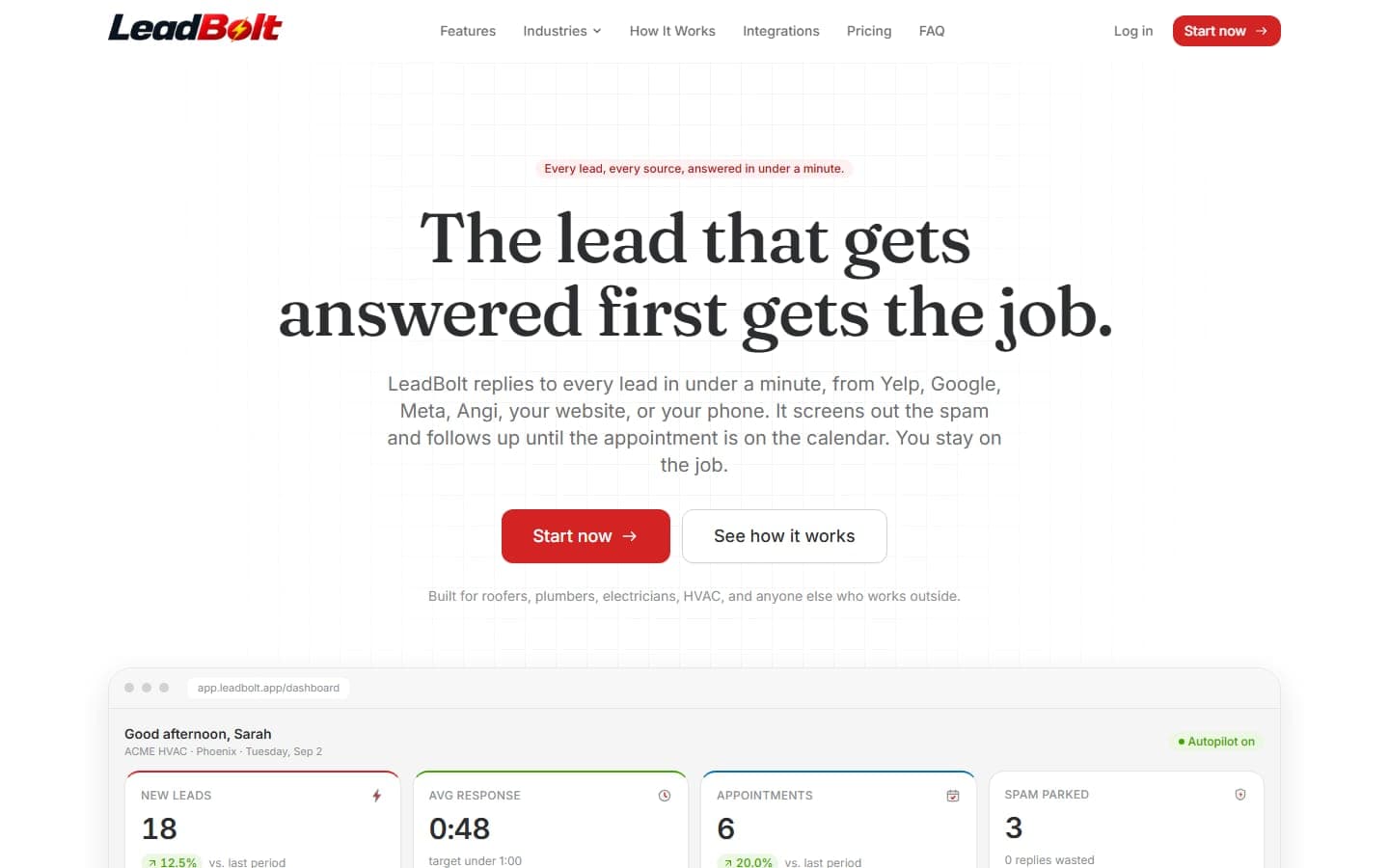 LeadBolt: Speed-to-Lead Software for ContractorsSan Antonio, TX · NationwideA software product, not a brochure: LeadBolt answers every Yelp, Google, Meta, Angi, website and phone lead in under a minute, screens out the spam, and follows up until the appointment is on the calendar, so a roofer or plumber on a job still wins the lead that came in while they were on the roof. The marketing site carries the same discipline — one promise on the first screen, the live dashboard shown rather than described, pricing published, and a start button on every page.
Keep reading
- AI search for haulersGEO for Junk Removal: Be the Hauler AI Names When Someone Wants It All Gone TodayHow junk haulers get named by ChatGPT, Gemini and Siri: what AI reads, Texas tire and appliance rules worth publishing, and a month of fixes.
- Websites for haulersJunk Removal Website Design: Turn Three Phone Photos Into a Booked PickupJunk removal website design built for photo quotes, load pricing, same-day booking and service-area pages. Fixed-price custom builds from $1,500.
- Marketing for contractorsHome Services Marketing: Plans Built to Fill the ScheduleHome services marketing for HVAC, plumbing, roofing and every trade: local SEO, maps, reviews, ads and AI search. Plans from $575 a month, no long contract.
- Marketing for washing companiesPressure Washing Marketing: Climb Out of the $99 Driveway Price WarPressure washing marketing for house, roof, concrete and commercial work: maps, search ads, before and after content, HOA and fleet accounts. From $575.
- AI search for gutter crewsGEO for Gutter Companies: Show Up When AI Is Asked Who Installs, Cleans or Guards GuttersHow gutter installers, cleaners and guard dealers get named by ChatGPT and Gemini: the sources AI trusts, Texas claim rules, and a four-week plan.
- Websites for landscapersWebsite Design for Landscaping Companies: Show the Work, Book the EstimateLandscaping website design with fast project galleries, town pages, license numbers and estimate booking. Custom sites from $1,500, with financing.
- Everything in Marketing by IndustrySee the section
Get a junk removal marketing plan built on speed
Tell us your towns, your trucks and where jobs come from today. We check your listings, reviews, ads and reply speed, then quote a fixed monthly price you can cancel without a long contract.
Which of these sounds like you? (pick any)
Rather talk now? Call (210) 346-0848.