
Marketing for appliance repair
Appliance Repair Marketing: Turn Diagnostic Visits Into Approved Repairs
An appliance repair shop does not sell 'appliance repair'. It sells a fix for a specific Bosch dishwasher that will not drain, to someone who searched those exact words twenty minutes ago. Then it has to turn a paid diagnostic into an approved repair. Marketing that ignores either half leaves money on the counter.
November 6, 2026 · 9 min read
Two in five quotes stall: send the quote in writing the same day and follow up in 48 hours
The short answer
Appliance repair marketing works when it catches brand and symptom searches on Google Maps, search pages and AI answers, then converts diagnostic visits into approved repairs with clear fees and fast follow-up. DataCram runs local SEO, Business Profile work, reviews, focused ads and customer email for appliance repair companies from $575 a month, with ad spend billed by Google to you.
On this page
- Searches that start with a model number
- Where the diagnostic fee turns into a repair, or does not
- A quarter of appliance repair marketing, step by step
- Your own tickets are the seasonal forecast
- Brand names, warranty promises and the review ask
- Count approved repairs, not booked diagnostics
- Costs, money leaks and the shop that can go it alone
Searches that start with a model number
Appliance customers search like mechanics. They type the brand, the appliance and the symptom, sometimes the error code from the display. Some will try a video fix first; the rest want someone who knows that brand and can come soon. Each channel below catches a different slice of that moment, and each has its own way of wasting money.
| What it does well | Where it goes wrong | |
|---|---|---|
| Google Maps and Business Profile | Catches 'appliance repair near me' with reviews, hours and a call button | Generic categories and no brands listed, so the profile never matches 'Samsung refrigerator repair' |
| Brand and symptom pages | Win the long searches: brand, appliance, failure, error code | One 'we fix all brands' page trying to rank for everything |
| Local Services Ads | Google takes appliance repair businesses in this program and bills by the lead; screened businesses get the Google Verified badge | Paying for leads on appliances or brands you do not service |
| Search ads | Put a brand page in front of a ready buyer at the moment of failure | Broad terms that buy clicks from people looking for parts or DIY videos |
| Manufacturer locators | Send owners of brands that list you as an authorized or certified servicer | Name and address on the locator that do not match your other listings |
| Landlords and property managers | Steady volume across many units | No invoicing or photo reporting process, so they drift to a bigger shop |
| AI answers | Name a few shops for brand and 'fix or replace' questions, drawing on your site, listings and reviews | Chasing a trick for the robots while the profile and pages that feed them stay thin |
AI is in the table because the assistants read the same pages and listings that win searches. Our page on GEO for appliance repair lists the sources they draw on, and our free AI visibility check reveals which shops ChatGPT and the others name when your customers ask about their brand.
Where the diagnostic fee turns into a repair, or does not
The appliance trade has a conversion step most trades do not: the paid diagnostic. A customer who pays to learn the control board costs a few hundred dollars may approve it, or may decide to shop for a new range. Marketing that only counts booked diagnostics is counting the wrong thing. The goal is approved repairs, and a lot of that is won before the tech arrives.
Before the visit
- The diagnostic fee and whether it is credited, stated on the site and on the phone
- Brands and appliance types listed, so nobody books you for a make you avoid
- A short repair-or-replace guide that sets honest expectations
- A booking form that asks for the model number or a photo of the data plate
After the visit
- A written quote sent the same day, by text and email
- A follow-up two or three days later for quotes not yet approved
- A clear parts timeline and a reminder before the return visit
- A review request once the machine runs again
Follow-up on unapproved quotes is where a shop can quietly lose a great deal. DataCram redesigned HomeService WebApp, a contractor command center that puts every open estimate and overdue follow-up on one screen with an automated follow-up engine, which is the same discipline an appliance shop needs. Our email marketing service sets up the messages.
A quarter of appliance repair marketing, step by step
- 1
Week 1: sort last year's jobs
We pull a year of tickets by appliance type, brand, town, source and outcome: diagnosed only, repaired, or declined. It shows which brands pay and which channels send repairs rather than tire-kickers.
- 2
Weeks 1 and 2: tracking that follows the ticket
Call tracking, form tracking and a report that follows each lead to an approved repair, set up through conversion tracking setup.
- 3
Weeks 2 to 4: rebuild the Business Profile
Correct primary category, every appliance type and major brand listed as a service, true weekend hours, photos of real repairs, and the same details on Apple Business, Bing Places, Yelp and any brand locator.
- 4
Weeks 3 to 8: brand and symptom pages
A page for each brand you know well, then pages for the failures customers search most in your job history. The map pack audit shows which towns need local pages.
- 5
Weeks 5 to 9: ads with a short leash
Local Services Ads or search ads limited to your brands, appliance types and towns through PPC advertising, with search terms pruned every week.
- 6
Weeks 8 to 13: quote follow-up and reviews
Automated follow-up on open quotes, review requests after completed repairs, and the first report showing approved repairs and cost per approved repair by channel.
Your own tickets are the seasonal forecast
Appliance demand moves with heat, holidays and household routines, but every market and every shop's mix is different, and we would rather show you your own pattern than recite someone else's. A year of tickets sorted by month and appliance type is the forecast. It tells us when refrigerator calls climb in your area, when ovens need attention, and when the calendar goes quiet.
- Ahead of the busy weeks your tickets show: refresh the pages for the appliances that spike, post matching photos on the Business Profile, and line up parts you know you will need.
- While they last: put extra ad money only behind the appliance types and towns that convert to approved repairs, and send review requests the day each repair finishes.
- After them: email customers whose quotes went unapproved, with a reminder of the credit policy if you have one.
- When it is quiet: write the next brand pages, call on property managers, and fix whatever the busy weeks exposed.
Brand names, warranty promises and the review ask
Appliance ads lean on brand names, and that is where they get into trouble. Saying you repair a brand is fine; implying you are factory authorized when you are not misleads customers. Promises about warranties need the same care. Federal warranty law, as the FTC explains it, stops a manufacturer from voiding coverage just because an outside shop or an aftermarket part was involved (unless the manufacturer supplies that service at no charge), while still letting it reject claims for harm the outside repair did. 'We will never affect your warranty' goes further than the law does.
Credentials belong in the copy only when they are real. EPA Section 608 certification is required for technicians working on equipment that could release refrigerant, and Texas licenses residential appliance installation through TDLR when an appliance is connected to an existing circuit other than by a plug. For reviews, the FTC's 2024 rule bans fake and AI-generated testimonials and sentiment-based rewards, and Google bans any incentive and any review gating.
Count approved repairs, not booked diagnostics
- Approval rate: the share of diagnostic visits that become approved repairs, by source and by brand.
- Completed on the first visit versus parts orders, and how many second visits actually happen.
- Average repair ticket by appliance type, so ad money goes where the jobs are worth it.
- Every lead traced to its origin: recorded calls, tagged forms, and, since GA4 gained a Business Profile link on June 8, 2026, the profile's own calls and bookings in one place.
- AI referrals, through GA4's AI Assistant channel (added May 2026), which excludes Google's AI Overviews and AI Mode; those stay in Organic Search.
- Cost per approved repair by channel, the number that decides budgets.
If plenty of people reach the site and few book, conversion rate optimization usually pays before more traffic does, and the appliance repair website page shows a site built around brand pages and model-number booking.
Costs, money leaks and the shop that can go it alone
Our local marketing plans have a written scope, no long contract, and start at $575 a month, depending on complexity, setup and budget. Covering more towns or adding ads raises the tier, and ad spend is paid from your own account to Google. Shops that want to rank brand and symptom pages across a metro usually add an SEO program, also from $575 a month (SEO pricing). If you run ServiceTitan, Housecall Pro or Jobber, we can tie web requests and reporting to it.
- Buying clicks on every appliance and brand, including the ones your techs dislike working on.
- Advertising 'factory authorized' without the authorization.
- Letting diagnosed-but-unapproved quotes die without a single follow-up.
- Hiding the diagnostic fee, then collecting bad reviews from customers who expected a free estimate.
- Measuring the agency by booked diagnostics instead of approved repairs.
A one-tech shop with steady referrals can do most of this alone: complete the profile, write a page per brand, publish the fee, follow up on quotes and ask for reviews. Hire help when the follow-up slips because the van is always out. More reading: the home services marketing overview, marketing by industry, the appliance repair industry page, and sister trades HVAC marketing and electrician marketing. For the site itself, see website design by industry or ask for a free mockup.
Questions owners ask about marketing
List every brand and appliance type you service on your Business Profile and website, publish your diagnostic fee, build pages for the failures customers search, ask every customer for a review, and follow up on quotes that were not approved. Ads help once those basics are in place and tracking can tie them to approved repairs.
Yes, for brands you service well, because customers search by brand. Describe what you do accurately and never imply factory authorization you do not hold. Where a manufacturer does list you, match your business name exactly on its locator so the listing reinforces your other profiles.
They can be. Google accepts appliance repair companies, charges by the lead instead of the click, and badges screened businesses as Google Verified. Limit them to your appliance types and towns, mark leads that do not book, and compare the cost per approved repair with your other channels.
Set expectations before the visit with a published fee and credit policy, send a written quote the same day, follow up two or three days later, and keep the customer informed about parts. The lift tends to come from follow-up that happens every time, more than from a better script.
Local marketing and SEO programs each start at $575 a month, depending on complexity, setup and budget, with no long contract. Ad spend is separate and billed by Google to your own account. The tier is set after a free audit of your listings, site and ads.
It is growing, and it rewards the same work: clear brand pages, a published fee, consistent listings and specific reviews. GEO is part of our SEO programs rather than an extra product. Run the free AI visibility check to see whether assistants name your shop today.
Field-service software
Run on ServiceTitan?
Your website should hand every lead, booking and ad click straight to the software that runs your trucks, not to an inbox somebody retypes from. We connect the site to the system you already use.
ServiceTitan
Larger shops with dispatchers and memberships
Housecall Pro
Owner-operators and small crews
Let visitors book without a phone call
Kairos, our AI chat and booking widget, answers from your own pages and books the appointment in the chat, day or night, on WordPress, Wix, GoDaddy or any site. Booking straight into ServiceTitan, Housecall Pro, Jobber, FieldEdge and more is rolling out.
Related home service work
Built for neighboring trades with the same jobs to do as a appliance repair business: answer fast, quote plainly and fill the schedule.
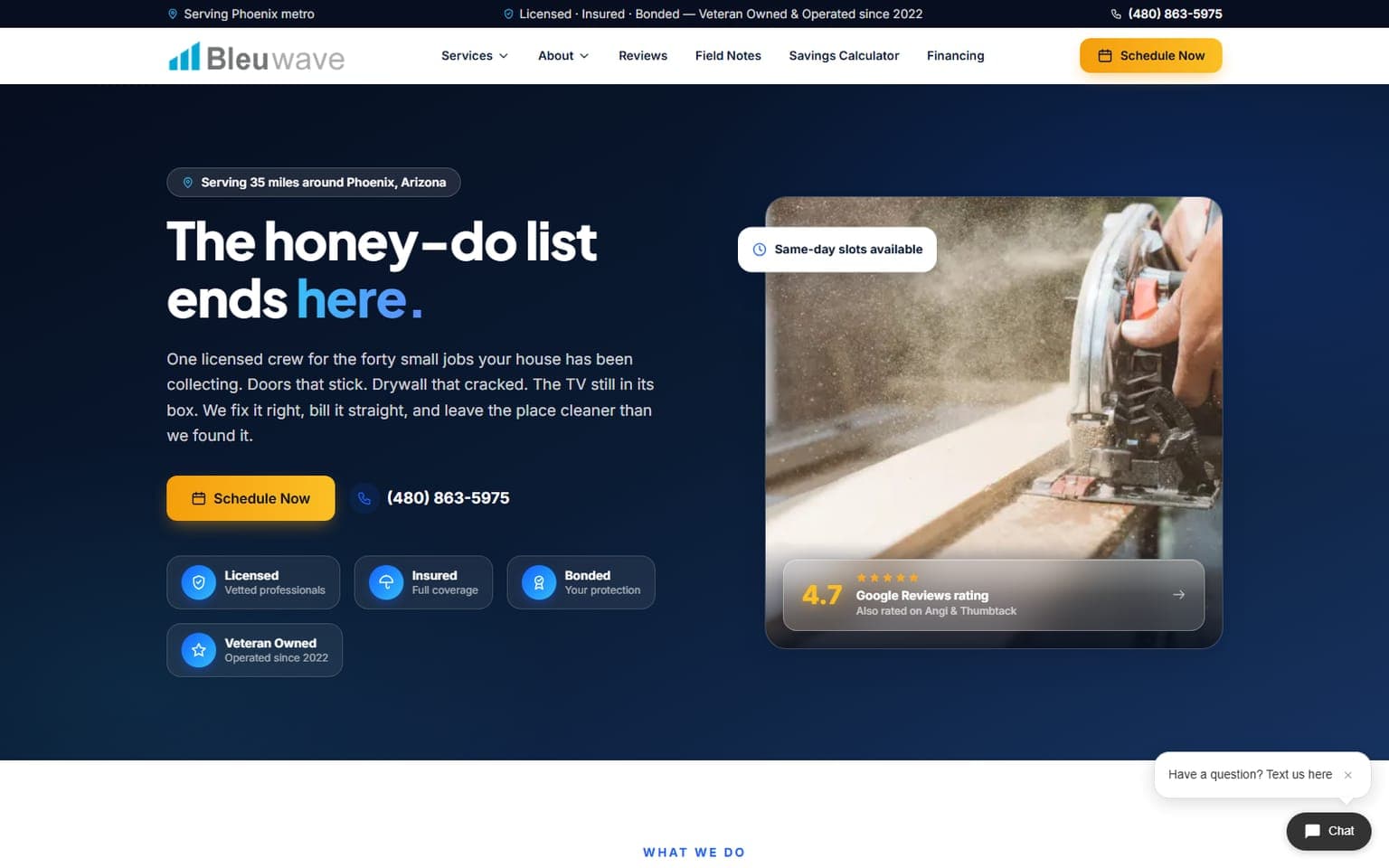 Bleuwave Handyman: Redesign & Savings CalculatorPhoenix, AZ · MetroA full redesign for a Phoenix handyman crew, rebuilt on React, Next.js, and TypeScript with a PostgreSQL back end and organized around the forty small jobs a house collects. The centerpiece is a savings calculator that stacks a bundled visit against hiring four separate trades and shows the homeowner the difference in dollars — the argument for booking everything at once, made arithmetically instead of rhetorically. A geofenced service radius, same-day slot availability, financing paths, and a Field Notes content engine run off the same typed schema.
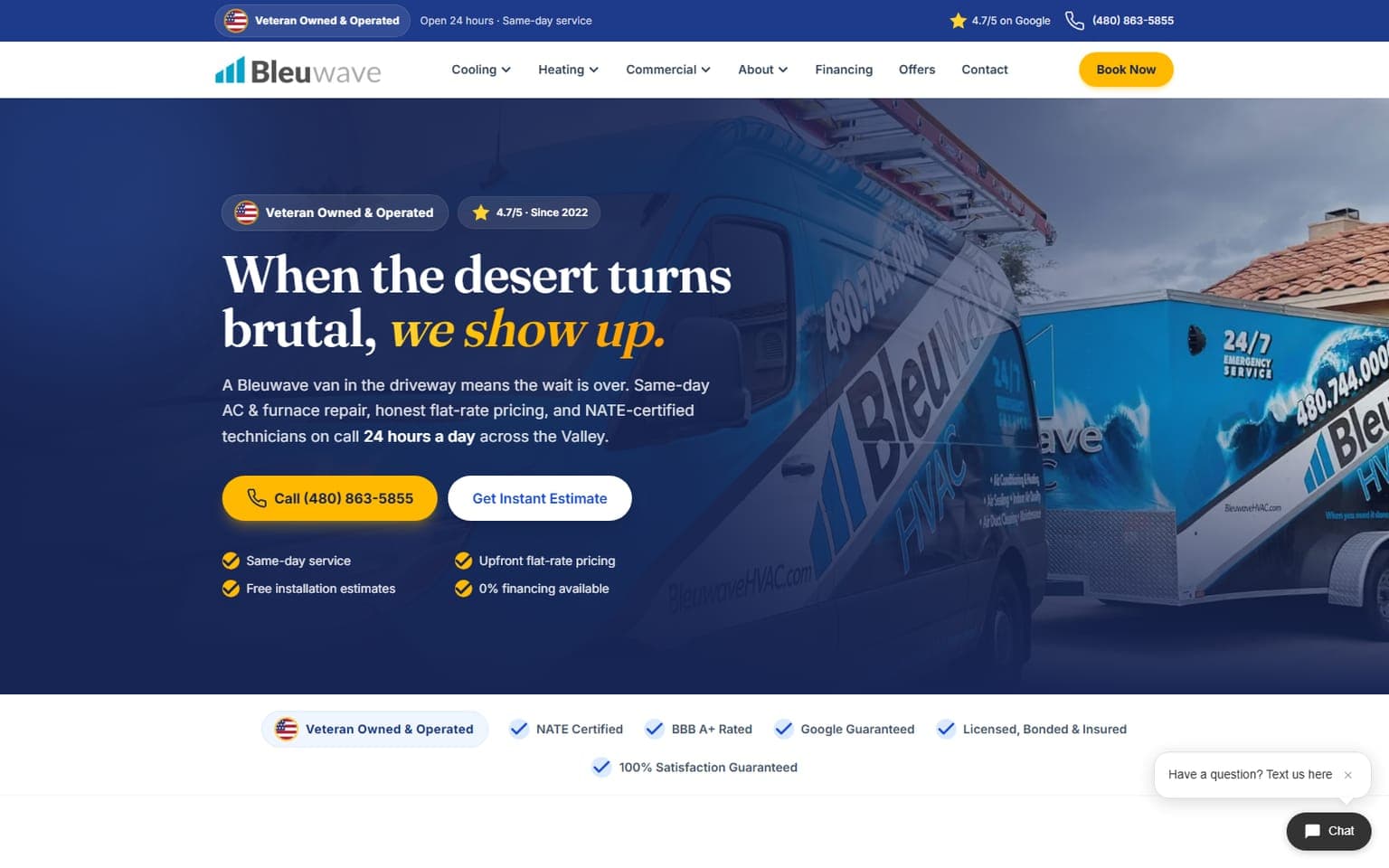 Bleuwave HVAC: Redesign & Instant EstimatePhoenix, AZA ground-up redesign that turns a 2 a.m. air-conditioning failure into a booked job before a competitor's phone even rings. The centerpiece is the Instant Estimate — a real-time pricing engine that hands a homeowner an honest flat-rate number in seconds instead of a promise to call back. Rebuilt on Next.js and React with a Neon Postgres backend, it marries a fast, conversion-first design to the kind of dynamic tooling most HVAC sites only advertise.
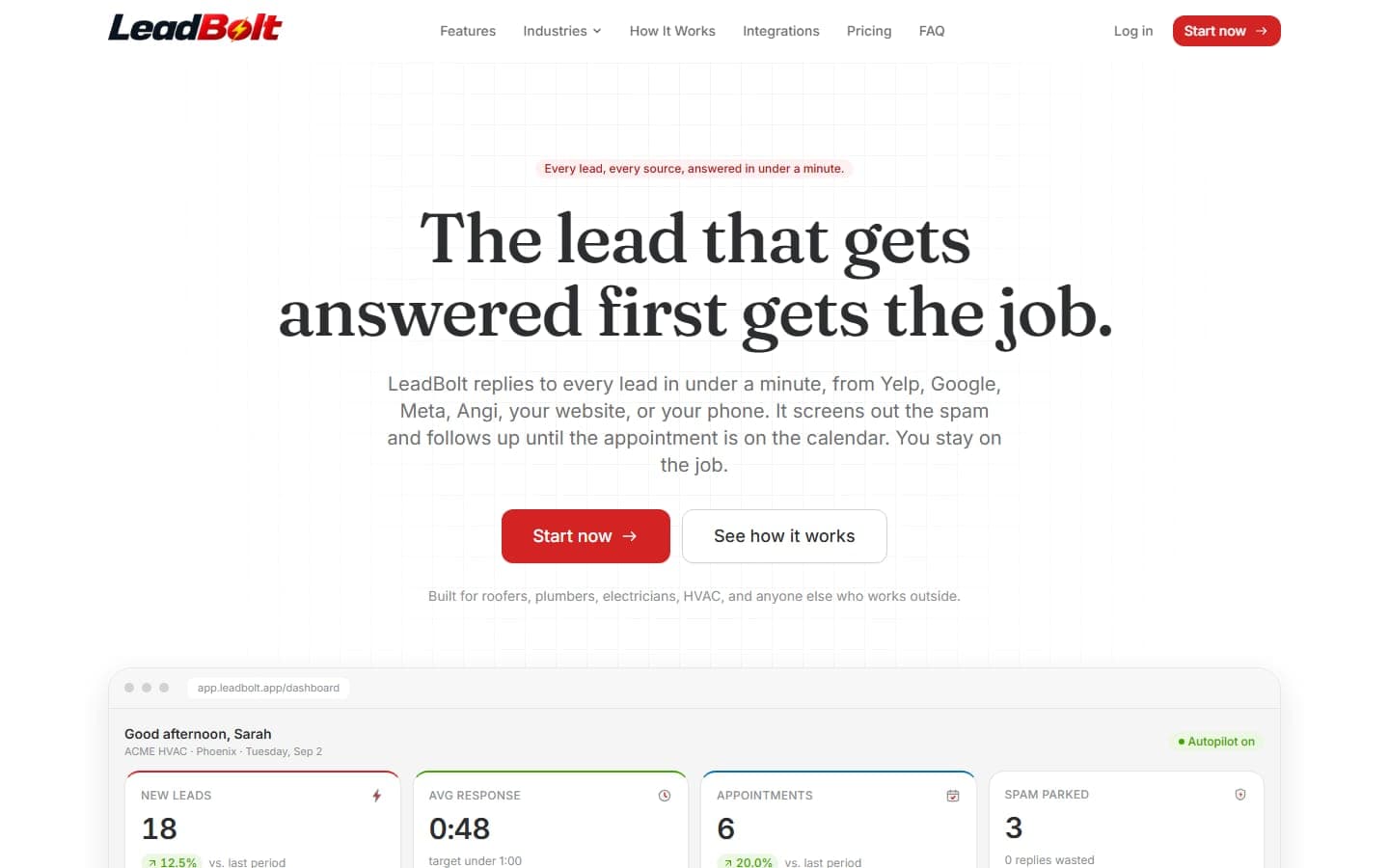 LeadBolt: Speed-to-Lead Software for ContractorsSan Antonio, TX · NationwideA software product, not a brochure: LeadBolt answers every Yelp, Google, Meta, Angi, website and phone lead in under a minute, screens out the spam, and follows up until the appointment is on the calendar, so a roofer or plumber on a job still wins the lead that came in while they were on the roof. The marketing site carries the same discipline — one promise on the first screen, the live dashboard shown rather than described, pricing published, and a start button on every page.
Keep reading
- AI search for appliance techsGEO for Appliance Repair: Get Named When the Fridge Quits and Someone Asks AIHow appliance repair companies get recommended by ChatGPT, Gemini and Siri: brand locators, EPA and Texas license facts, warranty answers and a GEO plan.
- Websites for appliance repairAppliance Repair Website Design: Brand Pages, Model-Number Booking and Honest FeesAppliance repair website design with brand and symptom pages, booking that captures the model number, and a clear diagnostic fee. Fixed price from $1,500.
- Marketing for contractorsHome Services Marketing: Plans Built to Fill the ScheduleHome services marketing for HVAC, plumbing, roofing and every trade: local SEO, maps, reviews, ads and AI search. Plans from $575 a month, no long contract.
- Marketing for roofersRoofing Marketing for Storm Weeks and the Slow Months BetweenRoofing marketing planned around hail season and replacement work: the map, reviews, Local Services Ads, SEO and AI answers. From $575 a month, no contract.
- AI search for washersGEO for Pressure Washing Companies: Stand Out When AI Is Asked Who Can Clean the HouseHow pressure washing and soft wash companies get named by ChatGPT, Gemini and Siri: what AI reads, San Antonio water rules, and a 30-day plan.
- Websites for door companiesGarage Door Website Design That Turns a Stuck Door Into a Booked VisitGarage door website design with tap-to-call, repair booking, door galleries and quote forms with photos. Custom builds from $1,500, 0% financing.
- Everything in Marketing by IndustrySee the section
Get a plan that counts approved repairs
Tell us the brands you service, your towns and where calls come from now. We will audit your listings, pages and ads and send a fixed monthly quote, with nothing locked in.
Which of these sounds like you? (pick any)
Rather talk now? Call (210) 346-0848.