
Five stops on the way to a call
A Small Business Website That Generates Leads, Walked Page by Page to the Phone Call
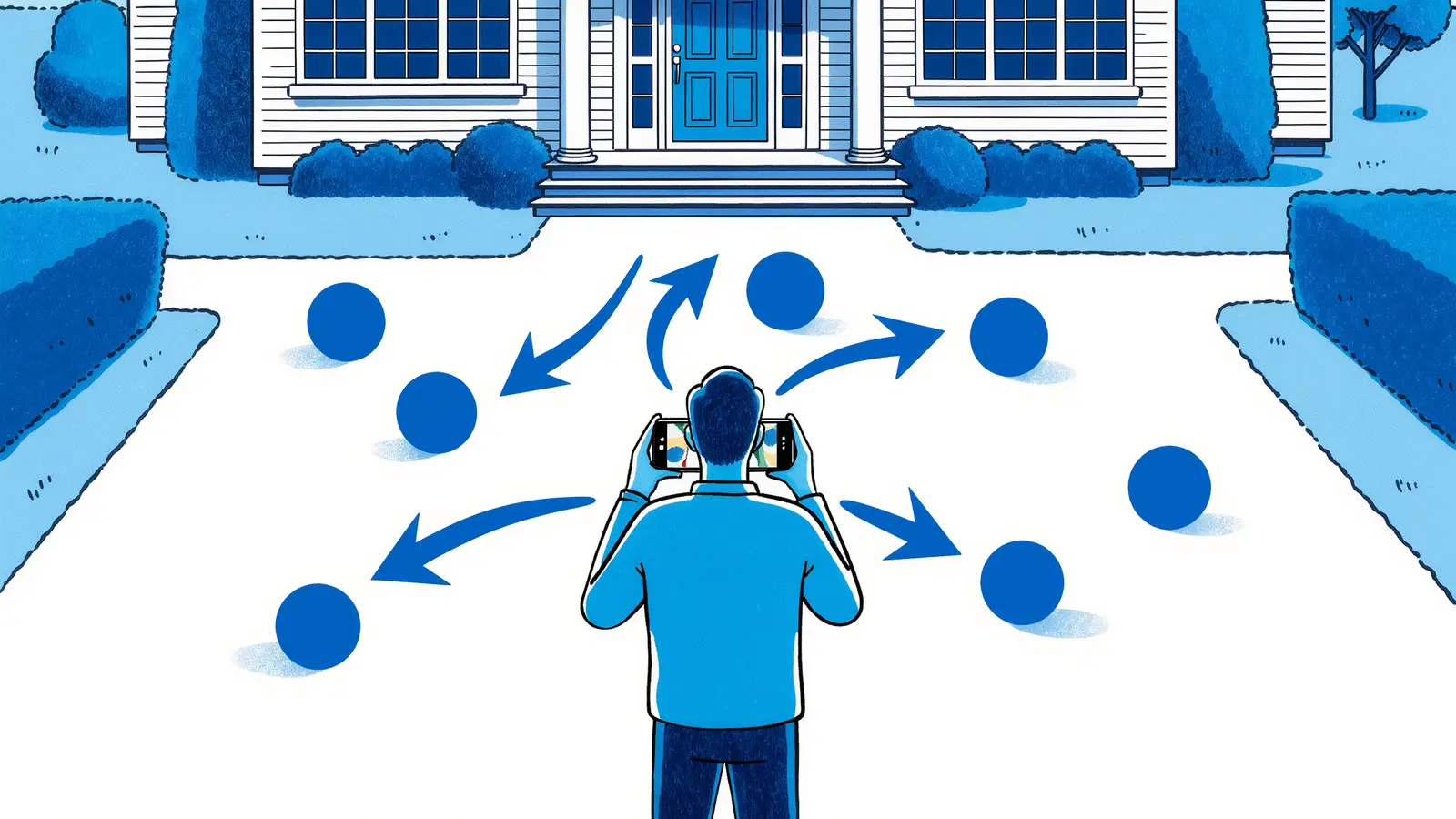
A website does not generate leads the way a well generates water. It is a short walk: a stranger arrives, checks three things and decides to bother you or not. On most small sites, that walk ends at a locked door, a stale form or a voicemail nobody returns.
November 13, 2026 · 9 min read
Calls that came in while the owner was on a job, with no callback
The short answer
A small business website generates leads by moving a stranger along a short path: a search result that names the job, a service page that answers it, proof you do the work, an easy way to call or book, and a fast reply. Fix the stops in order, and count calls and forms. Nobody can promise a number.
On this page
- The bad news first: a site cannot produce demand
- Stop one: the line in the search result
- Stop two: the service page, read on a phone in a driveway
- Stop three: proof that you exist and did this
- Stop four: the call, and the moment you cannot take it
- Stop five: counting, which nobody does
- Which stop to fix first when you only have one evening
The bad news first: a site cannot produce demand
Nobody searches for a septic inspector on a whim. If no one in your area wants what you sell this month, no page will fix that, and we will not guarantee you a lead count. What a site can do is stop losing the people who were already looking. That is more modest than a sales deck, and a good deal more dependable. Everything on this page is about those people: the ones who found you and almost called.
We wrote a longer treatment of the layout of a lead site and another on how many leads to expect. This page is narrower. It follows one visitor across one small site that belongs to one owner, who is usually under a sink when that visitor shows up. We will use a made-up business throughout: a one-person pressure washing outfit in Amarillo, invented for this example, with a truck, a phone and four services.
Stop one: the line in the search result
The walk starts before your site loads. Someone typed "driveway pressure washing Amarillo," and saw a title and a sentence. A page titled "Home" loses here, without anyone ever knowing. So does "Quality Exterior Solutions." Our Amarillo owner wants "Driveway Pressure Washing in Amarillo: Priced by the Square Foot," because it says the thing they searched and adds one reason to choose it.
This requires one page per service, each saying something different, or there is nothing specific to put in that line. It does not require 200 pages. Google's guidance, last updated October 5, 2026, says its systems aim to reward content made to benefit people rather than to manipulate rankings. A driveway page that states the price per square foot, the drying time and the oil stain caveat passes that test without trying. Getting into the results at all is a separate job: the SEO page for small shops and the Google Maps guide start there.
Stop two: the service page, read on a phone in a driveway
The visitor lands on the service page, not the home page. Owners spend weeks on home pages and an hour on the page that gets the call. Reverse that. Here is what the page owes the visitor, top to bottom, with the part most small sites get wrong.
| Its job | The usual mistake | |
|---|---|---|
| First screen | Name the job and the area, show the number | A big photo of a sunset and the word "Excellence" |
| What it costs | A range or a pricing rule | "Contact us for a free quote" and nothing else |
| What happens next | The steps, in plain order | A paragraph about your passion |
| The worry | The fear they have and your answer to it | Ignoring the one question they came with |
| Proof | A photo of this job, a review mentioning it | Five stars, no name, no date |
| Next move | A button, repeated at the bottom | A link to the home page |
Speed belongs here too. Google's web.dev, read November 6, 2026, treats Largest Contentful Paint of 2.5 seconds or less and Interaction to Next Paint of 200 milliseconds or less as good. You do not need a consultant to feel the difference: load your page on your phone in a parking lot, on cellular, and count. If it fails, see the slow site fixes or the core web vitals guide.
Stop three: proof that you exist and did this
By now the visitor believes you do pressure washing. The remaining question is whether you are a real person who will show up. Proof answers that, and it is the cheapest stop on the walk, because you already own it. Take photos on the job. Put your name and face somewhere. Mention the job in a sentence: "Stripped 20 years of oil off a two-car driveway on Georgia Street" beats any adjective. If you make that up, you have a different problem.
Reviews do the rest, and a thin handful of honest ones will do. The rules on collecting them are stricter than most owners assume, so see the guide to your first 25 reviews before you ask anybody, and do not offer a discount for one on Google. We are not lawyers, so legal questions belong with your own attorney. On the page itself, use reviews that mention the service the page is about. A review saying "great guy" is pleasant. A review saying "got the rust marks off our patio" sells the patio page.
An adjective is a claim. A photo of the driveway is evidence.
Stop four: the call, and the moment you cannot take it
This is where the one-person shop differs from every guide written for a firm with a front desk. You will miss calls. You are on a ladder. So the site has to give a stranger three ways to raise a hand, and each has to tell them what happens next. Otherwise they will try the next result.
- 1
The phone number, tappable, with a promise you can keep
"I answer between jobs. If I miss you, I call back by 6 the same day." That sentence does more than a stock photo of a headset. If you cannot keep that promise, write one you can.
- 2
A short form with three fields
Name, phone and what needs doing. Every extra box loses somebody. Send it to your phone so you read it the same way you read a text. Our form troubleshooting page shows how to test delivery.
- 3
Booking for what can be booked
A flat-rate driveway wash can be booked. An unseen roof repair may not be. Booking is included in every DataCram package, so the only question is whether your work fits. Keep your calendar accurate, or you will be phoning people to cancel.
- 4
A thank-you page that says something
"Got it. I will call you by 6 today. If it is urgent, here is the number again." It reassures the customer, and it also gives you a page you can count as a completed lead.
- 5
An alert that actually reaches you
A lead that sits in a mailbox for two days has gone to someone else. Use a text or an email rule that interrupts you. If messaging becomes automatic, read the follow-up automation page first, because texting has rules.
Stop five: counting, which nobody does
Most small sites cannot say how many leads they produced last month. The agency report with a chart of nothing will tell you about sessions and impressions instead. Those are not customers. Keep it crude, and it will work: a tally on paper by the phone, or one row a job in a spreadsheet. You need only four columns.
- Date and source. Ask every caller how they found you. People misremember, but not by so much that the pattern disappears.
- What they wanted. It tells you which service pages are earning and which to rewrite.
- Whether you answered. The most uncomfortable column. Missed calls that never call back are the leak nobody invoices you for.
- Whether it became a job, and for how much. Traffic is not money. This column is. It also feeds the cost per lead sum, if you ever buy ads.
If you outgrow paper, proper conversion tracking for small shops counts forms and calls by source, and we can set it up. Give changes time before judging them. Google's starter guide, last updated December 10, 2025, says some changes take effect in a few hours and others could take several months, and that you likely want to wait a few weeks before judging results. So changing your home page every Thursday tells you nothing.
Which stop to fix first when you only have one evening
People visit, nobody calls
Fix stops two and three: price, proof, phone. Our diagnostic for a site that is not generating leads sorts causes in order.
Nobody visits
A better page will not help yet. Go to the local marketing page for one-truck shops, or look at a landing page for ads.
Calls come, and you miss them
Fix stop four. This costs almost nothing and pays on the same day. Set the callback promise, fix the alert and consider booking.
The whole site is wrong
Then build it again. Our web design service for small shops starts at $1,500 for up to 10 pages, or $375 down and $93.75 a month through financing. The free mockup lets you look first.
Spend the evening on the page your customers actually land on. If you do not know which that is, the free site audit can tell you, and it will also tell you if your problem is not your website. For how this fits with the rest of a small operation's technology, including when to spend nothing, start with the section overview. You can reach DataCram at (210) 346-0848, or send the form below and a person will reply.
Questions owner-operators ask
We cannot tell you, and anyone who gives you a number without knowing your trade, town and competition is guessing. Start by counting what you get today, using a paper tally for a month. Then fix one stop and count again. Your own before and after will tell you more than any benchmark from a stranger's industry.
Usually one of three reasons: they could not tell whether you serve their area or their job, they saw no price and assumed the worst, or the phone number took work to find on a phone. Read your own service page on your phone as a stranger would. Those problems tend to be visible within a minute.
Offer both, since they catch different people. Someone with a flooded kitchen will call. Someone comparing prices at midnight will fill in a form. For a one-person shop, the form is often the better catch, because it survives your being on a job. Whichever comes in, the speed of your reply matters more than the channel.
For organic search, a good service page is your landing page. A separate page makes sense when you run ads, because it can stay focused on one job, one area and one number with no menu to wander off through. Our landing page guide for phone calls shows that version, if you ever start buying clicks.
It might, and no one can honestly promise it. A rebuild helps when the old site was slow, unclear or impossible to edit. It does nothing if your service area has no demand or if you cannot answer the calls. Check the five stops on your current site first, because the fix may cost nothing.
Keep reading
- A diagnosis, not a makeoverWhy Your Small Business Website Isn't Generating Leads: Seven Checks, in OrderA diagnostic for a small business website that brings no calls: seven checks in order, most free, so you fix the actual leak and not the paint.
- One thumb, one buttonA Landing Page That Generates Phone Calls When One Person Answers ThemBuild a call-first landing page for a small business: one job, one area, one tracked number, and what the page does when you cannot answer.
- One owner, one phoneWeb Design for One-Person Businesses: What You Need and What to RefuseWebsite design for one-person businesses: the short page list, what to refuse to pay for, and fixed prices from $1,500, or when a builder plan is better.
- The build sideSmall Business Website Development: Who Holds the Keys When the Builder LeavesWebsite development for independent contractors: who owns the code, domain and accounts, what custom means at $1,500, and what you must maintain yourself.
- Probably not. Sometimes yes.iOS App Development for Small Businesses: When an iPhone App Earns Its KeepWhen an iPhone app makes sense for a very small company, what from $3,750 buys, Apple's fees and rules as of 2026, and what to try before you build.
- Two stores, one budgetMobile App Development for Small Business: iPhone, Android or a Web App FirstiPhone and Android apps for a small business: web app from $575, native from $3,750, Google Play and Apple fees as of 2026, and what to build first.
- Everything in MicrobusinessSee the section
From the Insights desk
- There Is No #1 in an AI AnswerSomebody will offer to rank you first in ChatGPT. But a generated answer is written, not ordered — ask the same question five times and get five answers. Here is what can honestly be measured instead of a position.
- Twelve Questions to Ask Before You Sign With Any Web CompanyBuying a website means judging work you cannot inspect, in a vocabulary chosen to keep you from inspecting it. Twelve questions that sort the field faster than any proposal — ask them of us, too.
Find out which stop is losing your calls
Send your site and tell us what a typical job looks like. A person at DataCram walks the path on a phone and replies with the first thing we would fix.
Which of these sounds like you? (pick any)
Rather talk now? Call (210) 346-0848.