Twelve Questions to Ask Before You Sign With Any Web Company

Buying a website is a strange transaction. You are purchasing something you cannot inspect, from someone whose work you cannot evaluate, in a vocabulary chosen partly to keep you from evaluating it.
So you fall back on the two things you can judge: the price and whether you liked the person. Which is roughly how you would pick a surgeon from a billboard.
Here are twelve questions that cut through it. Ask them of us. Ask them of the agency your brother-in-law recommended. The answers will sort the field faster than any proposal.
1. Who owns the code when this is over?
The correct answer is you, without an argument and without a fee.
Be specific: the code, the content, the database, and the hosting account. If any of the four stays with the vendor, you have not bought a website. You have leased one, and the renewal terms are whatever they decide later.
2. If I leave, what do I actually walk out with?
This is question one with the politeness removed, and it separates platforms fast.
Some will hand you a folder of static files and call it an export. That is code without a working content system, which means the site freezes the day you leave. Ask directly whether the thing you receive still runs.
3. Who writes the words?
The quiet cost of every cheap website in America.
Templates and builders are inexpensive because the labor moved to you. Somebody has to write the service pages, the about page, the FAQs, and the fifty small decisions that make a site sound like a business rather than a placeholder. If the answer is "you can just fill in the content," add your own hourly rate to the quote and see how it looks.
4. Who does the search work, and what does that include?
"SEO included" means nothing. Ask what is included.
Technical foundations, page-level targeting, local listings, structured data, and ongoing content are five different jobs. A vendor who cannot separate them is selling you a checkbox. Our search work and pricing are both published, which is the format you should expect from anyone.
5. What happens when it breaks at 9 p.m. on a Saturday?
Not whether it breaks. When.
Ask what the path is: who answers, how fast, and what it costs. Then ask what the most common failures are on the platform they are recommending. If they cannot name any, they have not run one long enough. We publish ours — forty-five of the most common website failures, each with a plain-English explanation, in the Repair Hub.
6. Can I edit it myself without calling you?
The answer should be yes, and the demonstration should take about ninety seconds.
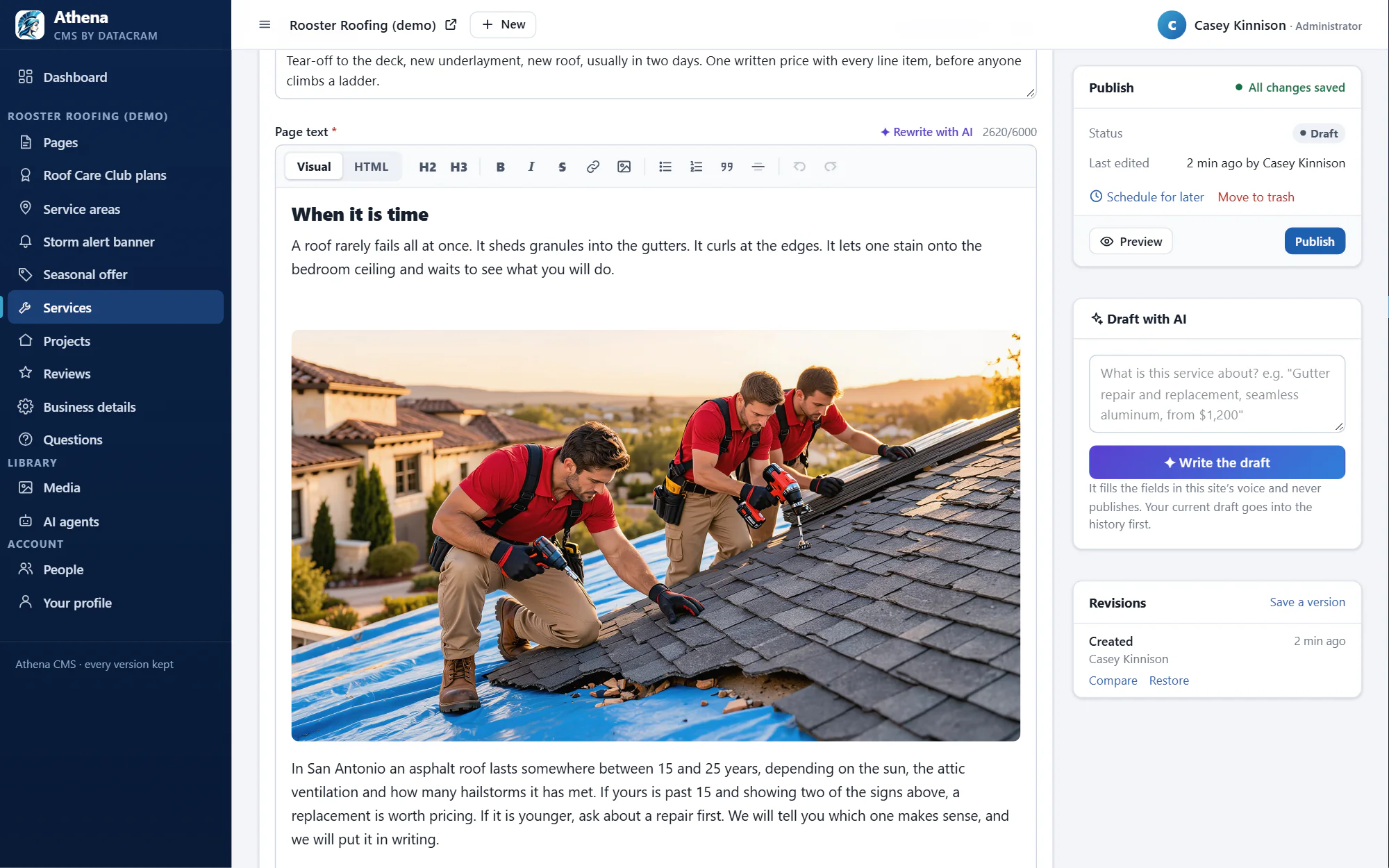
Ask to see the content system. Not a slide about it — the actual screen where you would change a headline, add a service, or schedule a post. If editing your own site requires a support ticket, you have bought a subscription to your vendor.
7. What is the five-year cost, not the launch cost?
The launch invoice is the least useful number in the transaction.
Add platform fees, app and plugin subscriptions, plan-tier upgrades as you grow, per-seat editor pricing, and the hours your team spends doing work the vendor did not include. We put the whole comparison in one place — custom builds against page builders over five years — because the crossover point surprises people.
8. Is your pricing published?
If the price appears only after a discovery call, the discovery includes discovering what you can afford.
There are legitimate reasons for custom quotes on complex work. There is no legitimate reason to hide the starting point. Ours starts at $1,750, in writing, before you talk to anyone.
9. Will it integrate with the software we already run?
Most businesses already have a system of record — a CRM, field software, a scheduler, a payment processor. The website should talk to it directly.
Ask specifically whether the integration is a direct connection or a chain of third-party connectors. The chain works until one link changes its pricing or its API, and then it is your problem at the worst possible moment.
10. What are your performance targets, in numbers?
"Fast" is not a target. Core Web Vitals are.
A vendor who takes speed seriously will name the metrics and tell you what they are aiming for. One who does not will show you a design mockup. Speed is not vanity — it is ranking and it is conversion, and it is largely determined by what the site is built on rather than what you put on it.
11. What is not included?
The most useful question in the list, and the one almost nobody asks.
Content. Photography. Ongoing search work. Hosting. Maintenance. Training. Integrations. Get the exclusions in writing, because the gap between the quote and the working website is where the second invoice lives.
12. Who am I actually going to talk to?
Ask who does the work, who answers the phone, and whether those are the same people.
A national brand with a television budget is paying for that budget somehow. We wrote about that trade-off at length — the agency on television versus the one that picks up — and it remains the most reliable predictor of how the relationship will feel in month four.
How DataCram answers all twelve
You own everything. You walk out with a running site, not a frozen export. We write the copy. The search work is itemized and published. Failures have a documented path and a phone number. The content system takes ninety seconds to demonstrate. The five-year math is on the site. Pricing starts at $1,750 in writing. Integrations connect directly to the software you run. Performance targets are numbers, not adjectives. Exclusions are in the proposal. And you talk to the people doing the work.
We build custom sites on a modern full-stack foundation for clients across more than forty industries, from San Antonio to the rest of the country. See the work.
FAQ
Is it rude to ask a vendor all twelve of these?
It is a business purchase that will outlast most of your equipment. Any vendor irritated by these questions has told you something useful about what working with them will be like.
What if I already signed with someone?
Ask them anyway. Ownership and exit terms are worth knowing before the relationship is tested, not during. If the answers concern you, we do rescue work.
Do these questions favor custom builds on purpose?
They favor whoever answers them cleanly. Some of them a page builder genuinely cannot answer well — exit, integrations, five-year cost. For a five-page brochure that never changes, a builder can still be the right call, and we will say so.
How much should a small business website cost?
Ours start at $1,750 and scale with what the site has to do — booking, quoting, inventory, or integrations. The pricing page breaks the tiers down.
Next steps
Print the twelve. Take them to every conversation, including ours.
Tell DataCram what you need, or start with the free audit, and we will answer all twelve before you spend a dollar — in writing, in plain English, and without a discovery call designed to size you up.

 What you edit with on Next.js