
Marketing for locksmiths
Locksmith Marketing: Ads That Pass Verification and a Phone That Answers at 2 a.m.
Google makes every US locksmith that wants to advertise prove, on a video call, that the shop exists where it says it does. Very few trades get that treatment, and it says something about the competition. A licensed locksmith's marketing has one advantage nobody can fake: being exactly who the listing says, at the address it shows, at the price it quoted.
November 6, 2026 · 9 min read
- 02:07 call from Maps listing: locked out, Elm St
- 02:07 answered in 8 seconds by the on-call tech
- 02:08 quoted $145 after-hours lockout, by text
- 02:31 arrived, license shown at the door
- 02:40 paid $145, same as quoted, review asked
The short answer
Locksmith marketing works when a licensed shop owns the emergency search: a Business Profile and site with the Texas license number, real address, prices and night hours; Google's advanced verification for ads; reviews that confirm the quoted price held; and calls answered in seconds. DataCram runs local marketing and SEO for locksmiths from $575 a month, ad spend billed by Google.
On this page
- Four businesses behind one key machine
- Channels, ranked by how a locked-out customer behaves
- Advanced verification, license numbers and the word 'locksmith'
- Quote the price you will charge at the door
- A first quarter of locksmith marketing
- Nights, move-ins and the commercial calendar
- Answered calls and arrival times beat clicks
- Budget, missteps and the one-van locksmith
Four businesses behind one key machine
A typical locksmith shop runs several businesses that look alike from outside and behave nothing alike in marketing. The emergency lockout is won in minutes on a phone. The rekey after a move-in is planned a week ahead. Car keys are a parts-and-programming job with its own search terms. Commercial work is won by relationships and bids. One generic campaign for all four wastes money on at least three.
Emergency lockouts
Homes, cars and businesses, often at night. Won on Maps, ads and the phone being answered. Price clarity decides the call.
Residential rekeys and hardware
New homeowners, landlords between tenants, smart lock upgrades. Won on search pages, reviews and referrals from agents and property managers.
Automotive keys
Key fobs, transponder keys, lost-all-keys jobs. Customers search by make, model and year; pages that name them win.
Commercial and access control
Master key systems, high-security cylinders, electronic access control. Won by relationships and bids. In Texas, electronic access control is its own DPS license category, so advertise it only if you hold it.
Channels, ranked by how a locked-out customer behaves
| Good for | How it goes wrong | |
|---|---|---|
| Google Maps and Business Profile | The 'locksmith near me' search with your reviews, hours and call button on one screen | A trade name that differs from the DPS license, or a service area that promises arrivals you cannot make |
| Google Ads and Local Services Ads | The top of the page during a lockout; Locksmith is an LSA category | Ads cannot run until advanced verification is complete, and Google says it typically takes around six to eight weeks |
| Search pages | Rekeys, smart locks, car keys by make, commercial master keys | One page for all services, so no specific search is answered |
| Reviews on Google, Yelp and Nextdoor | Proof that the price held and the tech showed up | Asking only the happy customers, which Google forbids |
| Agents, landlords and property managers | Rekeys between owners and tenants, repeat commercial work | No easy way for them to send a job and get an invoice |
| AI answers and voice assistants | Name a locksmith for 'open now' and price questions from listings, reviews and your pages | Treated as a gimmick rather than the payoff of clean listings and pages |
An assistant is an easy thing to ask with one hand on a car door, so these answers matter in emergency work. The same listings and reviews feed them, and our GEO for locksmiths page shows which sources matter. The free AI visibility check puts a customer's question to ChatGPT and other engines and shows who they named.
Advanced verification, license numbers and the word 'locksmith'
Locksmith advertising is regulated twice, once by the platforms and once by the state. Google restricts locksmith ads in the United States and requires advanced verification before they serve, including Local Services Ads; the process includes a video call to confirm the business exists at its location. In Texas, 37 TAC 35.9 requires a DPS licensee's advertisements, in any medium used to promote the business, to carry the company name and address as DPS has them and the company license number. And DPS says advertising with the word 'locksmith' is acting as a locksmith company, which requires the license.
- Every ad, landing page and Business Profile description carries the licensed company name and license number; ask your attorney whether truck lettering counts too.
- Commercial access control is advertised only under the DPS license that covers it.
- Review requests go to every customer with no reward attached; the FTC bans paid praise and fake reviews, and Google bans any incentive and review gating.
- Prices in ads match the price on the phone and at the door.
- Old 'Google Guaranteed' language is gone; Local Services Ads now show a Google Verified badge.
Quote the price you will charge at the door
The locksmith trade's reputation problem is the quote that changes on the porch. A licensed shop can turn that into its best marketing by doing the opposite in public: publishing the service fee, the after-hours rate and typical ranges, quoting the same numbers on the phone, and charging them. It costs some price shoppers. It wins the customer who has heard the stories, and it produces reviews that say so.
On the website and the phone
- Service or trip fee, and whether it is waived when work is done
- Night, weekend and holiday rates stated, not discovered
- Typical ranges for house lockouts, car openings, rekeys and fobs
- A plain note on the Texas ID and signed authorization requirement
At the door
- The quoted price confirmed before work begins
- ID and authorization checked politely, as the law requires
- A written invoice with the license number on it
- A review request sent by text once the job is closed
A first quarter of locksmith marketing
- 1
Week 1: start verification and map the calls
Begin Google's advanced verification on day one, then pull recent calls by service line, town, hour and outcome to see where the work and the waste are.
- 2
Weeks 1 and 2: tracking
Call tracking that does not scatter numbers across directories, form tracking and a booked-job report, through conversion tracking setup.
- 3
Weeks 2 to 4: reconcile every listing with the license
Business Profile, Apple Business, Bing Places, Yelp and ALOA if you are a member, all matching the licensed company name and address.
- 4
Weeks 3 to 6: pages for each service line
Emergency lockouts, rekeys, smart locks, car keys by make and commercial work, plus a price page and a license and ID page. The map pack audit shows which towns are weakest.
- 5
Weeks 6 to 9: ads, once verified
Local Services Ads and search ads limited to the hours you answer and the towns you can reach quickly, managed through PPC advertising.
- 6
Weeks 8 to 13: partners and reviews
A rekey offer for agents and property managers, a review request after every job, and the first report on answered calls, arrival times and booked jobs by channel.
Nights, move-ins and the commercial calendar
Lockouts follow people's routines: late nights, weekends, the morning rush. Rekeys follow moves and lease changes. Commercial work follows budgets, renovations and staff turnover. We describe these in general because every market is different; your own call log by hour and month is the real forecast, and the plan follows it.
- Hours you answer: ads and the 'open now' status run only when a person or a reliable answering service picks up.
- Moving season in your area: a rekey page and a note to agents and property managers before it starts.
- Commercial year: a check-in with business clients before their budget cycle, offering master key audits and access reviews.
- Quiet weeks: car key pages by make, Business Profile photos of real jobs, and the next set of town pages.
Answered calls and arrival times beat clicks
- Answer rate by hour. An emergency caller who reaches voicemail often just dials the next name.
- Time to arrival, promised versus actual, by town.
- Booked jobs and revenue by service line and channel, not leads.
- Quote-held rate: the share of jobs where the invoice matched the quote, a number your reviews will reflect sooner or later.
- AI referrals through GA4's AI Assistant channel, added in May 2026; Google's AI Overviews and AI Mode remain in Organic Search.
- Cost per booked job by channel, which sets the budget.
Speed of response is where many emergency leads are won or lost. DataCram built two of its own products around it: LeadBolt, speed-to-lead software for contractors, and TeamAIOps, AI employees that answer web chat and email in seconds and book the job. A locksmith does not need either to start, but the standard they set (answer immediately, every time) is the one to measure against. If the site loses visitors, conversion rate optimization helps, and the locksmith website page shows a site built for night calls.
Budget, missteps and the one-van locksmith
DataCram's local marketing runs month to month on a written scope, from $575 a month depending on complexity, setup and budget, rising with towns covered and with ads. Ad spend is billed by Google to your own account. Ranking rekey, car key and commercial pages across a whole metro is SEO program territory, which is priced separately from $575 a month on the SEO pricing page. If you dispatch through Housecall Pro or Jobber, we can connect web requests to it.
- Running ads before verification, or under a name that does not match the license.
- Scattering a dozen tracking numbers across directories and confusing every map and engine.
- Advertising a low 'starting at' price that no customer ever pays.
- Leaving 'open 24 hours' on the profile when nobody answers at 3 a.m.
- Advertising access control without the license that covers it.
A one-van locksmith can do most of this alone: verify, match listings to the license, publish prices and answer every call. Hire help when the phone outruns one person or you want the commercial work. Our locksmith industry page shows everything else we build for the trade. Other emergency trades are covered in garage door marketing and electrician marketing; the whole family sits under home services marketing and the industry marketing index. Site questions go to websites by industry, and the free mockup shows what a new one would look like.
Questions owners ask about marketing
Complete the Business Profile under your licensed name, list each service line, keep hours truthful, collect reviews from every customer and publish prices. For ads, finish Google's advanced verification first, because locksmith ads cannot serve on related searches until it is done.
Yes, in the United States, after passing Google's advanced verification. Google restricts locksmith ads and requires the process for Google Ads and Local Services Ads alike. Google describes a video call that checks the shop is real and at its stated address, and puts the usual timeline at roughly six to eight weeks.
Yes. The DPS advertising rule, 37 TAC 35.9, asks for the licensed company name, its address of record and its license number in a licensee's ads, and it counts any promotional medium as an ad. Ask your attorney how it applies to short formats such as search ads.
Publish the service fee, after-hours rates and typical ranges, and charge them. It is the clearest way to separate a licensed shop from listings that quote low and charge high, and it produces reviews that mention the quote holding, which future customers and AI engines both read.
Work back from the value of a booked job and a repeat commercial client, not a percentage. DataCram's local marketing and SEO programs start at $575 a month each, with ad spend separate and billed by Google to your account. The tier is set after a free audit.
In emergency work, yes. Someone locked out is likely to try the next listing if the first one does not pick up. Measure answer rate by hour, run ads only when calls are answered, and treat the phone as part of the marketing budget rather than a separate problem.
Field-service software
Run on ServiceTitan?
Your website should hand every lead, booking and ad click straight to the software that runs your trucks, not to an inbox somebody retypes from. We connect the site to the system you already use.
ServiceTitan
Larger shops with dispatchers and memberships
Housecall Pro
Owner-operators and small crews
Let visitors book without a phone call
Kairos, our AI chat and booking widget, answers from your own pages and books the appointment in the chat, day or night, on WordPress, Wix, GoDaddy or any site. Booking straight into ServiceTitan, Housecall Pro, Jobber, FieldEdge and more is rolling out.
Related home service work
Built for neighboring trades with the same jobs to do as a locksmith business: answer fast, quote plainly and fill the schedule.
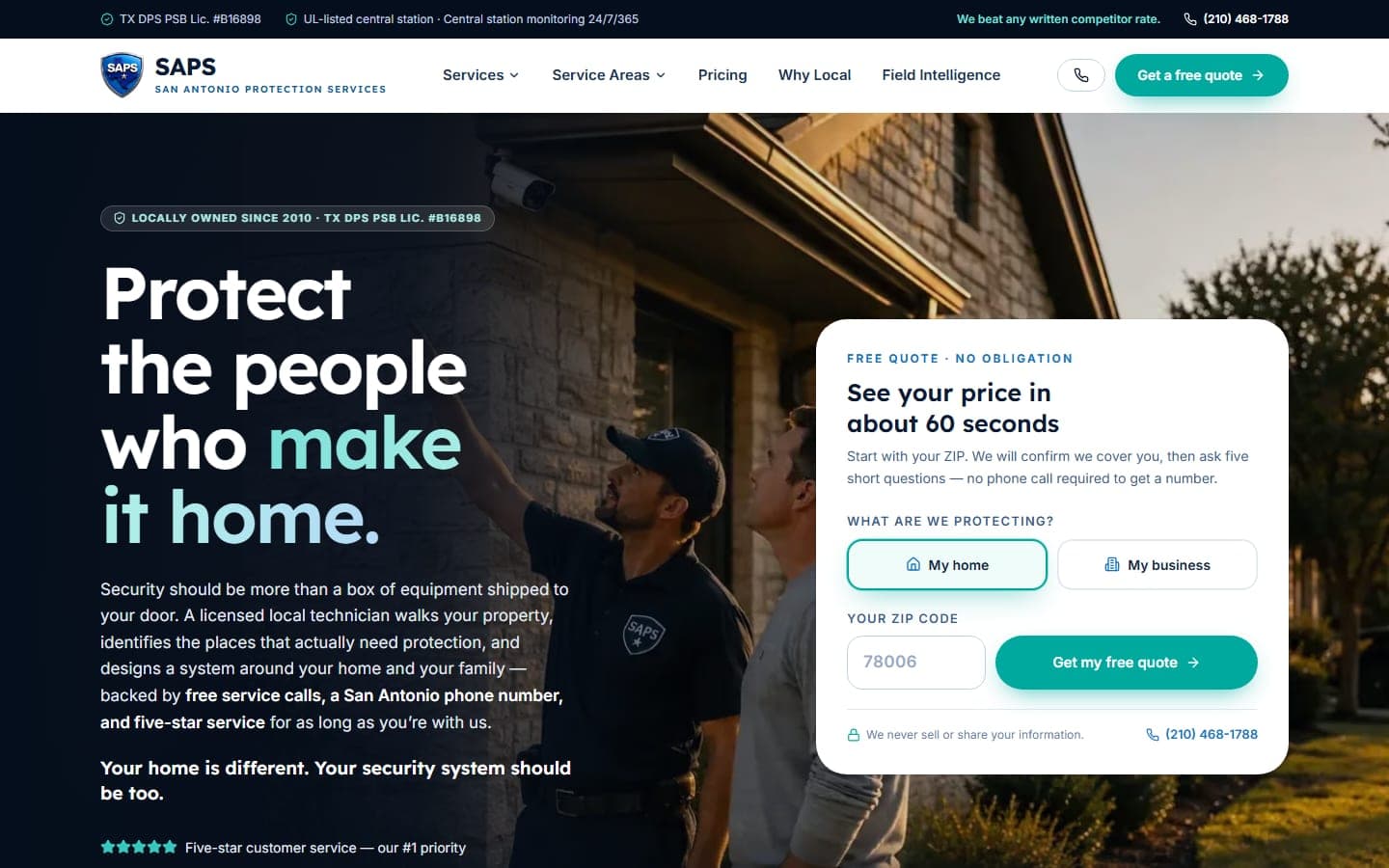 San Antonio Protection ServicesSan Antonio, TXA licensed local alarm company competing against national brands that outspend it a hundred to one, so the site does the thing the nationals will not: it gives you a price without a phone call. Start with a ZIP, answer five short questions, see a number in about a minute — a full-stack Next.js, TypeScript and Postgres build where the quote flow is the front door rather than a form buried on a contact page. Around it, service and service-area pages written for the searches that actually turn into installs, the license number and UL-listed monitoring stated up front where a buyer checks for them, and local listings worked so the company surfaces when someone in Bexar County starts looking. The promises that differentiate it — no long-term contracts, no leased equipment, free service calls — are on the first screen, not in the fine print.
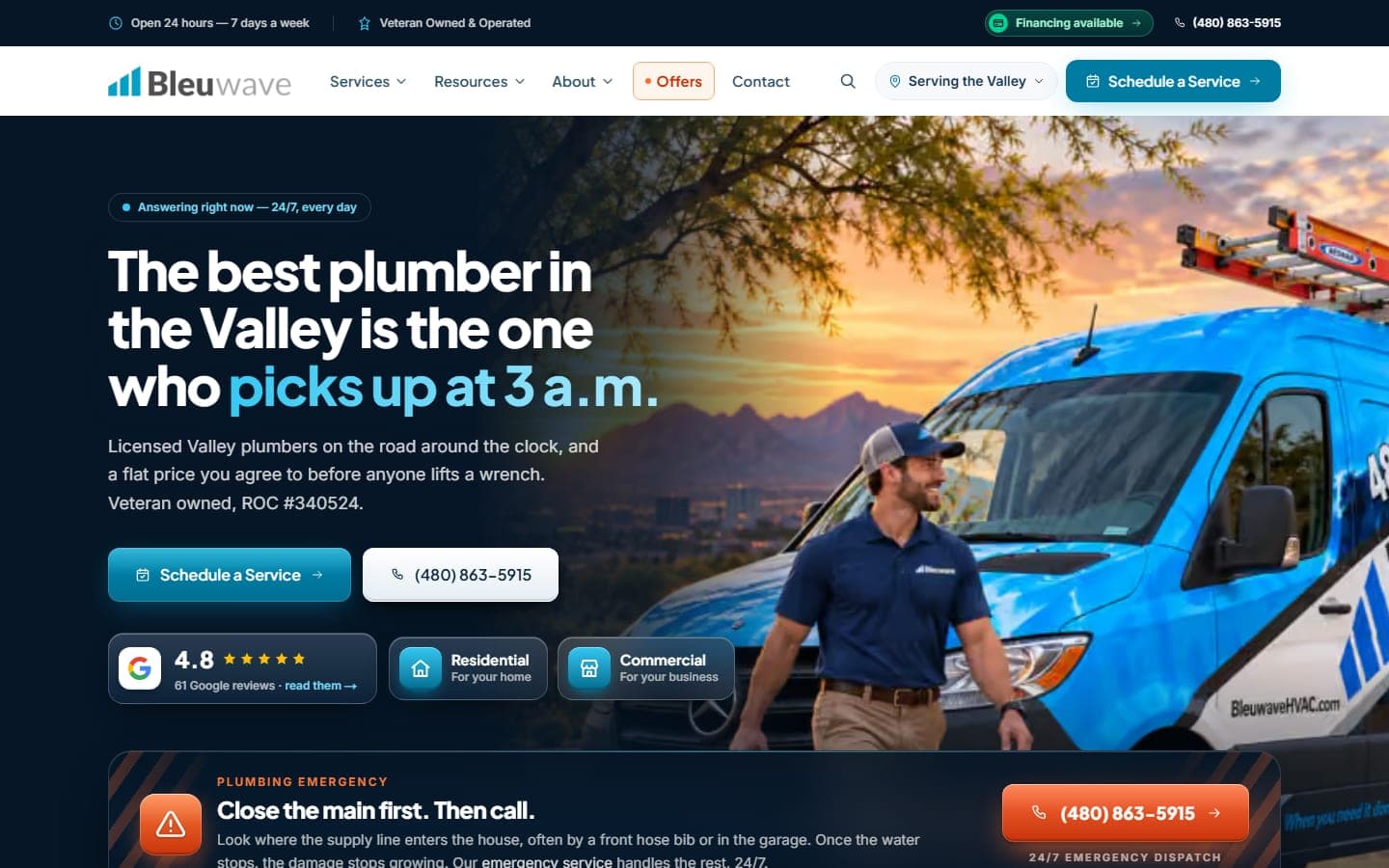 Bleuwave Plumbing: Redesign & Emergency TriagePhoenix, AZ · MetroRebuilt from the ground up on React, Next.js, and TypeScript over PostgreSQL for a veteran-owned Valley plumber whose business is decided at three in the morning. The estimate panel doubles as a triage engine: a homeowner who cannot name the problem picks “help me figure it out” and the form diagnoses it, while an emergency flag escalates an active leak ahead of the queue. Service-area routing, license and bonding proof, and a live cost path are wired into the same typed data layer, so an emergency turns into a dispatched truck instead of a voicemail.
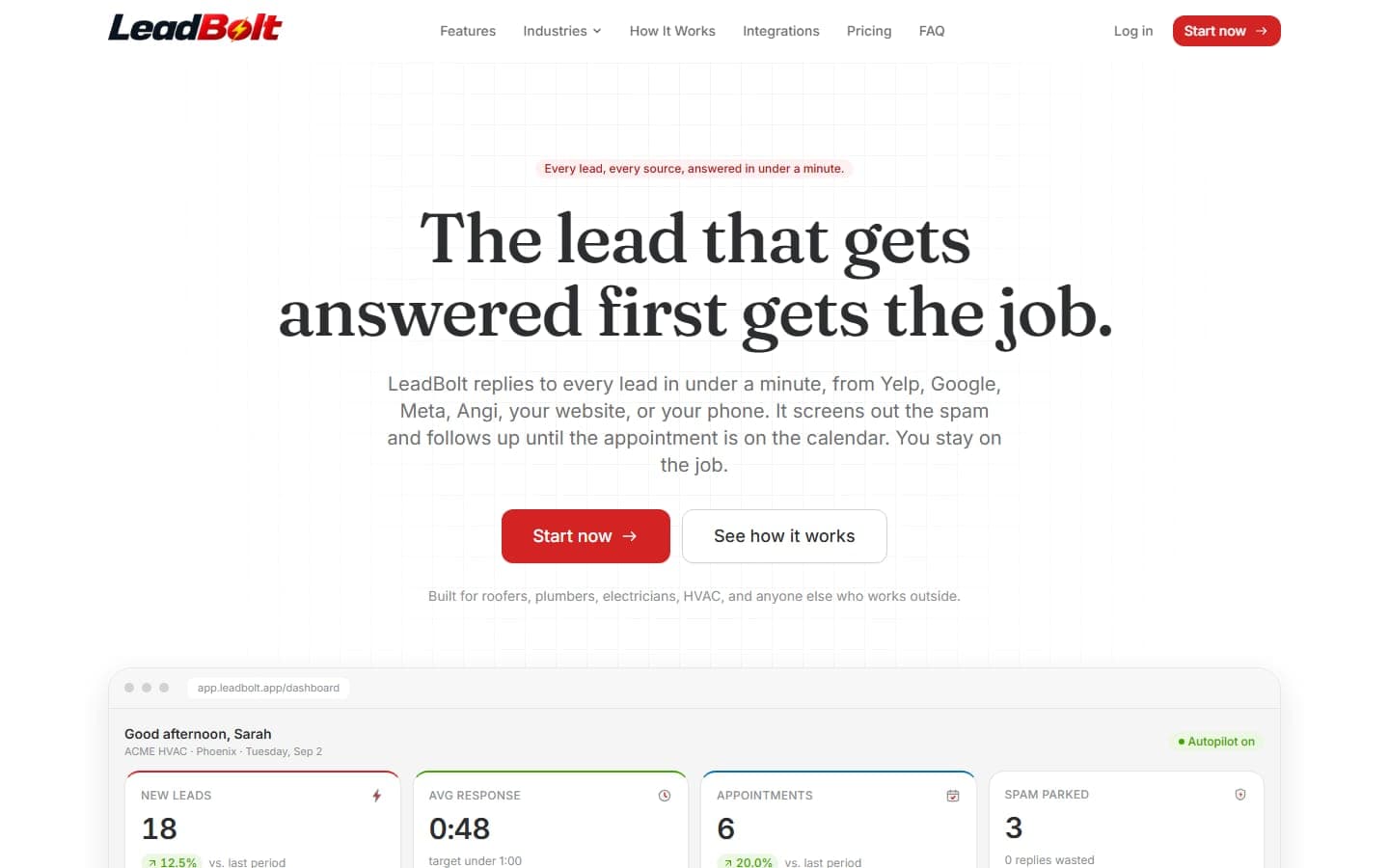 LeadBolt: Speed-to-Lead Software for ContractorsSan Antonio, TX · NationwideA software product, not a brochure: LeadBolt answers every Yelp, Google, Meta, Angi, website and phone lead in under a minute, screens out the spam, and follows up until the appointment is on the calendar, so a roofer or plumber on a job still wins the lead that came in while they were on the roof. The marketing site carries the same discipline — one promise on the first screen, the live dashboard shown rather than described, pricing published, and a start button on every page.
Keep reading
- AI search for locksmithsGEO for Locksmiths: Get Named When Someone Is Locked Out and Asks AIHow licensed locksmiths get named by ChatGPT, Gemini and Siri: the Texas DPS license rules, the sources AI checks, honest pricing pages and a GEO plan.
- Websites for locksmithsLocksmith Website Design: Licensed, Fast and Clear on PriceLocksmith website design with your DPS license on every page, call buttons, published fees, car key pages and the Texas ID rule explained. From $1,500.
- Marketing for contractorsHome Services Marketing: Plans Built to Fill the ScheduleHome services marketing for HVAC, plumbing, roofing and every trade: local SEO, maps, reviews, ads and AI search. Plans from $575 a month, no long contract.
- Marketing for foundation companiesFoundation Repair Marketing for a Sale That Takes Weeks to CloseFoundation repair marketing built around a long sales cycle: maps, reviews, agent and engineer referrals, search ads and follow-up. Plans from $575 a month.
- AI search for pool prosGEO for Pool Service Companies: Get Named When Homeowners Ask AI About Their PoolHow pool cleaning and repair companies get recommended by ChatGPT, Google's AI and Siri: the sources AI reads, the rules that apply, and a 30-day plan.
- Websites for arboristsWebsite Design for Tree Service Companies: A Site Built for the Call After the StormTree service websites with storm call buttons, photo estimate requests, arborist credentials and fast pages. Custom builds from $1,500, with 0% financing.
- Everything in Marketing by IndustrySee the section
Get a locksmith plan that starts with verification
Tell us your licensed name, towns, hours and service lines. We check whether your listings match the license, read your pages and ads, and come back with one monthly price and no term commitment.
Which of these sounds like you? (pick any)
Rather talk now? Call (210) 346-0848.