“We'll Fix It Later” Is the Most Expensive Sentence in Web Design

There is a sentence that shows up in every website project, usually around week three, usually in a tone of great reasonableness.
"We will fix it later."
It is said about the slow pages, the placeholder copy, the form nobody tested, the plugin installed to solve a problem at 11 p.m. It is said with the best intentions by sensible people. And it is, dollar for dollar, the most expensive sentence in this business — not because anyone lied, but because "later" is not a time. It is a place where work goes to accumulate interest.
The arithmetic nobody runs
A shortcut at launch costs an hour. The same shortcut costs a day in year two, because by then four other things are built on top of it and none of them were designed with it in mind.
This is not a moral failing. It is compounding. Every deferred decision becomes a constraint on the next decision, and constraints multiply rather than add. Which is why a site that was cheap and quick in March is somehow quoted like a rebuild in November, and why the owner is convinced someone is padding the estimate.
Nobody is padding. The estimate is what "later" costs when it finally arrives.
What "later" looks like when it shows up
It rarely announces itself as technical debt. It arrives wearing an ordinary problem.
The site broke after the host moved everyone to a new PHP version, and the plugins from 2019 did not survive it — that is site broke after a PHP update, and it is "we will update the plugins later" arriving with a bill.
The site started throwing a 500 Internal Server Error or a memory exhausted error, because the install kept growing and nobody revisited what it was running on. The certificate expired and now every visitor sees a not secure warning, because renewal was a manual step on a calendar nobody kept.
An update died halfway and left the site stuck on briefly unavailable for scheduled maintenance or another update is currently in progress. The editor stopped saving with publishing failed. The database stopped answering entirely with an error establishing a database connection.
Then the ones with no technical cause at all, which are the purest form of the sentence. The domain expired, because the renewal notice went to an inbox nobody checks. The host suspended the site over a bill or a resource limit somebody meant to look at. Email stopped working after the site moved, and nobody noticed until a customer mentioned they never heard back. Nothing broke. Something was simply not done.
Forty-five of these are documented in the Repair Hub, one page each. Read them in a row and they stop looking like forty-five separate accidents. They look like an invoice.
The quiet ones cost the most
The failures above at least tell you something is wrong. The expensive ones do not.
Robots.txt blocking Google is the classic — a single line left over from a staging site, telling search engines to stay away, which nobody notices because the site looks perfect. Same family: a new site never indexed, crawl errors piling up unread, sitemap errors handing Google a bad map, or the worst version, being de-indexed after you were already ranking.
For a store, the quiet version is order emails not sending — orders arriving, nobody notified, fulfillment stalled, revenue looking fine on the dashboard while customers wait. Or subscriptions not renewing, which cancels recurring revenue one customer at a time without a single alert.
There is no error page for lost money. There is just a slow month, and a theory about the economy.
Why builders make it worse, not better
The pitch for a page builder is that it removes maintenance. It removes the visible kind.
What it actually does is move the debt somewhere you cannot reach it. You cannot update a platform's rendering engine on your schedule. You cannot fix the payload it ships to every visitor. When the plan tier caps your content, that is not a bug to fix later — it is a bill. And the labor the platform saved you on setup gets paid back in the words you write, the search work you do, and the connectors you maintain.
That is not theoretical. A Squarespace site loading slowly is a payload you have no way to trim. Squarespace forms not sending loses inquiries with no error anyone sees. A Shopify or Wix site not appearing in Google is a rendering decision made for you. And on WordPress, when Elementor stops loading or a theme breaks after an update, you are locked out of your own pages until somebody else's fix ships. Each of these is deferred work you were never allowed to do.
Deferred work on a build you own is a decision you can revisit. Deferred work on a rented platform is a decision somebody else gets to make about you. We laid out the five-year version of this math in the comparison of custom builds against page builders.
The honest version of "later"
We are not going to pretend everything must be perfect at launch. That is how projects die at 90 percent.
The difference between healthy deferral and the expensive kind is whether it was written down. A deferred item with an owner and a date is a plan. A deferred item that lives in somebody's memory is a liability that will surface at the least convenient hour, usually on a Saturday, usually to a customer before it surfaces to you.
So the question to ask your web company is not whether they cut anything. It is: what did we defer, who owns it, and when does it come due?
How DataCram helps
Sometimes the right answer is repair. We do that — broken sites, WordPress rescue, speed and Core Web Vitals, search recovery when the rankings went down with it.
Sometimes the arithmetic has already turned, and paying for a rebuild in installments is more expensive than paying for it once. Then we talk about a redesign, a move off WordPress, or the path from WordPress to a modern build that keeps your rankings intact.
We will tell you which of those you are actually in. Sometimes the answer is to leave it alone and spend the money on marketing instead, and we say that too. We work with businesses across more than forty industries, in San Antonio and across the country.
FAQ
How do I know if my site has real debt or is just old?
Old is fine. Debt shows up as fragility — things break when unrelated things change, nobody wants to touch the site, and small requests get surprisingly expensive. If your team avoids the website, that is the tell.
Is it cheaper to fix or rebuild?
Depends entirely on how much is load-bearing. If the failures are isolated, repair is cheaper and we will say so. If every fix requires touching three other things, you are already paying rebuild prices in installments.
We cannot afford a rebuild right now. What is the minimum?
Stop the bleeding first: certificate renewal handled, backups verified, search indexing confirmed, and every form tested from outside your network. That is a short list and it prevents most of the expensive surprises.
How much does a rebuild cost?
Ours start at $1,750 and scale with what the site has to do. The pricing is published so you can do the math before you call.
Next steps
"Later" always arrives. The only variable is whether it arrives as a scheduled task or as a Saturday.
Tell DataCram what you have been putting off, or take the free audit, and we will give you the list — what is urgent, what can genuinely wait, and what is quietly costing you money right now with no error message at all.

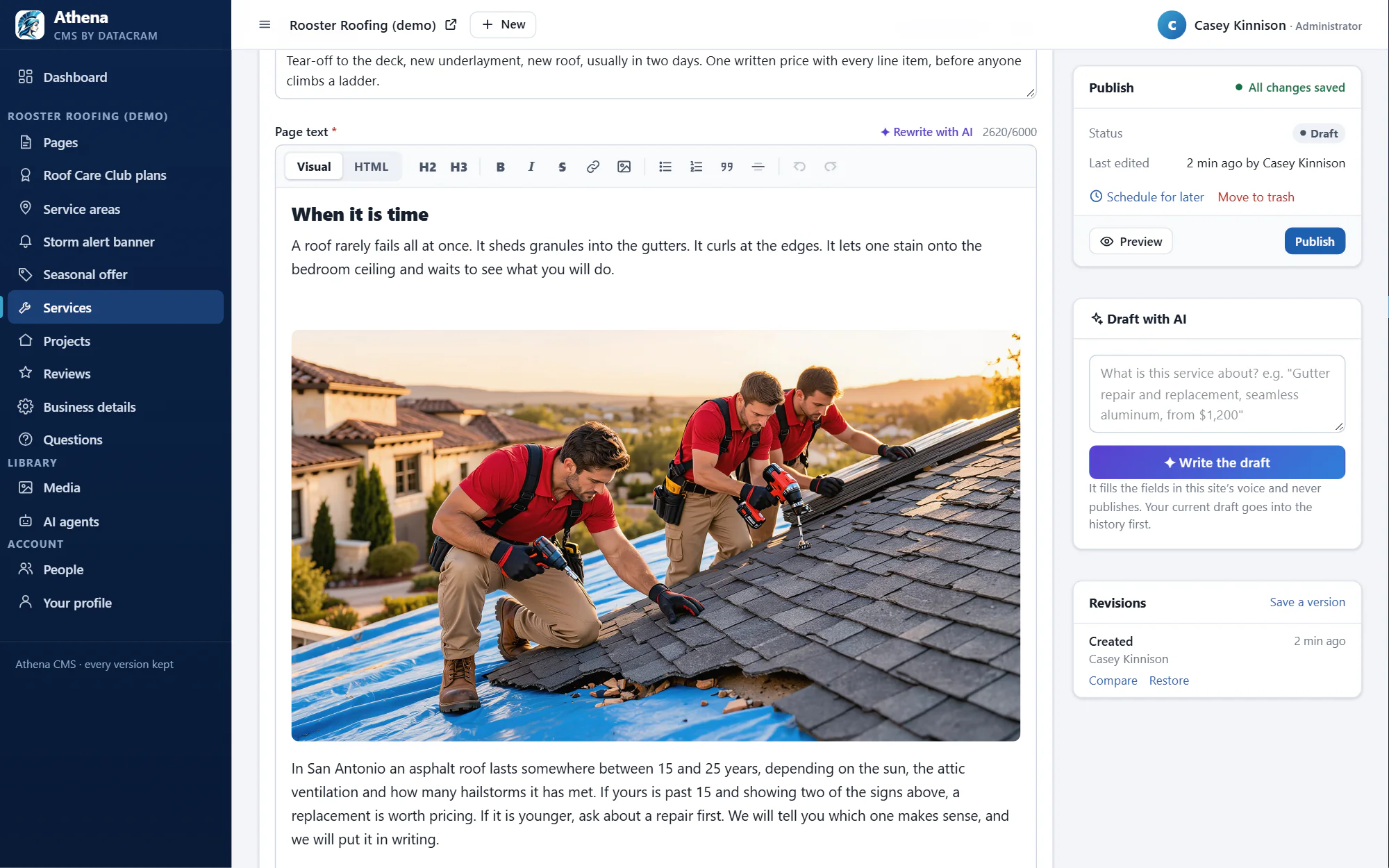
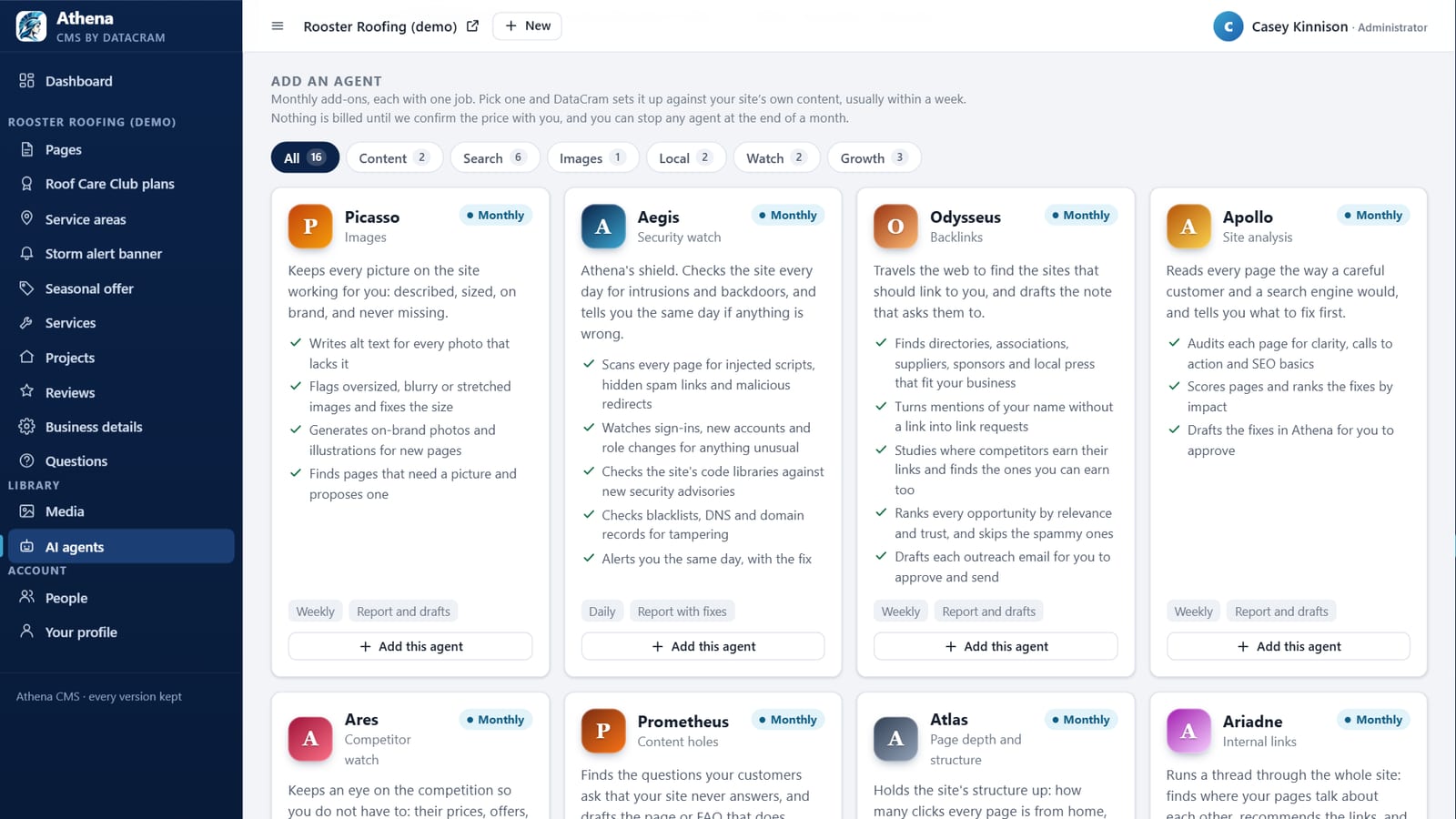
 What you edit with on Next.js