AI Agents vs. Plugins: Why Athena CMS Hires Agents
A plumber we know once counted the plugins on his WordPress site. There were thirty-one. He knew what four of them did.
The rest had arrived the way furniture arrives in a rental: one at a time, each for a good reason, none of them ever asked to leave. A form plugin. A plugin to stop spam on the form. A caching plugin, because the site got slow, and a second caching plugin, because nobody remembered the first. Every one of them was a stranger with a key to the house.
That is not a story about a careless owner. It is a story about how plugins work. And it is the reason Athena CMS, the content system we put behind every DataCram site, does not have them. It has agents instead.
A plugin adds a button. An agent does the job.
A plugin is code that adds a feature to your website and then waits. It is a very patient piece of software. An SEO plugin will show you a red light beside a weak page title for three years without once fixing it. An image plugin will compress the photo you upload, and say nothing about the forty photos already on the site with no description. A plugin does what it is told, when it is told, and not one thing more.
An agent is a worker with a job. It has a name, a schedule, a narrow brief and a set of rules it cannot break. It notices. It does the work. Then it reports what it did, or leaves the work as a draft for a person to approve.
The difference sounds like a distinction for engineers. It is not. It is the difference between buying a ladder and hiring someone to clean the gutters.
Here is a real one. On our roofing demo, an agent named Zeus checks the National Weather Service every hour. When hail an inch or larger falls within thirty miles, Zeus puts a storm banner on the site offering free inspections. When the storm is old news, Zeus takes it down. Nobody on the roofing crew has to remember. The site changes when the weather changes, which is the only time a roofer's website needs to change in a hurry.
You could build that with plugins. You would install a weather widget, then a banner plugin, and then someone would have to watch the one and remember to switch on the other. The plugins give you the parts. The agent gives you the result.
Seven reasons we hire agents instead of installing plugins
1. Nothing new runs inside your website
Every plugin is somebody else's code running inside your site, with the same access your site has. Security researchers who track WordPress report the same thing year after year: the overwhelming majority of new vulnerabilities are found in plugins, not in WordPress itself. A plugin abandoned by its author keeps running anyway, with last year's hole in it.
An Athena agent never runs inside the site. It works through Athena's front door, like a member of your staff, with an editor's permissions and nothing more. It cannot install anything, change the design or touch the code. If an agent somehow went wrong, the worst it could do is write a bad draft.
2. Every change can be undone
When a plugin changes something, it usually changes it in place. Ask it what the page said yesterday and it will look at you blankly.
Every change an Athena agent makes lands in that page's history under the agent's own name, beside the edits made by people. Compare any two versions field by field. Bring back the old one with a click. An agent that cannot be undone is an agent nobody should trust, so we did not build one.
3. Your site does not get slower
Plugins load their scripts and styles on your pages, often on every page, whether the page needs them or not. Thirty-one plugins is thirty-one chances to add weight, and each one is small enough that nobody notices which straw finally does it.
Agents work off to the side. The site visitors see is pre-built and served fast; the agents do their work in Athena, and the site only hears about it when something is published. Adding an agent adds no code to a single page.
4. They do not fight each other
The most common WordPress emergency is not a hack. It is two plugins that both want to control the same thing, discovered at 9 p.m. the night before a launch. One update, one conflict, one white screen.
Athena agents share one content model. They all read and write the same plain fields (a page's title, its description, its photos, its questions), so there is nothing to fight over. Each has its own lane: the agent that writes page titles does not touch the photos, and the one that minds the photos does not write blog posts.
5. There is nothing to update
Plugins need updating, weekly in some months, and each update is a small bet that nothing breaks. Skipping updates is a bigger bet. Most owners we meet have stopped placing either and simply hope.
An agent is maintained by us. When an agent gets better at its job, it is better on every site the next morning. You never see an update screen, because there is no update for you to make.
6. They answer to you
A plugin is either on or off. An agent can be told how far it may go. A few publish on their own when what they write passes the rules, like Zeus with the storm banner, because a storm does not wait for a meeting. Most leave a draft and a note: here is the new page title, here is why, approve it or don't. Each one is off until you turn it on, and every run is logged.
7. They work in your voice
Plugins that write anything write it in the voice of whoever built the plugin, which is to say no voice at all. Every Athena site has a house voice and a short list of hard rules. For a roofer, the rules might read: never quote a price that is not on the price list, never call anything "cheap," always say "free inspection" and never "free estimate." Every agent reads them before every job.
Where a plugin is still the right answer
We would be lying if we said agents win every time. They do not.
If you need a store with four thousand products, a membership site or an event calendar with ticketing, the WordPress plugin world is enormous and much of it is good. A plugin is a product off the shelf; it is often free, and it is there tonight. An agent is set up against your site's own content, and the ones that do serious work are a monthly cost.
Plugins also suit people who like to tinker. Some owners enjoy running their site the way some people enjoy working on old trucks. That is a fine hobby. It is just not a business plan.
If WordPress is working for you, keep it, and keep it patched. We build and repair WordPress sites too. But if you are tired of being the night watchman for thirty-one strangers, there is another way to run a website.
Meet the agents
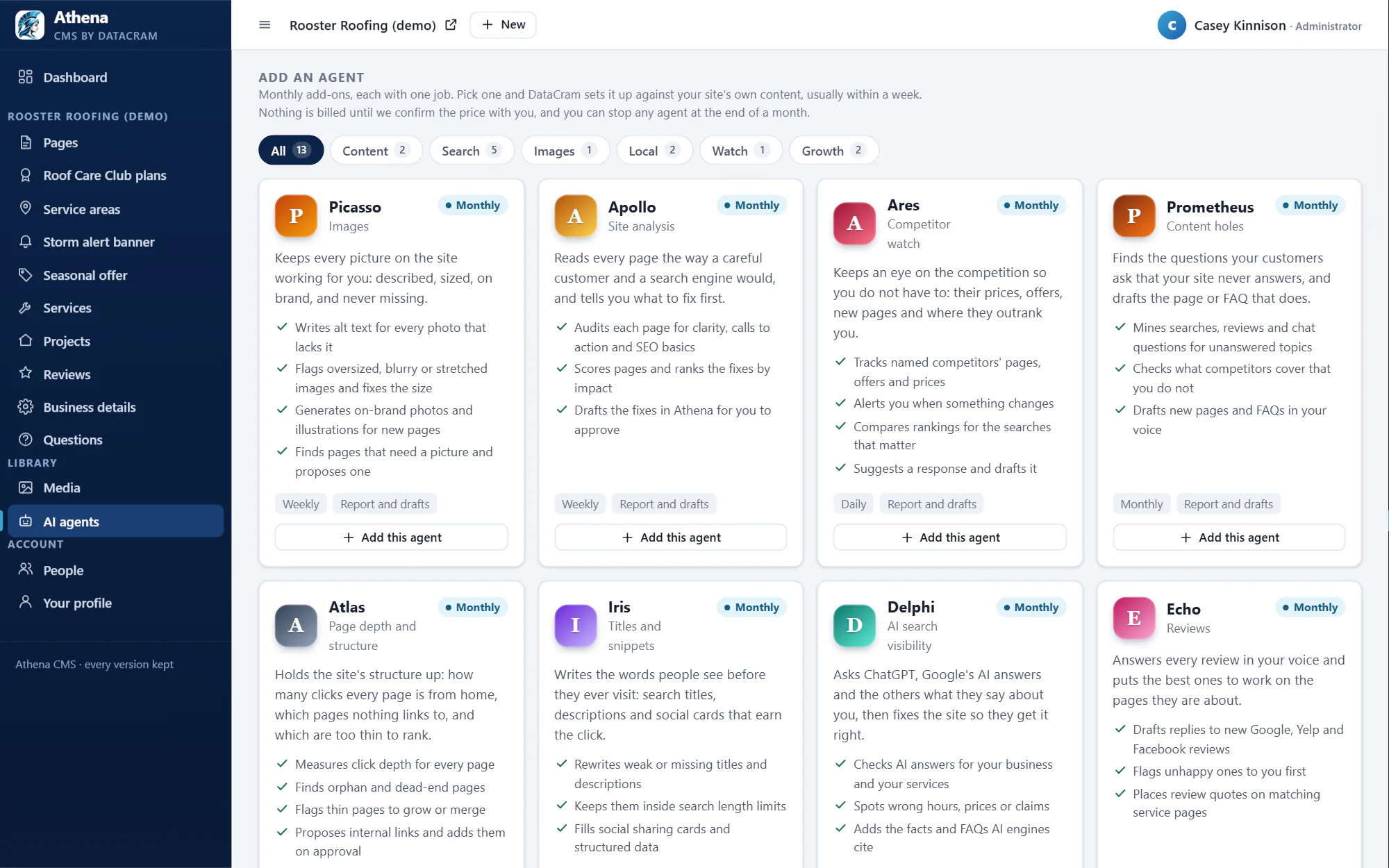
Every agent in Athena has a name and one job. Two come with Athena:
- Zeus, the event watcher, changes the site when the world changes: storm banners, closures, sold-out notices.
- Demeter, the seasonal offers agent, drafts the next season's offer before the current one ends.
The rest are monthly add-ons. Pick the ones that take a job off your plate:
- Picasso minds the pictures: writes the missing descriptions, fixes oversized and blurry images, and makes on-brand images for new pages.
- Apollo reads every page like a careful customer and a search engine, then ranks the fixes by what they are worth.
- Ares watches your competitors' prices, offers and new pages, and tells you when they move.
- Prometheus finds the questions your customers ask that your site never answers, and drafts the answers.
- Atlas holds up the structure: pages buried too many clicks deep, pages nothing links to, pages too thin to rank.
- Iris writes what people see before they visit: search titles, descriptions and social cards.
- Delphi asks the AI assistants what they say about you, and fixes the site so they get it right.
- Echo drafts replies to your reviews and puts the best ones on the pages they are about.
- Hestia keeps your hours, phone and address the same everywhere, including the holiday hours nobody remembers.
- Argus watches for broken links, failing forms, slow pages and expiring certificates.
- Hermes turns every new page, offer and finished job into a post for your social accounts.
- Calliope writes the articles you keep meaning to get around to.
- Harmonia drafts Spanish versions of your pages and checks that everyone can read them.
You can meet them all, and take a tour of Athena itself, on the Athena page.
The question that picks your first agent
You do not need fifteen agents. You need the one that does the job you keep putting off.
So try this. Write down the three things you keep meaning to do on your website. Update the photos. Answer the reviews. Write about the new service. Find out why the competitor down the road shows up first.
That list is not a to-do list. It is three job descriptions. A plugin will hand you the tools for each one and wait, politely, for years. An agent will simply start.
If you want to see what that looks like on your own site, tell us what you change most. We will show you the fields, the agents and what it would take to get you there. And if you are wondering how a site like that gets built, read how AI agents are replacing WordPress sites, or start with our WordPress to Next.js page.