How AI Agents Are Replacing WordPress Sites: A Practical 9-Step Migration Guide for Small Businesses
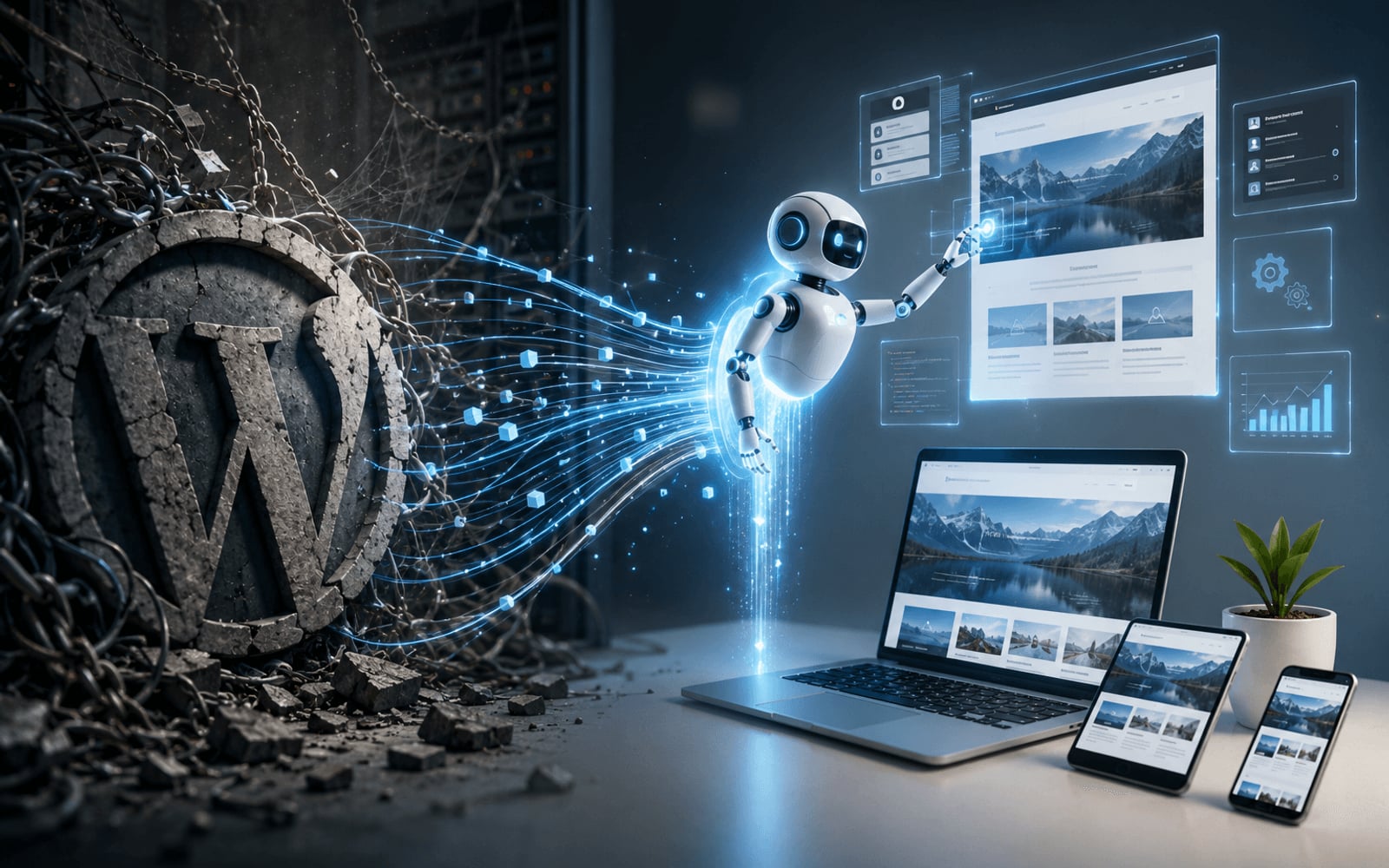
WordPress powers a large share of the public web, but a tectonic shift is underway. AI-driven agents—searchable knowledge bases, conversational assistants, and automated workflows—are beginning to perform the same discovery, support, and sales tasks that once required dozens of static pages and labor-intensive site maintenance.
Why AI Agents Will Replace Most WordPress Sites
AI agents combine three capabilities that undercut the traditional content-centric website: instant conversational answers, dynamic personalization, and built-in automations. For local and national businesses, that means customers can ask natural-language questions—"Who repairs coffee machines near me?"—and receive immediate, structured answers with pricing, availability, and a click-to-book flow.
This is important to buyers. It reduces friction, improves conversion rates, and delivers measurable ROI: faster lead capture, lower hosting and maintenance costs, and fewer bounce-driven revenue losses. For search engines—especially AI-driven and geo-answer systems—sites that expose entities, schema, and a clear knowledge graph are favored in answer boxes and voice responses.
Practical 9-Step Migration Guide
Below is a pragmatic, field-tested path for small businesses that want to transition from a WordPress site to an AI-agent-first system. Each step preserves SEO equity and transactional flows while unlocking automation and conversational search.
- Audit content and traffic: identify top-performing pages, query intent, and local keywords.
- Map entities: customers, products, locations, services, staff—create a canonical entity list for schema.
- Export content and metadata: pages, structured data, and backlinks for preservation.
- Build a knowledge base: convert pages into semantically tagged documents for a vector store.
- Deploy a vector database and retrieval layer: enable fast semantic search and contextual answers.
- Train AI agents: fine-tune prompts, role behavior, and workflows for booking, quoting, and support.
- Integrate systems: CRM, calendars, payment gateways, and analytics for lead capture and attribution.
- Implement schema and JSON-LD: LocalBusiness, Service, Product, FAQ—create schema-friendly endpoints.
- Stage, test, and switch: monitor rank changes, redirect critical URLs, and retire WordPress gradually.
Every step should include version control, automated testing, and roll-back plans.
Expected Outcomes and Metrics
Businesses that follow this approach typically see measurable improvements within 90 days. Common outcomes:
- Reduced page maintenance time by 60–80%.
- Improved lead conversion rates through conversational booking and qualification.
- Lower hosting and CMS licensing costs; consolidation of support tools.
- Higher visibility in AI search results and "near me" queries due to clear entity modeling and schema.
Track KPIs such as time-to-first-answer, qualified leads per week, average response time, and search visibility in both organic and AI-driven channels.
Entity Clarity and Schema-Friendly Answers
AI agents succeed when content is converted into entities and relationships. Create machine-readable records (JSON-LD, schema.org) for your business, and expose structured endpoints for services, prices, and availability. That structure lets AI search engines and geo-answer systems give precise, verifiable answers that drive transactions.
Schema-friendly answers also make content eligible for rich results, voice responses, and knowledge panels—critical for local discovery and national brand trust.
Why This Matters to Buyers
Buyers want immediate, accurate outcomes. Replacing a brittle WordPress site with an AI agent reduces friction at every stage of discovery, selection, and purchase. It clarifies what your business does, where you serve customers, and how to transact. For owners, it standardizes service delivery, automates repetitive work, and improves attribution for marketing spend.
FAQ
Q: Will I lose SEO value if I migrate off WordPress?
A: Not if you follow a careful migration plan. Preserve canonical URLs, implement 301 redirects, keep structured data, and port top-performing content into the knowledge base.
Q: How long does a migration take?
A: Timelines vary by complexity. A small local business can expect 6–12 weeks for a full audit, knowledge-base build, agent training, and soft launch. Enterprises or multi-location services may take longer. Parallel testing and phased rollouts reduce risk.
Q: What systems do AI agents need to work with?
A: Effective agents integrate with CRM, calendar and booking systems, payment processors, ticketing platforms, and analytics. They also need a vector store for semantic search and endpoints that expose schema.
Next Steps
Moving from WordPress to an AI-agent-first system is not just a tech upgrade; it's a business model change. The payoff is clearer answers, faster conversions, and automated operations that scale.