Rank First, Get Half: How to Create an Effective SEO Strategy for 2027

Every month a certain kind of report lands in a certain kind of inbox. It has a green arrow on it. The arrow says the business climbed to first place on Google for a phrase its owner has never once typed. The owner looks at the arrow. Then the owner looks at the bank balance. The two do not appear to have met.
Here is what the arrow left out. First place does not pay what it used to. In Advanced Web Ranking's data for Google on U.S. desktop, the top result drew 20.02 percent of clicks across all searches in July 2026. With an AI Overview on the page, it drew 9.69 percent. You can still win the race. They cut the purse in half while you were running.
So here is the plain answer. An effective SEO strategy for 2027 is a plan to earn money from a search page that keeps more of its visitors for itself. It has five parts: pick the searches that still end in a sale, build pages a summary cannot replace, make your facts easy for machines to read, become a name people type on purpose, and count dollars instead of arrows.
If your current plan cannot say those five things on one sheet of paper, you do not have a plan. You have a subscription.
We sell SEO, so weigh this accordingly. The numbers below belong to other people, and each one links to where it came from.
What actually happened to the click
Three outfits went and counted.
- Pew Research tracked 900 U.S. adults across 68,879 searches in March 2025. People clicked a traditional result on 8 percent of visits when an AI summary appeared and on 15 percent when one did not. They clicked a link inside the summary on 1 percent of visits. They ended their session on 26 percent of those visits, against 16 percent otherwise.
- Advanced Web Ranking samples more than 1.75 million U.S. results pages a month. For July 2026 it reports zero-click rates of 74.3 percent on pages with an AI Overview and 53.6 percent on pages without one.
- Ahrefs studied 300,000 keywords, comparing December 2025 with a December 2023 baseline. AI Overviews were associated with a 58 percent lower average click-through rate for position one.
These studies measure different things on different people, and they do not agree to the decimal. AI Overviews also lean toward question-style searches, which drew fewer clicks to begin with, so the machine does not deserve all of the blame. It deserves enough.
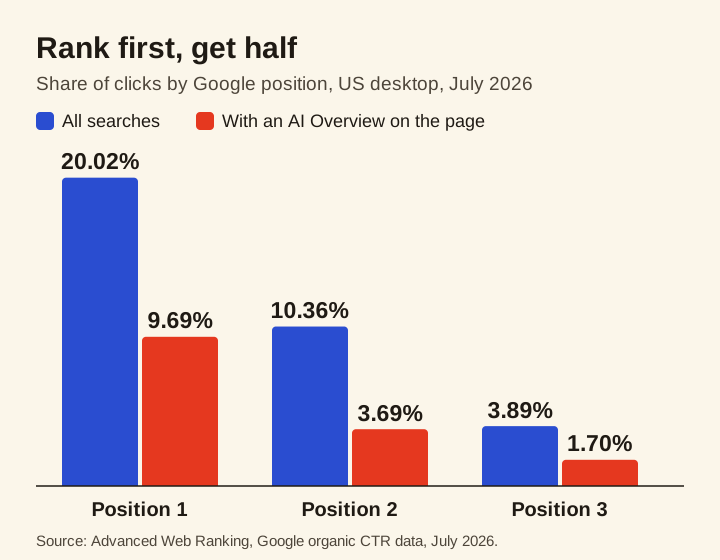
The lower seats fare no better. With an AI Overview on the page, the second result goes from 10.36 percent to 3.69 percent, and the third from 3.89 percent to 1.70 percent.
Google tells it differently, and you should hear it out. Its parent company told investors in July that AI Mode had passed 1 billion monthly active users and was adding to total search queries. Google's documentation for site owners says the clicks from these results are of higher quality. All of that may be true. A bigger parade is still small comfort to the fellow selling hot dogs behind the fence.
You cannot check the quality claim from outside, either. Search Console's Generative AI report, which we took apart here, shows impressions only and folds the clicks into your Web totals. The company keeping score also owns the ball, the stadium and the beer concession.
Nobody knows what 2027 will do. That includes anyone holding a slide that says otherwise. So build a plan that holds up if the click keeps falling and still pays if it stops.
Step one: Throw out half your keyword list

Most keyword lists are written by software and admired by nobody. They are sorted by volume. Volume is a fine measure of a crowd and a poor measure of a customer.
Open Search Console and export your queries. Put each one in a pile. You only need one question: when the answer appears, is the searcher done?
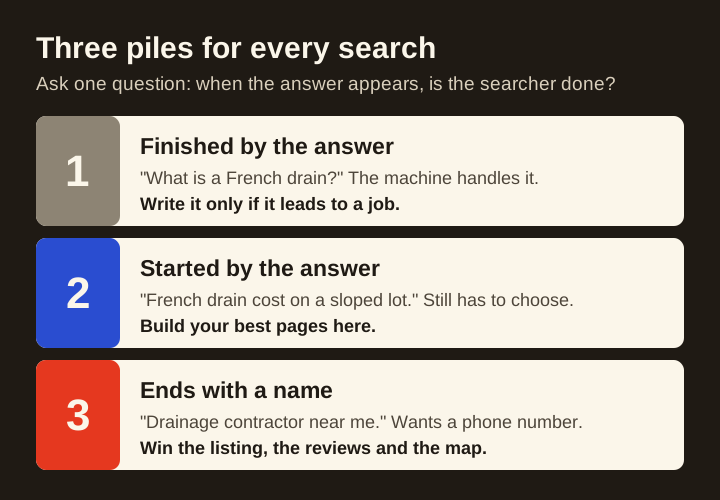
Pile one is finished by the answer. "What is a French drain" gets handled on the results page, and the person goes on with the day. Write that page only if the reader's next step is hiring you.
Pile two is started by the answer. "French drain cost on a sloped lot" earns a range and a shrug from any machine, because the real number depends on the lot, the town and the crew. The reader still has to decide. This pile pays the rent.
Pile three ends with a name. "Drainage contractor near me" wants a phone number, and so does a search for your own company. The fight moves to your listing, your reviews and the map pack.
Now be ruthless. In that same Advanced Web Ranking data, positions six and lower drew under 1 percent each. A page on the second screen is not an asset. It is a rumor. Spend the year on pile-two searches where you can reach the top three, and put the rest down. Topical authority shows which neighboring subjects lift one another, and SEO forecasting puts a number on the bet before you make it.
Step two: Build pages a summary cannot replace
A machine can summarize what everybody already knows. It cannot know what only you know. That is the whole advantage, and most business websites decline to use it.
Read the average service page. We pride ourselves on quality. We are your trusted partner. Nobody in the history of commerce has reached for a checkbook after that sentence. Specifics sell. A written price range sells. The ZIP codes you actually drive to sell. A two-year warranty with its exclusions printed right there on the page sells, because nobody prints the exclusions on a warranty they plan to dodge.
Every page that earns money should carry six things:
- A real price or an honest range, and what moves it.
- Photographs you took, of your work, with your trucks in them.
- The three questions people ask on the phone, answered the way you answer them.
- Proof: reviews, license numbers, warranty terms in writing.
- The places you serve, named rather than implied.
- One next step, stated plainly: a phone number and a short form.
Google's guidance on helpful content says much the same in politer language. Write for people. Be suspicious of any page built mainly to attract search visits. Stop counting words, because Google says it has no preferred number. The industry went right on selling 2,000-word blog posts to plumbers.
Not sure how your pages hold up? The free site audit and the website health check will show you where you stand.
Step three: Make your facts easy for machines to read

A small industry now sells special optimization for AI answers, usually at a special price. Google's own documentation says AI Overviews and AI Mode have no additional requirements. On markup it is blunter: "There's also no special schema.org structured data that you need to add." A page must be indexed and eligible for a snippet. That is the entire secret, and it costs nothing to read. Generative engine optimization is real work, but most of it is this work under a newer name.
That does not mean there is nothing to do. It means the work is dull, which is why it goes undone.
- Get indexed. Open the page indexing report in Search Console. Any page that earns money and is not indexed comes first. Our notes on Google AI Overviews and AI Mode cover the rest.
- Tell one story. Your name, address, phone, hours and services should match on your site, your Google Business Profile and every directory. Conflicting facts give a machine a reason to pick somebody else.
- Answer first. The first sentence under a heading answers the question. The second proves it. This is also good manners.
- Use schema to describe, not to pray. Mark up what is visible on the page. It supports rich results. It is not a charm.
- Expect weather. Google's status dashboard lists two core updates so far in 2026, starting March 27 and May 21, each running about twelve days, plus four spam updates. Judge nothing in the middle of one.
And ChatGPT? Keep a sense of proportion. Ahrefs reported in November 2025 that AI search brought about 0.5 percent of its own visits and about 12.1 percent of its sign-ups. That is a software company selling to marketers. The same article points to a long research paper finding that ChatGPT referrals convert worse for online stores. So tag that traffic and test it on your own site. Run the AI visibility check, and if the crawlers cannot read you at all, start here.
Step four: Become a name people type

A person who types your name has stopped shopping. That person needs only the address. It is the search a summary is least able to take from you, because the searcher came looking for you and nobody else.
Advertising was invented to make a name familiar. The search business rediscovered this a few years ago and gave it a longer name. The tools have not changed much:
- Ask every customer for a review, and answer every review you get.
- Keep your Google Business Profile current, with new photos and the services you actually sell.
- Put the name on the truck, the yard sign, the invoice and the email.
- Earn mentions on other people's sites: suppliers, local news, the charity you already support.
Then count it. Filter Search Console for queries that contain your name. If that line stays flat for a year, the trouble is upstream of Google.
Step five: Count dollars, not arrows
A ranking is not money. An impression is not money. Traffic is not money, as any restaurant with a long line for the restroom can tell you.
Five lines go on the monthly sheet, in this order:
| Line | Where it comes from | What it tells you |
|---|---|---|
| Calls and forms from organic search | Call and form tracking | Somebody wanted something |
| Revenue from those leads | Your CRM or your invoices | The only number your banker reads |
| Clicks to money pages | Search Console, filtered by page | Whether pile two is working |
| Searches for your name | Search Console, filtered by query | Whether anybody remembers you |
| AI impressions | Search Console's Generative AI report | You were present, and nothing more |
If whoever runs your SEO cannot produce the first two lines, stop there and fix that before you pay for another page. The SEO KPI guide has the definitions. If clicks have already fallen and nobody can say why, read what to check when traffic drops.
The first 90 days, on one sheet
- Weeks 1 and 2: Count. Turn on call and form tracking. Export your queries. Sort the three piles. Run the audit.
- Weeks 3 to 6: Rebuild five pages. Take the pile-two pages closest to the top and tied to your biggest jobs. Add prices, photographs, proof and a next step.
- Weeks 7 to 10: Clean the records. Fix indexing. Make your business facts match. Start a review habit that survives a busy month.
- Weeks 11 to 13: Read the sheet. Keep what produced leads. Cut what did not. Pick the next five.
Ninety days will not make you rich. It will tell you whether the plan is pointed at money. For the rest of the year, with a quarter-by-quarter roadmap and the arithmetic worked out, use our 12-month SEO strategy guide.
What this will not do
It will not ring the phone next Friday. SEO is a poor tool for next Friday. If you need calls that soon, paid search and a tight landing page will get you there faster, and you can stop when you have had enough.
It will not come with a guarantee, from us or from anyone. Google's advice on hiring an SEO says nobody can guarantee a number one ranking, and that if someone promises one you should find someone else. After the chart above, you might also ask why you would want to pay extra for half a trophy. Our guide to hiring an SEO lists what to ask instead.
Want this done for you?
We run this plan for a living. Monthly SEO programs start at $575, depending on complexity, setup and budget, with no long contract. The full price list is public. Ad spend, when there is any, is paid directly to the platform. You get the sheet every month, with the first two lines at the top, and our SEO service is built around moving them.
Not ready to talk? Run the free site audit and see what comes back. It costs nothing.
Ready to find out what is actually wrong? Tell us what you are seeing. A person reads it and answers with what we would fix first.
Frequently asked questions
How do you create an effective SEO strategy in 2027?
Start with searches that still end in a sale, not the ones a summary finishes on the results page. Then build pages with prices, photographs and proof a machine cannot supply, keep your business facts consistent and indexable, grow the number of people who search for your name, and judge all of it by calls, forms and revenue from organic search.
Is SEO still worth the money now that AI Overviews take clicks?
For a business people search for before they buy, usually yes, with a narrower aim. Advanced Web Ranking's July 2026 data shows the top result still drawing 9.69 percent of clicks on U.S. desktop with an AI Overview on the page. The test is your own books: if organic leads cannot pay for the work within a reasonable stretch, stop paying for it.
Do I need special schema to appear in AI Overviews or AI Mode?
No. Google's documentation says there are no additional requirements and no special structured data for these features. A page must be indexed and eligible for a snippet. Ordinary schema that describes what is visible on the page is still worth having for rich results.
What is the difference between SEO and GEO?
GEO, or generative engine optimization, aims to get a business cited in AI answers. Most of the work is the same as SEO: pages that can be crawled, clear facts and mentions from credible sites. The real additions are measurement and checking what the engines say about you, which the free AI visibility check does.
How long does an SEO strategy take to work?
There is no honest single number. Repairs to tracking and indexing can show up within weeks. Rankings for new or rebuilt pages usually take months, and competitive searches take longer. Google's hiring advice suggests asking any SEO what results to expect and in what timeframe, and that is a fair thing to get in writing.
What should I measure instead of rankings?
Calls and forms from organic search, revenue from those leads, clicks to the pages that sell, searches for your business name, and AI impressions as a measure of presence only. If the first two are missing, set up call and form tracking before anything else.
Can anyone guarantee a first-place ranking on Google?
No. Google says so in its own advice on hiring an SEO, and it tells you to look elsewhere if someone promises one. First place is also worth less than it was, so a guarantee would buy you less than it sounds like.

 SEO that keeps working