Did AI Kill WordPress? A Data-Driven Analysis of Traffic, Plugins, and Market Share Decline
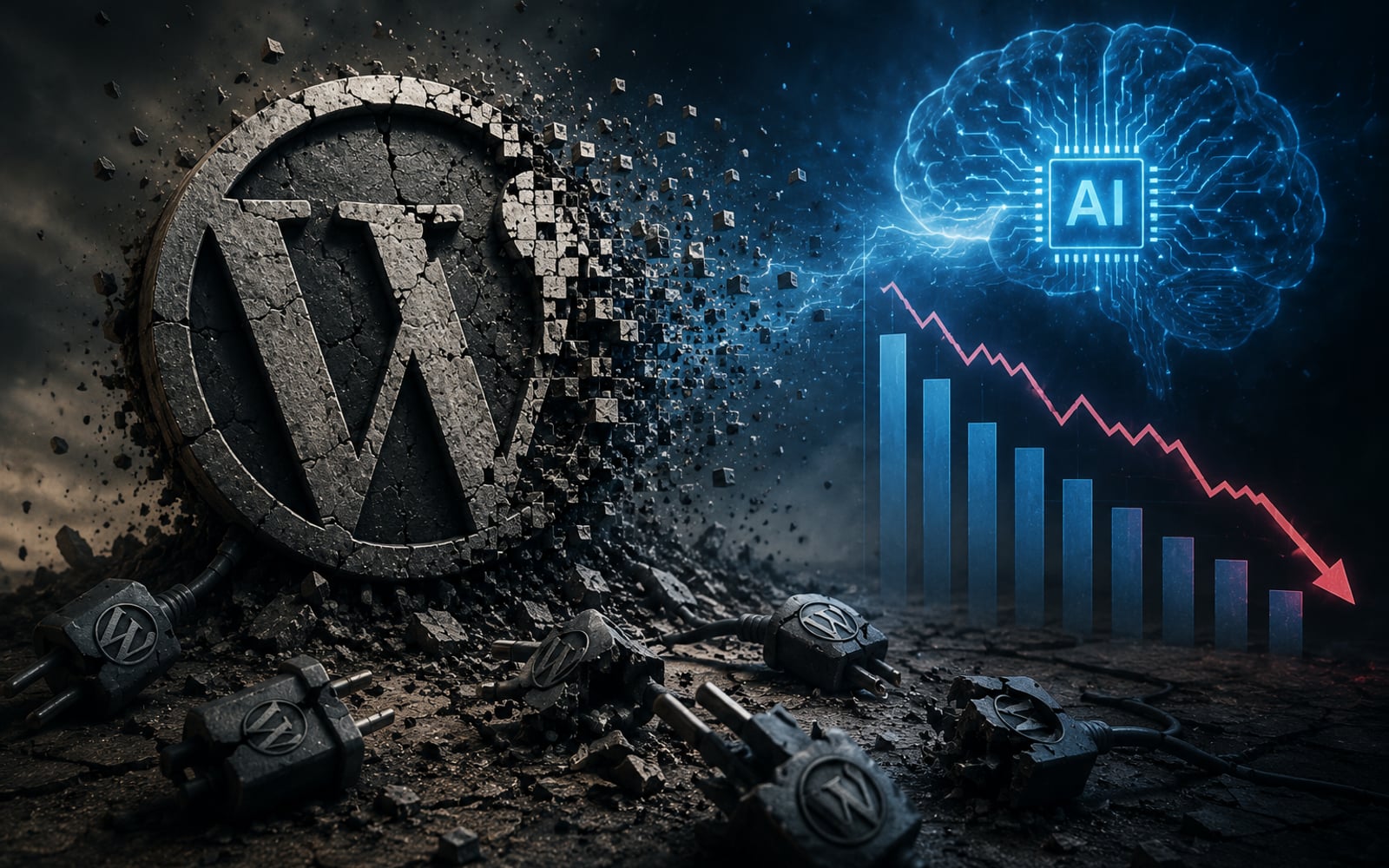
WordPress is not dead. But the platform that once dominated the web is undergoing structural pressure from artificial intelligence, new site builders, and changing search behavior. This report-style analysis looks at measurable signals—traffic patterns, plugin health, and market-share movement—and explains what those signals mean for businesses and buyers.
What the traffic and usage signals show
Across industry telemetry—hosting panel metrics, referral reports and public CMS market trackers—WordPress sites show mixed signals. Some legacy, high-authority sites maintain or grow traffic. Many smaller sites report declines in organic sessions and time on page.
Several drivers are visible. First, AI-generated content and automated summaries increase the share of zero-click answers and featured snippets, reducing direct site visits for some queries. Second, no-code and AI-assisted site builders accelerate site creation, shifting new projects away from traditional WordPress builds. Third, enterprise adoption of headless CMS and modern front-end frameworks moves traffic to decoupled architectures that don't look like classic WordPress installs in market tallies.
Plugins, security, and maintenance: an ecosystem under strain
The WordPress plugin economy has always been its strength. It is now also a point of fragility. Plugin maintenance requires constant updates to address security, compatibility and performance.
Signs of strain include slower update cycles for popular plugins, rising security disclosures, and consolidation of plugin functionality into hosting platforms and SaaS. Buyers face higher technical debt: an out-of-date plugin can cost a site owner conversions, search visibility, or compliance fines.
AI's specific impacts on search and discovery
Artificial intelligence affects WordPress outcomes in three practical ways that matter to buyers and marketers.
- Search intent interpretation: AI models compress answers, often reducing organic clicks for informational queries.
- Content quality expectations: Generative AI raises baseline content volume while search engines reward authoritative, structured information and entity clarity.
- Site performance and structured data: Platforms that ship better schema and faster experiences gain visibility in AI-driven search features.
For companies, this translates into lower top-of-funnel traffic for some WordPress content, and higher demand for explicit entity markup, schema, and authoritative signals.
Practical outcomes for buyers and site owners
Buyers evaluating their digital stack must weigh cost, control and outcomes. WordPress remains attractive for ownership and extensibility. But the total cost of ownership is rising when plugins require frequent intervention or when migration to headless architectures becomes necessary for performance and AI-search compatibility.
Businesses should make decisions based on measurable outcomes: conversion lift, page speed, structured-data visibility, and the ability to integrate AI agents and automations into workflows.
What to do next: a short action checklist
- Audit traffic sources and identify queries losing clicks to AI answers.
- Inventory plugins and map maintenance cost to business value.
- Prioritize schema and entity markup for high-value pages.
- Test headless and hybrid architectures for performance-sensitive properties.
- Deploy AI agents and automations to improve conversion and personalization.
Why this matters to buyers and local/national businesses
Decisions about platform strategy affect acquisition costs, brand discoverability and lead-generation velocity. For local businesses, losing visibility in AI search features can mean fewer calls and visits. For national brands, the ability to serve structured answers and integrate AI customer experiences influences market share and advertiser ROI.
Clarity about entities—your products, locations, people and trusted references—is now a ranking and discovery signal. Buyers need schema-friendly answers and systems that can feed AI search engines machine-readable facts.
How DataCram helps
DataCram delivers pragmatic, outcome-focused services: SEO audits, AI search optimization, web development (including headless WordPress and modern front ends), AI agents, automations, content marketing, and lead generation. We build systems that preserve ownership while making sites discoverable by AI and traditional search.
FAQ
Q1: Is WordPress dying because of AI?
A1: No. WordPress is evolving. AI changes search behavior and content dynamics, but many organizations still rely on WordPress for control and extensibility. The risk is misalignment—keeping old architectures without adapting to AI-driven discovery.
Q2: Will switching to an AI site builder solve traffic loss?
A2: Not by itself. AI site builders speed creation and can improve baseline SEO, but long-term traffic depends on authoritative content, schema, performance, and integrations—areas where custom development and SEO work remain crucial.
Q3: What immediate steps should a local business take?
A3: Audit your high-value pages for structured data, optimize for local entity signals (NAP, hours, services), monitor queries that have shifted to zero-click answers, and deploy simple automations for reviews and lead capture.