
Bundle against platform
Avada vs Elementor: One Boxed Suite or a Builder You Assemble
Avada arrives as one box with eight plugins inside. Elementor arrives as a free theme, a free plugin and a pricing page with four tiers. One asks you to unpack; the other asks you to shop. What the website has to do decides which chore costs you less.
October 10, 2026 · 10 min read
The short answer
Choose Avada if you want one purchase that covers layouts, headers, mega menus, forms and a WooCommerce builder for a single site at $69 one-time. Choose Elementor on the free Hello theme if you want a free start, a familiar editor and Pro plans from $60 a year, as of October 2026. Do not run both builders on one site.
On this page
- One purchase or a shopping list
- Avada and Elementor in fifteen rows
- Feature gates: what the box and the tiers leave out
- Who picks up when the site breaks
- Mixing the two builders is the expensive compromise
- A settings panel against a bare canvas
- Matching each one to a real business
- Neither box nor kit: when the site should be code
One purchase or a shopping list
Buy Avada on ThemeForest and you get a theme, two required plugins, Avada Core and Avada Builder, and six optional premium ones: Slider Revolution, LayerSlider, ACF Pro, Convert Plus, FileBird Pro and Avada Custom Branding. Inside the builder sit the Layout Builder, Header and Footer builders, Mega Menu and Off-Canvas builders, a Form Builder and a WooCommerce Builder. That is one $69 payment, as of October 2026, for one site, with six months of support.
Start with Elementor and you get Hello, a deliberately bare theme with more than 1,000,000 active installs, and the free Elementor plugin. Everything beyond that is chosen: a Pro tier, then perhaps a third-party widget pack for an effect the tier lacks, then another pack for a gallery. Each choice is cheap and sensible. Five years later the plugin list is long and nobody remembers why item seven is there. The Avada review and the Hello Elementor review describe each product in full.
Avada and Elementor in fifteen rows
| Avada | Elementor + Hello | |
|---|---|---|
| Cost, as of October 2026 | $69 one-time per site; $2,950 Extended License | Free core; Pro $60, $84, $108 or $204 a year |
| Sites per license | One end product | 1, 1, 3 or 25, depending on the Pro tier |
| Owner | ThemeFusion, sold through Envato's ThemeForest | Elementor Ltd., Israel |
| Support | Six months from ThemeFusion, extendable at purchase | Pro tickets at my.elementor.com; free users on wordpress.org |
| Builder model | Avada Builder plugin, live or back-end editing | Elementor plugin: classic widgets plus V4 Atomic elements |
| Theme Builder and headers | Layout and Header Builders, Mega Menu and Off-Canvas builders | Hello header in Site Settings, or a Pro Theme Builder header |
| Forms | Avada Form Builder included | Form widget in Pro; stored submissions from Advanced Solo |
| WooCommerce | Builder for shop, product, cart, checkout and thank-you | WooCommerce Builder from Advanced Solo; none in Essential |
| Speed approach | Performance Wizard plus CSS and JS compilers | Bare theme; Elementor's Performance and Features tabs |
| Output CSS and JS | CSS to file or database; JS combined; optional jQuery deferral | CSS Print Method external or embedded; Inline Font Icons |
| Lock-in and portability | Layouts depend on Avada's required plugins | Layouts survive a theme change, not a builder change |
| Refunds | Envato rules; no change-of-mind refunds | 30 days on initial Pro purchases; upgrades excluded |
| Lapse or renewal | No renewal; updates continue, support ends after six months | Pro lapse stops Pro updates; existing Pro features may be limited |
| Known issues | Out-of-step plugins after updates; Envato token expiry | Duplicate meta descriptions; FOUC reports with Pro |
| Long-term risk | Regular security patches make staying current mandatory | Free plugin keeps moving while a lapsed Pro freezes |
Elementor is absent from Avada's ThemeForest 'Compatible With' list, which names bbPress, Easy Digital Downloads, The Events Calendar, Gravity Forms, WooCommerce and WPML. Read that as the vendor telling you to pick one builder. Elementor makes the mirror-image suggestion in its own help center: when diagnosing a slow site, one of its first steps is switching to Hello.
Feature gates: what the box and the tiers leave out
Elementor's tiers are where its low entry price gets interesting. As of October 2026, Essential at $60 a year includes the Theme Builder, dynamic content from native WordPress fields and a form widget. It leaves out the Popup Builder, custom code and custom CSS, stored form submissions, ACF and Pods integration and the WooCommerce Builder. Each of those begins at Advanced Solo, $84 a year for one site, or Advanced, $108 for three. Expert covers 25 sites at $204. Every plan renews at list price, and plan upgrades are non-refundable.
Avada has no tiers. The $69 Regular License includes every builder and every bundled plugin; what it limits is scope. It covers one end product that is free to its users. If the site charges its users, the Extended License costs $2,950. Support runs six months unless you buy the 12-month extension at checkout, listed at $21.38. After that the theme keeps receiving updates, but the help desk is closed to you.
- Will the site need popups, custom CSS or WooCommerce templates? On Elementor, that rules out Essential.
- Will anyone pay to use the finished product? On Avada, that means the Extended License.
- Who answers questions after month six? Avada support ends unless extended; Elementor help is tied to an active Pro subscription.
- Who owns the account? Avada's purchase code and the my.elementor.com login should both belong to the business, not to whoever built the site.
Who picks up when the site breaks
Avada support comes from ThemeFusion through the ThemeForest item. Much of what it handles starts on update day. Avada Core and Avada Builder must move in step with the theme, and after major releases the vendor tells owners to rebuild Critical CSS and clear every cache, because visual problems are usually cache-related. Registration adds a second failure point: an Envato token stays valid for only 10 extra days after an update, then a purchase code is required, and errors such as 'Envato API did not respond' can stall updates. September's 7.16.2 patched six vulnerabilities, so stalled updates are not a cosmetic problem.
Elementor support splits by product. The free Hello theme and free plugin get wordpress.org forums. Pro users, even with theme questions, are told there that commercial products are not supported and are sent to tickets at my.elementor.com. The Hello changelog is not on its theme page either; users are pointed to Elementor's product changelog. None of that is unusual. It does mean an Elementor owner should know which account holds the license before the first bad night. See Avada update problems, the Avada repair hub and the Elementor repair hub for the emergencies we see most.

 The third option
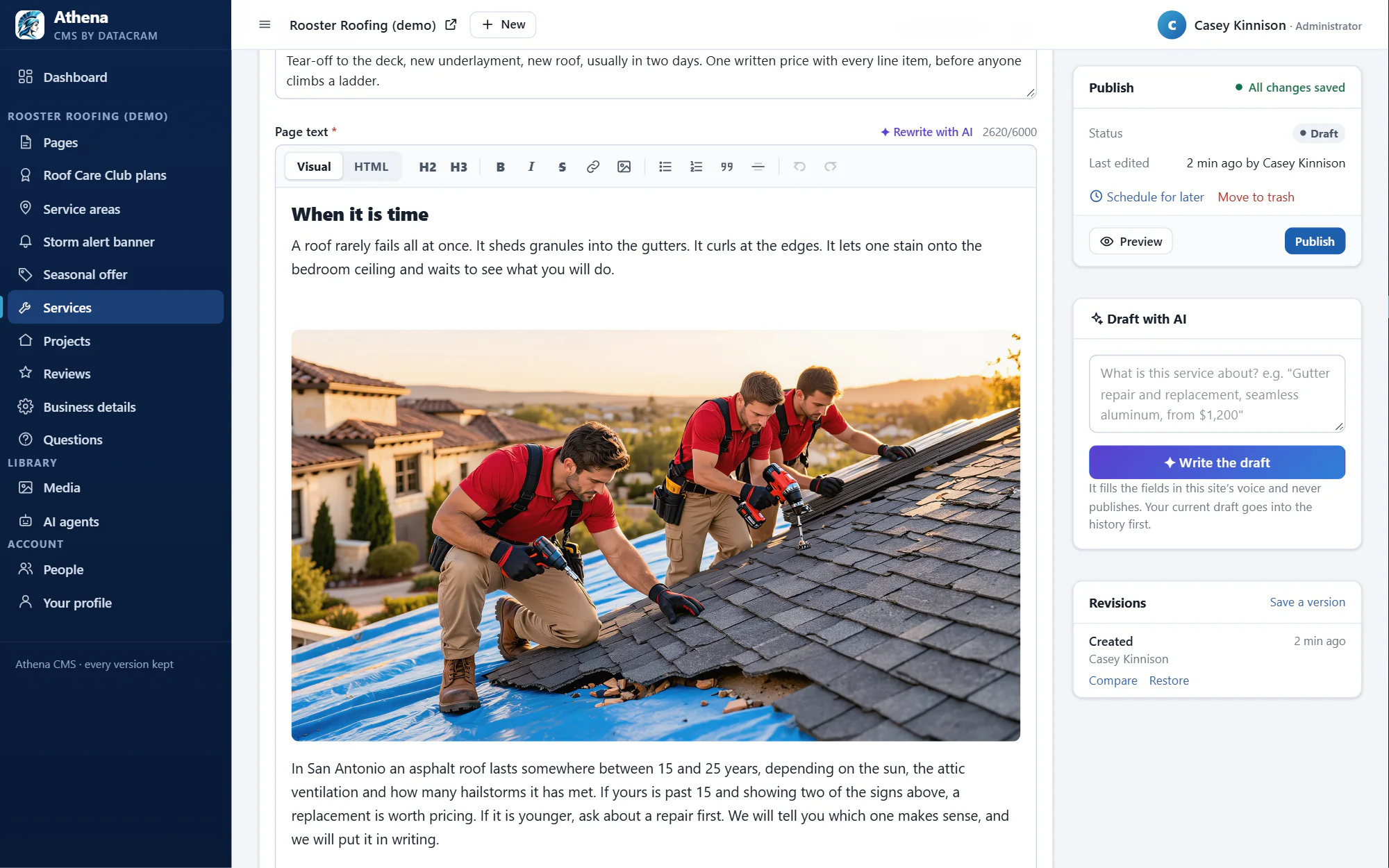
Athena CMS, with AI agents on staff.
Not a theme and not a blank Next.js repo. The content system we put behind every custom site: plain fields, a real preview, every version kept, and AI agents that handle the chores a plugin only nags you about.
- PicassoImages
- ApolloSite analysis
- AresCompetitor watch
- PrometheusContent holes
- AtlasPage depth and structure
- DelphiAI search visibility
and 12 more agents. Two come with Athena; the rest are monthly add-ons.
Mixing the two builders is the expensive compromise
Owners sometimes ask whether they can keep Avada and design new pages in Elementor, usually because a new freelancer prefers it. It is a poor bargain even where it runs. Avada does not list Elementor among its compatible plugins, and two builders on one site means two layout engines, two sets of global styles and two update routines, with each page editable by only one of them. The Elementor theme conflict guide shows what that looks like from the inside, and Avada header not showing covers one of its typical symptoms.
If you are switching, switch fully. Avada layouts stay tied to Avada Builder and its required plugins, so moving to Elementor means rebuilding each designed page, plus finding replacements for the Form Builder and mega menus. The reverse trip is the same work. Elementor's export tool, under Elementor > Editor > Tools > Website Templates, packs content, templates and site settings into a zip. That helps when moving an Elementor site between hosts, not between builders. Our theme migration team does these rebuilds on staging, page by page.
Two builders on one site is not flexibility. It is two landlords for one apartment.
A settings panel against a bare canvas
Avada treats speed as configuration. Global Options > Performance holds a CSS compiler, a JS compiler that combines scripts, Critical CSS, async media-query CSS, jQuery Migrate removal, optional jQuery deferral, font-display and preload settings, lazy loading, offscreen rendering, video facades and emoji removal. The Performance Wizard scans the site for the icons and fonts in use and switches off unused features. ThemeFusion's documentation says good scores are possible but that user content will mostly decide speed, an honest line worth remembering.
Elementor on Hello treats speed as subtraction. Hello ships three small stylesheets and a settings page that can deregister two of them or drop its own header and footer. Elementor then offers Optimized Image Loading, which sets fetchpriority on the LCP image and lazy-loads images below the fold, plus Lazy Load Background Images, Optimized Gutenberg Loading, Inline Font Icons and an external CSS file. Flexbox containers in place of nested sections reduce DOM depth. Elementor's help center also warns that caching plugins deferring its CSS can cause a flash of unstyled content.
Step-by-step tuning for each lives in Avada speed and Hello Elementor speed. If Avada fonts disappear after tuning, start with Avada fonts not loading; for a flicker on Hello, see Hello Elementor CSS not loading.
Matching each one to a real business
Avada suits
- A business that wants one complete site with forms, sliders and a mega menu from a single purchase
- A WooCommerce store that wants custom checkout and thank-you pages without another license
- Owners who prefer a one-time payment to a yearly renewal
- Teams with a developer who will keep Core, Builder and theme in step
Elementor on Hello suits
- A first site on a tight budget that starts free and adds Pro later
- Teams that hire freelancers, since Elementor skills are easy to find
- Marketers who need popups and stored form submissions and will pay for Advanced Solo
- Owners who may change themes later and want their layouts to survive
| Better choice | Reason | |
|---|---|---|
| Single brochure site, minimal budget | Elementor | Free tier and Hello cost nothing |
| Single site that needs everything at launch | Avada | $69 covers builders, forms and bundled plugins |
| Store with custom cart and checkout | Either | Avada includes it; Elementor from Advanced Solo |
| Agency with 20 small client sites | Elementor Expert | $204 a year covers 25 sites; 20 Avada licenses are $1,380 |
| Site sold to paying end users | Not Avada Regular | That needs the $2,950 Extended License |
| Site expected to add features every year | Often neither | See the next section |
Developer help for both is a click away: Avada developer and Elementor developer. Related contests include Avada vs Divi, Bricks vs Elementor and Divi vs Elementor, all listed in the comparisons hub.
Neither box nor kit: when the site should be code
Avada and Elementor solve the same problem from opposite ends: give a non-developer control over a WordPress site's design. When the site's value lies in features rather than layout, both strain. A membership product with billing, a quote engine tied to live inventory, or a few hundred service-area pages generated from data will each become another plugin on Avada and another add-on on Elementor. A Next.js site builds them into one tested codebase, prerendered and served from a CDN, with routing, redirects and metadata in code. It costs more up front and needs a developer for structural changes. Page builder vs Next.js covers the trade in detail.
Your team keeps editing through Athena CMS, which every site we build includes: plain fields, a real preview, every version kept, built-in e-commerce and membership areas with Stripe subscriptions. Prometheus finds customer questions the site does not answer and drafts the page; Delphi tracks how AI search sees you. Theme-level detail is in Avada vs Next.js and Hello Elementor vs Next.js, with the moves in Avada to Next.js and Elementor to Next.js.
Questions people ask before they call
It is not a pairing we recommend. Elementor is not on Avada's ThemeForest compatibility list, and two visual builders on one site double the code, the global styles and the update work. If a designer prefers Elementor, the cleaner route is Elementor on Hello with the Avada pages rebuilt. Elementor theme conflict describes the symptoms of a bad mix.
For one site over several years, usually. Avada is $69 once per site, as of October 2026, while Elementor Pro renews every year at $60 to $84 for one site. Elementor's free tier costs nothing, though, and many simple sites never need Pro. Across many sites, Elementor's Expert plan at $204 a year for 25 sites changes the math. See Avada pricing.
Both can design the whole store. Avada's WooCommerce Builder covers shop, product, cart, checkout and thank-you layouts within the $69 license, and the ThemeForest listing names WooCommerce 7.x to 9.x. Elementor's WooCommerce Builder needs Advanced Solo or higher, $84 a year as of October 2026, and Hello adds no store options of its own. Details are in Avada WooCommerce.
Avada has nothing to stop paying: the license is one-time, updates continue, and only the six months of support run out. Elementor Pro, if not renewed, stops updating and stops letting you add Pro widgets, and existing Pro features may be limited. Elementor also warns that updating the free plugin without Pro can cause compatibility problems. Put the renewal date on a calendar.
It is a rebuild. Posts, pages, products and media stay in WordPress, but layouts made in Avada Builder must be recreated in Elementor, and bundled features like the Form Builder and mega menus need replacements. Count designed pages and templates to size the job. If you are rebuilding anyway, compare it with Avada to Next.js; we keep your URLs and redirect every old one.
Keep reading
- Avada developmentAvada Developer for Hire: Builder Layouts, Global Options and Updates That Stay in StepHire an Avada developer to sync the theme with Avada Core and Builder, apply the 7.16.2 security fix, tidy demo imports and sort out your ThemeForest license.
- Elementor developmentHire an Elementor Developer for Hello, Theme Builder and the Parts Drag and Drop Can't ReachHire an Elementor developer for Theme Builder templates, custom widgets, container conversion and speed settings on Hello. Fixed quote after a free audit.
- Builders under the hoodPage Builder vs Custom Code: Elementor, Divi and a Next.js Build ComparedElementor vs Next.js, Divi vs Next.js: what page builders do to markup and CSS, where your content gets locked, and how editors keep freedom without drift.
- Avada menus on phonesAvada Mobile Menu Not Working: Breakpoints, Scripts and a Hamburger That Ignores YouAvada mobile menu not working? Check the Menu element's collapse breakpoint, container visibility, jQuery and JS compiler settings, and off-canvas triggers.
- Avada performance, by the settingAvada Speed Optimization: Wizard First, Then the Demo You ImportedAvada speed optimization step by step: the Performance Wizard, each Global Options performance setting, bundled sliders, demo bloat and Core Web Vitals fixes.
- Avada, tested by timeAvada Review (2026): The ThemeForest Giant From Day One to Year OneAvada theme review for 2026: who makes and sells it, what $69 covers, the builders, bundled plugins, speed tuning, updates, security and who should skip it.
- Everything in WordPress Theme ComparisonsSee the section
Get a clear pick between Avada and Elementor
Tell us what the site must do and who will run it. We count the licenses, plugins and upkeep each route needs and recommend one, including when the answer is neither.
Which of these sounds like you? (pick any)
Rather talk now? Call (210) 346-0848.