Website design for plumbers · fixed price · 0% financing
Plumber website design that gets the 9 p.m. call
Nobody plans to call a plumber. The website that wins is the one that was ready for the call nobody planned, and that still books the water heater and the repipe the next morning.
Fixed price · 0% financing with 25% down · reply within hours
The 9 p.m. Guarantee Package
A site that answers at 9 p.m., and six months of after-hours intake included, so the call that used to go to voicemail books a job.
- After-hours AI intake for six months: every emergency call answered, qualified and booked with the after-hours fee stated up front
- A published-fees page that names your service call fee and common repair ranges, because the customer who knows the number calls
- Water heater, drain, leak and repipe pages that rank on their own searches
- A map pack tune-up: Google Business Profile rebuilt and a review-request flow set up
Included with any plumbing website build quoted this quarter. The intake line continues month to month after six months if you keep it.
The water heater in the garage
The water heater in a garage in Helotes has been making a sound for a week. At 9 p.m. on a Tuesday it stops making the sound and starts making a puddle. The homeowner turns off what he hopes is the right valve, puts down towels, and searches "emergency plumber near me" with 12 percent battery. He taps the first result with a number and a rating. Four rings, then a recording. He taps the second. A person answers, asks whether the water is off, tells him the after-hours fee, and says a truck can be there by 10:30. He stops searching.
Plumbing is the most emergency-shaped trade in home services, and a plumber's website is judged in that moment on one question: when the water is on the floor, does this company look like it will pick up? The replacement business, the water heater, the repipe and the remodel rough-in are real money, but they walk through the door the emergency opened.
The site on this page is built for the 9 p.m. call first and the 9 a.m. quote second. The plumber marketing guide explains the difference between a repair search and a replacement search; this is the build that catches both.
What your customer does
From the search to the booked job
Every step is a place the site wins the job or loses it. The build is designed around the steps, not around the look.
- 1
The water is on the floor. He searches with 12 percent battery.
The site loads in under two seconds, the number is the biggest thing on the screen, and the words 24/7 and the service area sit beside it.
- 2
He looks for a reason to trust you.
A rating with a count, a license number, a real truck, and the after-hours fee stated plainly. A stated fee reads as honesty; a hidden one reads as a surprise.
- 3
He calls. Someone answers.
In hours, your office. After hours, the intake line: is the water off, where are you, here is the fee, a truck by 10:30. Booked and confirmed by text.
- 4
The next morning, the other customer arrives.
A search for water heater replacement cost lands on a page with a range, a monthly payment and a form. He compares you to two others and picks the one that named a number.
- 5
The review closes the loop.
A text the next day asks for a review that mentions the job. The next 9 p.m. searcher reads it.
What a plumber website has to have
- The number as the biggest thing on the screen, with 24/7 and the service area beside it, on every page.
- Published fees: the service call, the after-hours premium, common repair ranges. The customer who knows the number calls.
- One page per service: water heaters, drain cleaning, leak detection, repiping, sewer lines, emergency, remodel rough-in.
- A water heater page with a replacement range and a monthly payment, for the search that is comparing, not panicking.
- After-hours answering that books, not a voicemail that loses.
- Neighborhood service-area pages, because plumbing searches are hyper-local and the map pack rewards the specific.
- Reviews that mention the job: the 9 p.m. save, the clean install, the tech who explained the valve.
- Tracking that shows which page and which search produced each call.
What is included in the build
Emergency-first layout
The number, 24/7 and the area above the fold. Tap to call on every page.
After-hours AI intake
Answers, qualifies, states the fee, books the slot, texts a confirmation. Six months included.
Published fees page
Service call, after-hours premium and common ranges, written so they earn trust.
Service and neighborhood pages
Water heaters, drains, leaks, repipes; and a page for each neighborhood you cover.
Map pack tune-up
Google Business Profile rebuilt, categories set, a review flow that runs itself.
Tracking to the call
Every call and form tied to the page and the search that produced it.
Built by us, running today
Work you can click on
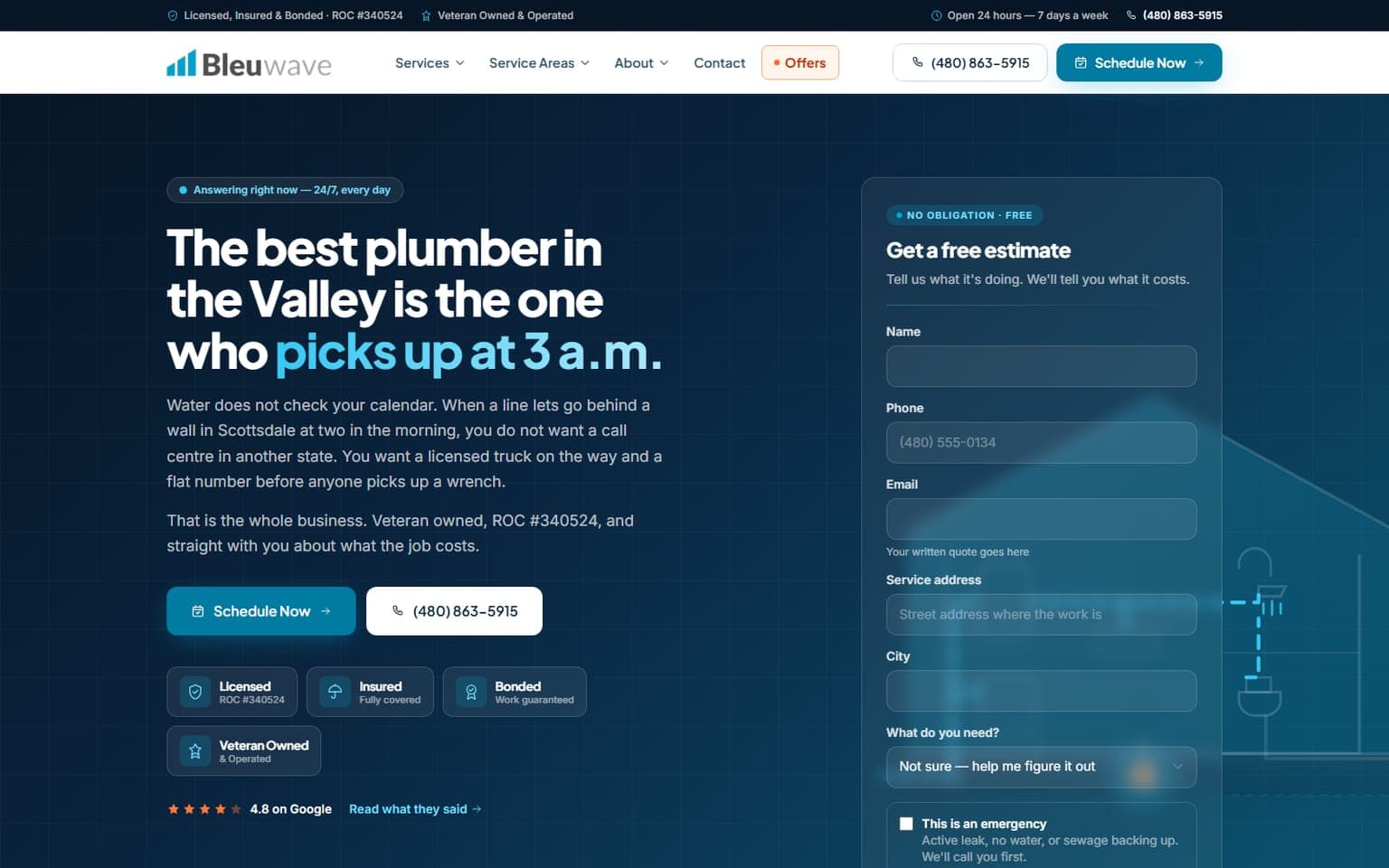
Bleuwave Plumbing — Redesign & Emergency Triage
Phoenix, AZ · Metro

Precision Leak Detection
Phoenix, AZ · Metro
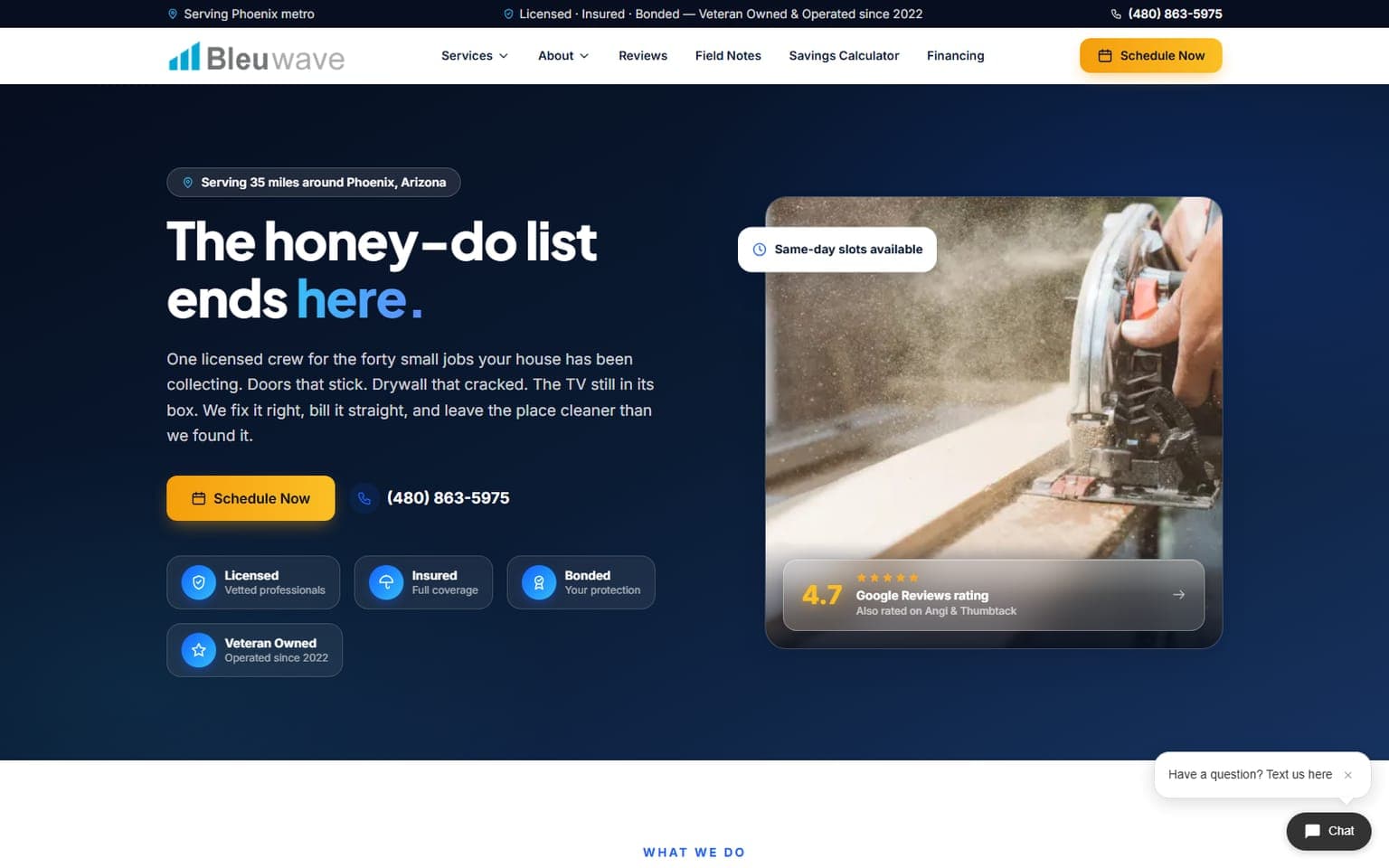
Bleuwave Handyman — Redesign & Savings Calculator
Phoenix, AZ · Metro
See the full portfolio, including seven complete demo sites.
What it costs
A fixed price, and a monthly number
A plumbing website built this way is a fixed price, quoted after a short call, most often between $6,500 and $16,000. The number moves with the count of service and town pages, whether the copy exists, and what the estimate flow has to do. It does not move with the design; the design is the part we are best at and the part that costs the least.
The price includes everything on this page and the offer above it. Local marketing and SEO are monthly, with a defined scope and no long contract, and you can add them later. Any build qualifies for 0% financing with 25% down. The worked example beside this shows what a typical plumbing project runs month to month.
A worked example at 0%
$10,000
- 25% down at signing
- $2,500
- Or 12 monthly payments of
- $625
- Interest
- $0
Financed projects are hosted on the DataCram platform for the length of the plan. Try your own number.
What happens after you claim it
Claim the offer
Two minutes on the form, or a call. Tell us the trade, the towns and what you have now.
A person looks first
We check your current site, your Google profile and what a customer in your area sees when they search. Then you get a fixed number.
The build, four to eight weeks
Copy written from your jobs, real photos, the estimate flow, the pages for each service and town, tracking installed.
Launch, then the offer kicks in
The included extras go live with the site. From then on one monthly report shows the calls and forms it produced.
Get the 9 p.m. Guarantee Package quoted
Tell us the neighborhoods you cover and how calls are handled now. A person calls back with a fixed number and the intake line written into it.
Which of these sounds like you? (pick any)
Questions, answered
Before you ask
Yes, at least the service call fee, the after-hours premium and ranges for common jobs. The customer who sees a number calls; the customer who sees nothing assumes the worst and calls someone who told him. You keep control of every figure and can change them any time.
A call after hours is answered by an AI line that asks whether the water is off, where the customer is and what is happening, states the after-hours fee, books an available slot and texts a confirmation. Anything unusual is routed to a person. It is included for six months with the build.
Plumbing searches are hyper-local, and the map pack ranks by distance and relevance. A page about Stone Oak or Helotes, with something true about its housing and your jobs there, ranks for searches a city page cannot, and it tells the searcher you are close.
Yes. Forms, bookings and intake calls can feed ServiceTitan, Housecall Pro, Jobber and most dispatch tools, so a lead becomes a ticket without retyping.
Most run between $6,500 and $16,000 as a fixed price, depending on the service and neighborhood pages and the estimate flow. The build qualifies for 0% financing with 25% down, so a $10,000 site is $2,500 down and $625 a month for twelve months.
Start now. Pay monthly. Add nothing for interest.
Put 25% down at signing and spread the rest in equal monthly payments. The total you pay is the price on the proposal.
- Up to 12 months on any project
- 24 months from $15,000
- 36 months from $20,000
Financed projects are hosted on the DataCram platform for the length of the plan.