Voice Search Statistics: Which Numbers Are Real and Which Are Recycled
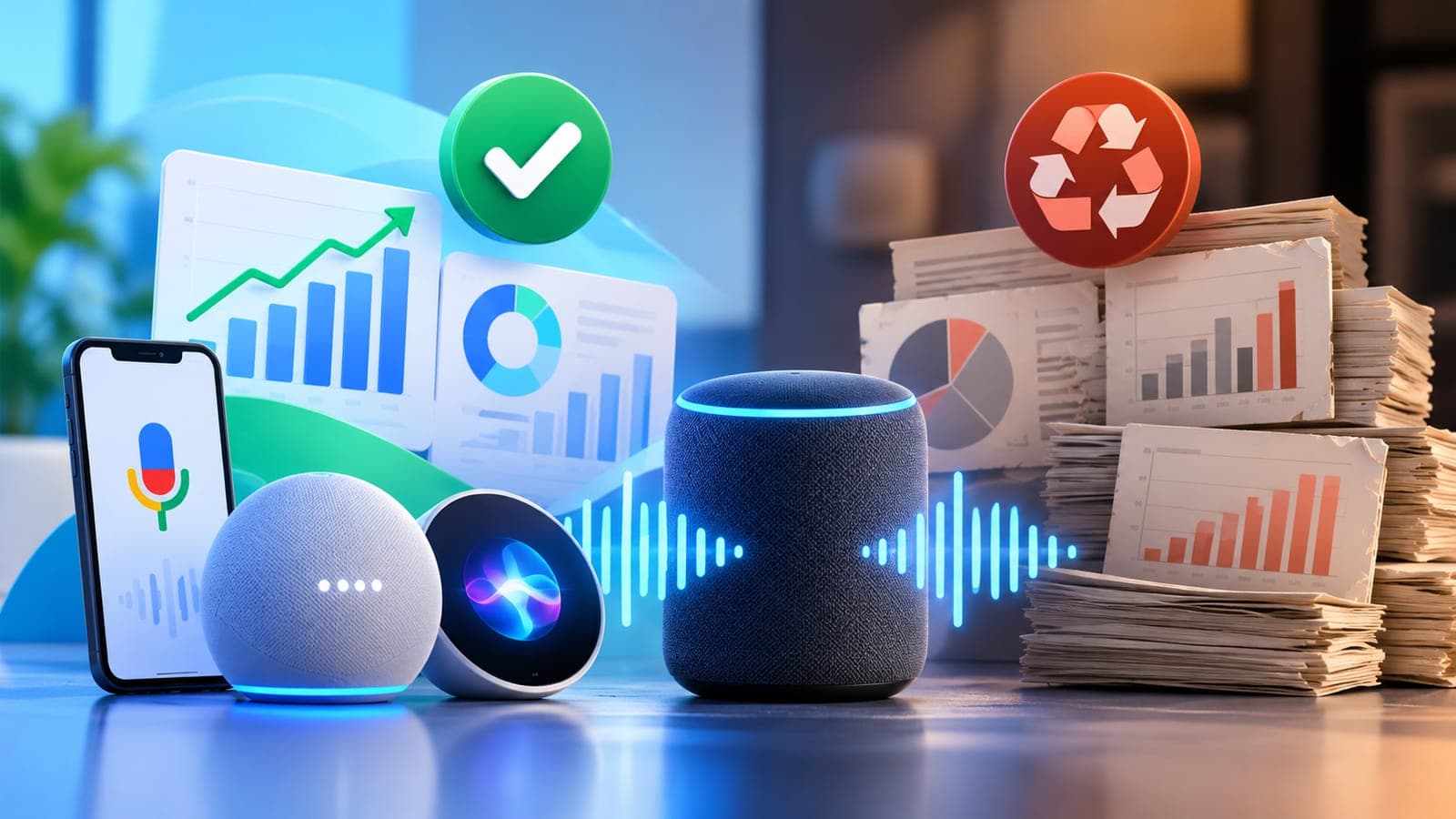
Nearly every sales pitch for voice search opens the same way. A big round number, a confident verb, a famous name in parentheses. "50% of all searches will be voice by 2020 (comScore)."
The year 2020 came and went. The number kept coming. It still turns up in proposals, slide decks and cold emails to dental offices, usually with the year quietly removed.
It is worth following that number home, because the trip teaches you how to read all the others. Then we'll go through the voice statistics that hold up, what each one actually measured, and what a business owner should do with any of them.
The most famous voice statistic was never a voice statistic
In September 2014, Andrew Ng, then chief scientist at Baidu, the Chinese search engine, spoke at a Gigaom meetup on deep learning. VentureBeat reported his prediction that within five years, "50 percent of queries will be on speech or images."
Read that slowly. It was a forecast, not a measurement. It lumped speech and images together. It came from an executive at a search company in China, a market with its own habits around typing and talking to phones. And "five years" was a guess about the future made by a person whose job was to build that future.
Then the sentence started to travel.
Marketer Thomas Haynes traced the trail in a January 2021 write-up, and it reads like a game of telephone. In April 2016, Campaign, a marketing trade magazine, wrote that comScore said half of all searches would be voice by 2020. There was no link to anything comScore published. In June 2016, Mary Meeker's widely read Internet Trends report cited Ng by name but framed the forecast as "by 2020," which is how CNBC headlined it. "Five years" had become a date, and "speech or images" kept getting trimmed to "voice."
From there it went into the blogs. A 2018 marketing post repeated the comScore version and linked to the Campaign article. A 2020 statistics roundup repeated the 2018 post. And in December 2020, the month the forecast was supposed to come true, Haynes found The Drum crediting Adobe with the finding that nearly half of searches were already voice, linking back to the roundup. A prediction had turned into a fact, and the fact had a new owner.
Search marketer Brodie Clark asked comScore about it directly and published the answer: comScore says it never released the statistic.
Nobody in that chain set out to lie. Each writer cited the writer before them, and each citation made the number look a little more solid. That is how a statistic gets laundered. It passes through enough respectable-looking hands that nobody remembers where it was picked up.
How a number gets laundered
The pattern repeats often enough to have stages.
- A real source says something narrow. A forecast. A survey of a thousand people. One company's number for one app in one country.
- A summary drops the qualifiers. "Speech or images" becomes "voice." "Within five years" becomes "by 2020." "Respondents said" becomes "consumers do."
- A listicle collects it. "87 Voice Search Statistics You Need to Know." The listicle cites the summary, not the source, and files it beside dozens of other orphans.
- The listicle ranks. Because it ranks, the next writer finds it, cites it, and never clicks past it.
- The attribution drifts. The number attaches itself to a bigger name, because a bigger name looks better on a slide.
- The date falls off. A 2016 claim appears in a 2026 sales email with no year at all, so it sounds like news.
You don't need to be a researcher to spot this. You need to be the person in the room who asks where it came from.
The famous voice numbers, checked
Here are the voice statistics that show up most often in pitches and articles, set against what the original source actually said.
| The claim as it's usually repeated | What the source actually said | Source and year |
|---|---|---|
| "50% of searches will be voice by 2020" | Half of queries would be speech or images within five years, as a forecast | Andrew Ng of Baidu, 2014 (not comScore) |
| "30% of searches will be screenless by 2020" | 30% of web browsing sessions would be done without a screen by 2020, as a forecast | Gartner prediction, October 2016 |
| "20% of searches are voice" | 1 in 5 queries on Google's mobile app on Android, in the US, were voice | Sundar Pichai at Google I/O, May 2016 |
| "58% of consumers use voice to find local businesses" | 58% of 1,012 US adults said they had done it at least once in the past 12 months | BrightLocal survey, April 2018 |
| "There will be more voice assistants than people" | A forecast of 8.4 billion devices with an assistant in use by 2024 | Juniper Research, April 2020 |
| "Voice answers are 29 words long" | The average answer across 10,000 Google Home results was 29 words | Backlinko study, February 2018 |
Every row is real. Every row is narrower than the way it usually gets quoted.
The Gartner figure was a prediction about browsing sessions, not searches. It was presented at Gartner's own conference as one of its strategic predictions, which is a forecast, not a count.
The Google figure is the strongest of the six, because it came from the one company that could actually count. It also described a single app, on a single operating system, in a single country, a decade ago.
The BrightLocal figure comes from a survey. People told an online panel what they remembered doing, which is different from what they did, and "at least once in the past year" is a low bar. The same survey found 46% of voice search users said they searched for a local business every day. That is a self-reported number about a subset of a subset, and it has been quoted for years as though it described everyone.
The Juniper forecast counts devices with an assistant built in, whether or not anyone ever speaks to them. Nearly every smartphone ships with one. That doesn't make every smartphone owner a voice searcher.
The Backlinko study holds up for what it measured. But it is from 2018, it looked at one device, and it predates Gemini, Apple Intelligence and the rebuilt Alexa. Treat 29 words as a sensible target for an answer meant to be read aloud, not as a law.
One number that is current and honest
If you want a single defensible figure about voice devices in American homes, use Edison Research's Infinite Dial survey. It is a nationally representative study of Americans 12 and older that Edison has run every year for decades, with its methods published alongside the results.
The 2025 edition found that 35% of Americans 12 and older said they owned at least one smart speaker, roughly 101 million people. It also noted that ownership had hovered around one third for four years running.
That is a useful corrective to the hype. Smart speakers did not take over. They settled in. About a third of the country owns one and uses it for music, timers, weather and, now and then, finding a business. For a local business, the bigger channels for spoken questions are the phone in a pocket and the dashboard of a car, which is why voice search in the car and the newer always-on assistants deserve more of your attention than the speaker on the counter.
Note what we don't have, too. There is no trustworthy, current, public figure for the share of all searches that are spoken. Google's 2016 number is the last first-party figure we can find that was widely reported. Apple and Amazon don't publish one. If someone quotes you a precise current percentage for "voice share of search," ask where it came from, and expect a pause.
How to judge a statistic in under a minute
You don't need a research department. You need five questions.
1. Who measured it?
Name the organization that collected the data. If the citation is another blog post, a listicle, or "studies show," you haven't found the source yet. Keep clicking until you reach the people who did the counting, or until the trail goes cold. A cold trail is an answer.
2. When?
Voice assistants have been rebuilt in the last few years around large language models. A 2018 number describes a different set of products, used by a different set of people, answering in a different way. Old numbers can show direction. They can't describe today.
3. Was it measured, surveyed or forecast?
These are three different things, in descending order of reliability. Measured means a company counted actual behavior in its own logs. Surveyed means people reported what they remember doing. Forecast means someone guessed. A large share of the voice statistics in circulation are forecasts dressed up as measurements.
4. Of whom, and how many?
Which country, which device, which age group, how many people. A survey of 1,012 American adults can be perfectly sound. It is still a survey of 1,012 American adults, not "consumers."
5. What exactly was counted?
Queries, browsing sessions, devices and people are four different units. "Speech or images" is not "voice." "Used at least once" is not "uses regularly." Most laundering happens right here, in the noun.
And a bonus rule: if a statistic is a round number tied to a year that has already passed, smile and move on.
What the numbers can't tell you, and why you don't need them
Here is the useful part. You don't need a statistic to decide whether voice matters to your business. You need one fact you can check for yourself.
When someone asks a phone, a speaker or a car for a business like yours, the assistant reads a listing and names one business, often offering to call it. Whether spoken searches are 10% of the total or 40%, each one is winner-take-all. A taco shop that is missing from Apple Maps doesn't lose a little visibility on that question. It loses the whole question.
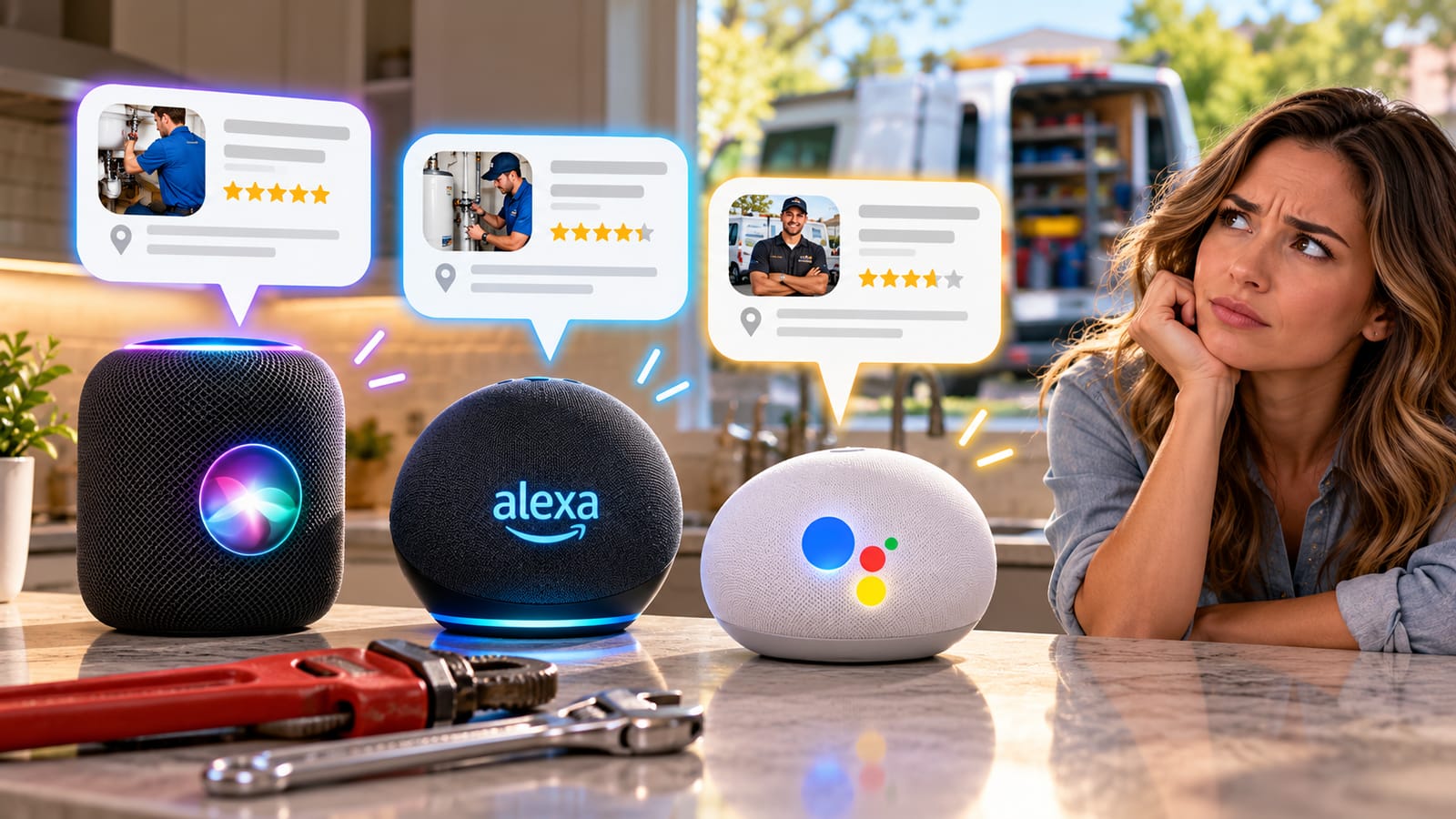
That is a decision you can make without a single laundered number. Find out what Google, Apple and Yelp say about you, make them agree, and put clear answers on your website. Our guide to voice search for local businesses lays out the whole job, and near me voice searches covers the questions that matter most for walk-in and call-in businesses. The mechanics of getting your business on Siri are free and take an afternoon. If you're curious why three assistants can give three different answers to the same question, we wrote about that in Siri, Alexa and Google don't agree on the best plumber.
And when a vendor's pitch opens with "half of all searches are voice," you now know what to do. Ask the five questions. Then ask which of your listings they plan to fix. If the second answer is as vague as the first, here's what's usually wrong instead.
Frequently asked questions
Is it true that 50% of searches are voice searches?
No. The figure traces back to a 2014 forecast by Andrew Ng, then at Baidu, that half of queries would be speech or images within five years. It was later credited to comScore, which says it never published it, and pinned to 2020. No reliable public measurement shows half of all searches are spoken.
What percentage of searches are voice searches today?
No one publishes a trustworthy current figure. The last widely reported number from Google itself came in 2016: about 1 in 5 queries on its mobile app on Android, in the US, were voice. Apple and Amazon don't publish comparable data. Treat any precise current percentage with suspicion until you see the original source.
How many Americans own a smart speaker?
Edison Research's Infinite Dial 2025 survey found that 35% of Americans 12 and older own at least one smart speaker, roughly 101 million people. The same report noted ownership had stayed near one third for four years, which suggests the category has leveled off rather than kept growing.
Are voice search statistics from 2018 still useful?
Some are, for direction. Most describe assistants that have since been rebuilt, so their specific percentages are stale. A 2018 survey can tell you people were already using voice to find local businesses back then. It can't tell you how often they do it now, or how today's assistants pick which business to name.
Should a small business bother with voice search if the numbers are inflated?
Yes, but spend on the right things. The case doesn't rest on market share. It rests on how voice answers work: one business named, often dialed directly. Accurate listings on Google, Apple, Yelp and Bing, plus clear answers on your website, cost little and help in ordinary search too.
Check the facts that actually matter
Skip the statistics and check the records. Our free Voice Search Visibility Check looks at your business across Google, Apple Maps, Yelp and your website, the places assistants actually read, and shows you where the details disagree. It takes a few minutes and involves no percentages of anything.
If you'd rather hand the whole job to someone who will log into every dashboard and fix what's wrong, that is our voice and ambient assistant optimization service. We'll even skip the slide about 2020.

 SEO that keeps working