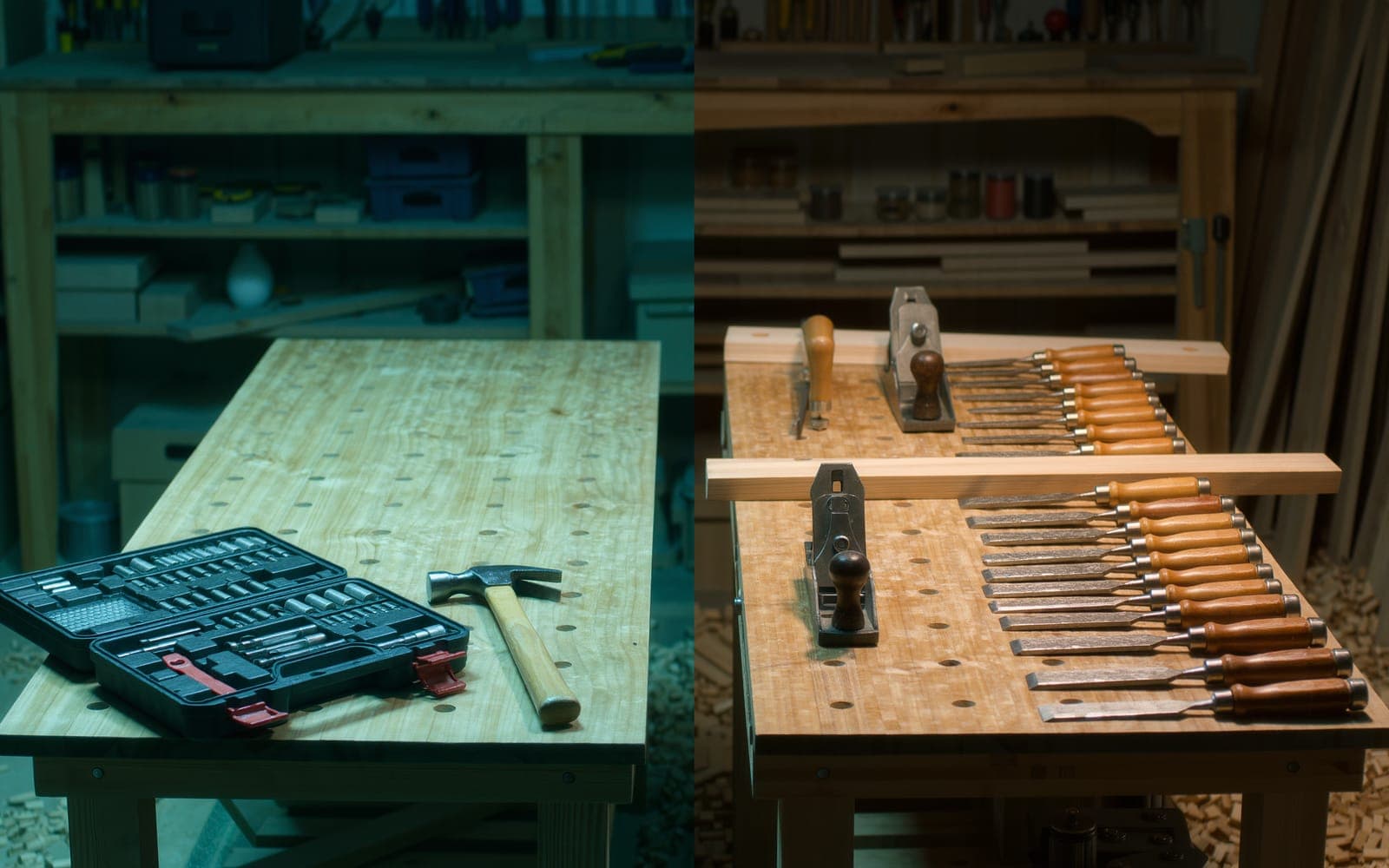
In short
- Airo produces a real, presentable site in minutes from a sentence and a business name. That part works.
- What it produces is a front desk: a home page, a few sections, generic copy. Nothing behind it that gets found or gets the call.
- The ceilings are the builder's ceilings: speed, search structure, features, ownership. The AI does not raise them.
- It is a fine placeholder for a business that needs to exist online this afternoon. It is not a growth plan.
- The honest comparison is not Airo versus custom. It is Airo now, then custom when the business can afford to be found.
A sentence goes in, a website comes out
A plumber in Boerne types "plumbing company in Boerne, Texas, family owned, emergency service" into a box. Forty seconds later there is a website. It has a hero image of a wrench that looks like a wrench, a headline that mentions Boerne, three service cards, a paragraph about being family owned, a contact form and a footer. It is not ugly. It is, by the standards of the template era, quite good.
That is GoDaddy Airo, and the marketing behind it is worth a minute of your attention, because a company does not hire a movie star to sell a product it expects you to think hard about. We wrote about the campaign when it launched, in the post about the ad and the show its star is famous for, and the short version is that a beautiful front desk with nothing working behind it is a genre with a long history.
This guide is the practical version. What Airo builds, what it cannot build, who should use it anyway, and what the honest alternative costs. It is a companion to the Wix and Squarespace guides, because underneath the AI, Airo is a GoDaddy website builder with a faster first hour.
The AI writes the first draft of a template. It does not write the parts of a website that make the phone ring.
What Airo actually gives you
Credit where it is due. Airo does three things faster than any tool before it.
The first hour. A domain suggestion, a logo, a color scheme, a home page with sections and copy, all from one sentence. A business that had nothing has something, and the something is coherent. For a new business that needs a URL on a business card by Friday, this is a real service.
The copy. The generated text is grammatical, on topic and roughly what a template's placeholder paragraphs would say if someone had bothered to fill them in. It mentions your town. It lists your services. It is, in the flattest sense of the word, fine.
The extras. An email address on the domain, a social media post generator, a logo you can put on a truck. Small things, bundled, for a monthly fee.
Here is what the sentence did not contain, so the AI could not build it: the nineteen questions your customers ask before they call, the after-hours fee, the towns you actually drive to, the photos of last week's job, the reviews that mention the street, the reason a homeowner should pick you over the two other tabs open on her phone. Airo builds a website about a plumbing company. It cannot build a website about yours, because it has never met you.
The ceilings, which are the builder's ceilings
Strip away the AI and Airo is GoDaddy's website builder. The generated site lives inside it, edits inside it, and inherits its limits. They are the same four limits every builder has, and the DIY versus professional guide covers them in general. Here is how each one lands on an Airo site specifically.
Airo against a custom build
| GoDaddy Airo | Custom site | |
|---|---|---|
| First site live | Under an hour | Four to eight weeks |
| Copy | Generic, generated from a sentence | Written from your jobs, your calls and your towns |
| Speed on a phone | The builder's, usually three to five seconds | Under two seconds, measured |
| Search structure | One page per template section; limited titles, headings and schema | A page per service and town, structured data, internal links |
| Features | What the builder offers: forms, a store, a booking widget | Whatever the business needs: estimate tools, intake, integrations |
| Ownership | Rented; the site lives in GoDaddy's builder | Yours: code, domain, hosting in your name |
| Cost | A monthly fee for as long as the site exists | A fixed price, then hosting; 0% financing available |
Builder speeds vary by template and by what you add; the point is that the floor is set by the platform, not by anything you do.
Who should use Airo anyway
A tool with ceilings is not a bad tool. It is a tool for the jobs beneath the ceilings, and there are several.
Airo is a reasonable choice when
- The business does not exist yet and needs a URL, an email and a page that says what it is, this week.
- Referrals bring all the work and the site is a place people check after they have already decided.
- The budget is genuinely zero beyond a monthly fee, and the alternative is no site at all.
- It is a side business whose owner will not be searching for customers online.
- It is a placeholder while a real site is being built, which is the best use of it there is.
Airo is the wrong choice when
- The phone has to ring from search. The site cannot rank for the searches that pay, and the copy gives a visitor no reason to call.
- You compete with businesses that have real sites. Theirs load faster, say more and prove more; a visitor comparing tabs notices.
- You need a feature the builder does not have: an estimate tool, after-hours intake, a customer portal, a real booking flow.
- You want to own what you paid for. The site cannot leave the builder. The technology guide explains what ownership means and why it matters the day you want to move.
The honest comparison is a sequence, not a choice
Most owners treat this as Airo versus custom, one or the other, forever. It is not. The useful way to see it is as a sequence.
Day one, when the business has a name and a truck and nothing else, an AI builder is a perfectly good way to exist online by dinner. Nobody should spend six thousand dollars on a site for a company that has not sent its first invoice.
The day the business needs the site to produce, the calculation flips. A site that costs a modest monthly fee and produces nothing is more expensive than one that costs a fixed price and produces calls, and the guide to what a website is worth shows the arithmetic. That day arrives sooner than owners expect, usually the first month they notice a competitor with a worse truck and a better site getting the jobs.
When it arrives, the move is not to fight the builder. It is to keep the domain, which you own, and put a real site behind it: a page for each service and town, copy written from your actual jobs, speed in the green, tracking installed. The custom website cost guide shows where the money goes, and 0% financing with 25% down turns the number into a monthly payment that the site's first few jobs cover.
< 1 hr
To an Airo site that exists
4–8 wks
To a custom site built for your searches
1
Page an Airo site can realistically rank for
20–40
Pages a service business site launches with
If you already built one
Good. You have a domain, a logo and a sense of what you want the site to say, which is more than most people bring to a first call. Keep the domain in your own GoDaddy account; it transfers or points anywhere.
Run the free audit on the Airo site. It will show the speed and the search structure in numbers, which is a more useful conversation than taste. Then, when you are ready, the free mockup shows what the same business looks like designed from the searches backward. You keep the mockup either way, and you will be able to see the difference from across the room.
Find out what your site is actually doing.
A free audit scores your site on speed, mobile, SEO and security, and lists the fixes in order of what they are worth. Delivered as a PDF to your inbox.
Go deeper
- GoDaddy hired Walton Goggins to sell you a websiteThe campaign, the show, and the front desk with nothing behind it
- Should you build your own website?The honest math on hours and ceilings
- How many pages a business site needsWhy one page cannot rank for what you sell
- Custom website vs. page buildersThe service-side comparison
Want an honest answer on building it yourself?
Tell us where you are and we will tell you, plainly, whether a builder will do the job or whether it is time for a real one. No pitch, and you keep the answer.
Which of these sounds like you? (pick any)
Questions people ask
Straight answers
It is good at making a small business exist online quickly: a domain, a logo and a presentable home page from one sentence. It is not good at making a business found or called, because it builds one generic page inside a builder with the usual speed and search limits. For a placeholder, yes. For a site that has to produce, no.
For the business name, usually. For the searches that pay, such as a service plus a town, rarely, because ranking for those takes a page per search, structured data, speed and local proof, none of which the AI generates and the builder makes hard to add. A custom site is built around those searches from the start.
Airo is a monthly subscription for as long as the site exists, typically in the tens of dollars. A custom small business site is a fixed price, most often $6,000 to $20,000, then hosting. The comparison that matters is cost against calls produced; a cheap site that produces nothing is the expensive one.
You can move the domain, which you own, and reuse the logo and any copy worth keeping. The site itself cannot leave the builder, so the pages are rebuilt. That is normal; the useful assets from an Airo site are the name, the domain and the clarity about what you want, and those transfer.
For a brand-new business with no budget, that is a sensible sequence: exist online now, build properly when the business needs the site to produce. Keep the domain in your own account, avoid buying add-ons you will not take with you, and treat the upgrade as a when, not an if.
Where to go from here