Website design for roofing companies · fixed price · 0% financing
Roofing website design built for the week after the hail
The storm chasers arrive by dinner with magnetic door signs. The local roofer who wins that week built the website in the spring. This is that website.
Fixed price · 0% financing with 25% down · reply within hours
The Storm-Ready Build
Every roofing site we build this season ships with the storm pages already live, before the first hail falls.
- A storm-response landing page, built and indexed ahead of the season, ready to be switched to the day's storm in minutes
- An insurance-claim explainer page that answers the questions homeowners ask before they sign anything
- A free inspection request form that asks for the address and a photo, and reaches you in seconds
- A geofenced hail ad campaign set up at no charge, so the neighborhoods that were hit see you first
Included with any roofing website build quoted before storm season. Ad spend is paid to Google from your own account; setup and the pages are ours.
The eleven minutes that decide the year
A spring cell drops golf-ball hail across the north side of a Texas city for eleven minutes. By dinner every homeowner in twelve neighborhoods is in the driveway looking up. By morning, crews from three states away are knocking doors with a clipboard and a promise to "handle the insurance." Within two weeks they have signed a third of the roofs in the area, and within a year many of those homeowners are trying to reach a company that no longer answers the phone.
The local roofer with ten years in the market should win every one of those jobs. He often does not, because on the night of the storm his website says "Quality roofing since 2011" and nothing about hail, inspections, insurance or the fact that he will still be here in five years. The storm chaser's landing page, built for exactly this night, says all of it.
The site on this page is built for the night of the storm and for the quieter months around it: the replacement customer comparing three bids at the kitchen table, the commercial manager with a flat roof that is patient until it is not. The roofing marketing guide covers the season in full; this is the build that puts it on your side.
What your customer does
From the search to the booked job
Every step is a place the site wins the job or loses it. The build is designed around the steps, not around the look.
- 1
The storm passes. He searches from the driveway.
The storm page is already indexed. It names the date, the neighborhoods, what to look for on the roof, and offers an inspection today. A number and a form sit at the top.
- 2
He compares you to the door-knocker.
Your page shows a local address, years in the market, a license, drone photos of roofs in his zip code and reviews that name the street. The clipboard cannot compete with that.
- 3
He asks about insurance.
The claim explainer answers the questions he was going to ask: what a deductible is, what a roofer can and cannot legally do with it in Texas, how the adjuster meeting goes, what you handle and what he signs.
- 4
He requests the inspection.
Address, phone, a photo from the yard. The request reaches you in seconds and the reply promise on the page is kept.
- 5
The replacement customer arrives in the quiet months.
A page for replacement with a range, financing and a gallery of finished roofs. A commercial page for the flat-roof manager. Each ranks on its own.
What a roofing company website has to have
- A storm-response page built before the season, indexed and waiting, switchable to the day's storm in minutes.
- An insurance-claim explainer that is honest about the law: no deductible waivers, no promises a roofer cannot keep.
- Drone and before-and-after galleries, sorted by neighborhood, because a homeowner wants to see a roof like his.
- One page per service: replacement, repair, storm damage, metal, commercial, gutters, inspections.
- Local proof up front: the address, the years, the license, the reviews that name streets.
- A replacement page with a range and a monthly payment, for the customer comparing bids.
- An inspection request that takes thirty seconds and a reply promise you keep.
- Service-area pages for the towns and suburbs you cover, each with something true about its housing.
What is included in the build
Storm-response page
Built and indexed ahead of the season. Switch the date and neighborhoods the morning after.
Insurance-claim explainer
The questions homeowners ask before signing, answered plainly and lawfully.
Galleries by neighborhood
Drone and before-and-after photos a homeowner can find by zip code.
Service and town pages
Replacement, repair, storm, metal, commercial; and a page for each town.
Geofenced storm ads
Set up at no charge, aimed at the neighborhoods that were hit.
Tracking to the call
Inspection requests and calls counted by page and source.
Built by us, running today
Work you can click on
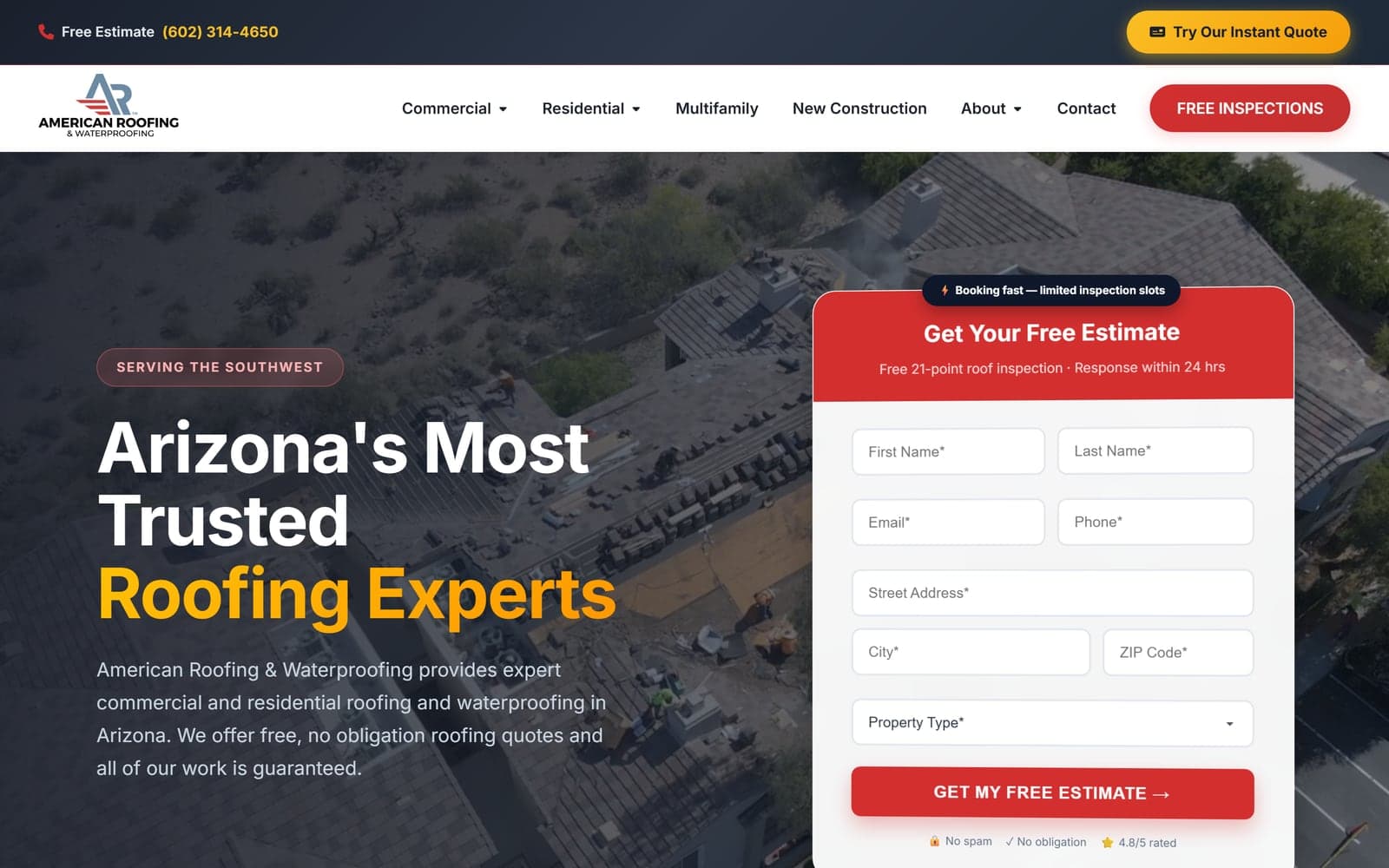
American Roofing & Waterproofing
Phoenix, AZ · Southwest
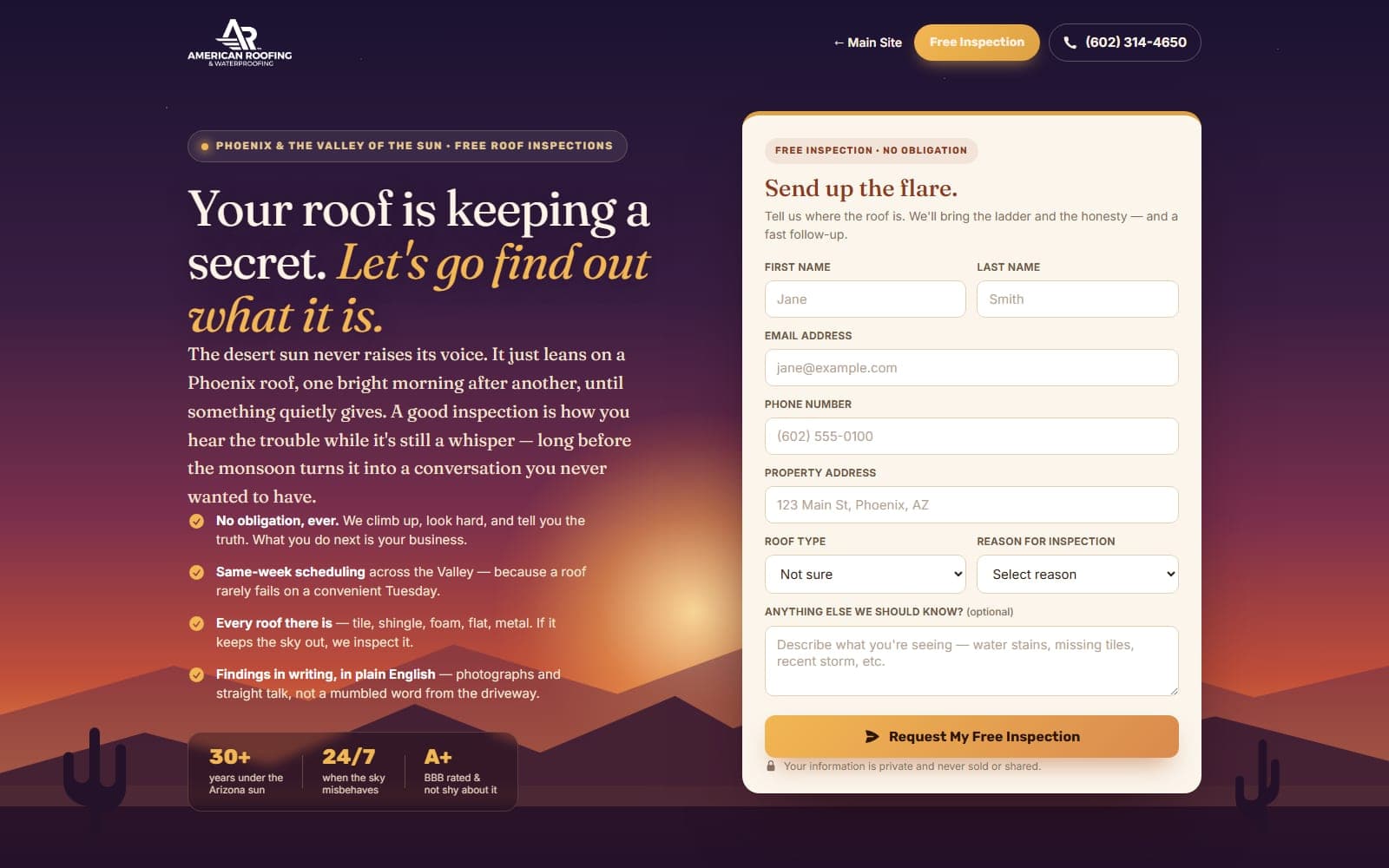
Free Roof Inspection
Phoenix, AZ · Southwest
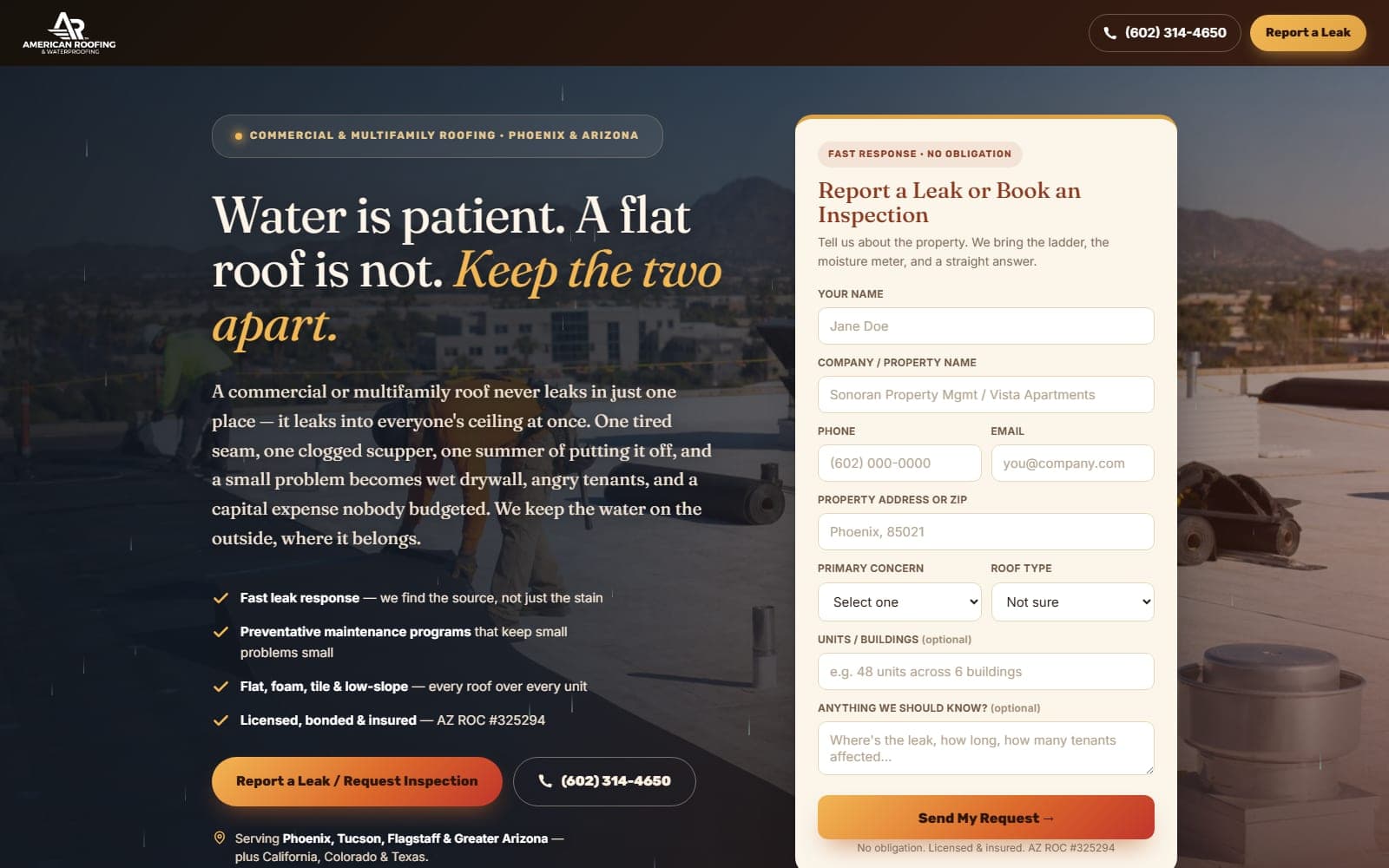
Commercial & Multifamily Roofing
Phoenix, AZ · Southwest
See the full portfolio, including seven complete demo sites.
What it costs
A fixed price, and a monthly number
A roofing website built this way is a fixed price, quoted after a short call, most often between $7,000 and $20,000. The number moves with the count of service and town pages, whether the copy exists, and what the estimate flow has to do. It does not move with the design; the design is the part we are best at and the part that costs the least.
The price includes everything on this page and the offer above it. Local marketing and SEO are monthly, with a defined scope and no long contract, and you can add them later. Any build qualifies for 0% financing with 25% down. The worked example beside this shows what a typical roofing project runs month to month.
A worked example at 0%
$14,000
- 25% down at signing
- $3,500
- Or 12 monthly payments of
- $875
- Interest
- $0
Financed projects are hosted on the DataCram platform for the length of the plan. Try your own number.
What happens after you claim it
Claim the offer
Two minutes on the form, or a call. Tell us the trade, the towns and what you have now.
A person looks first
We check your current site, your Google profile and what a customer in your area sees when they search. Then you get a fixed number.
The build, four to eight weeks
Copy written from your jobs, real photos, the estimate flow, the pages for each service and town, tracking installed.
Launch, then the offer kicks in
The included extras go live with the site. From then on one monthly report shows the calls and forms it produced.
Get the Storm-Ready Build quoted
Tell us the towns you cover and what you have now. A person calls back with a fixed number and the storm pages written into it.
Which of these sounds like you? (pick any)
Questions, answered
Before you ask
Yes. It is built with the structure, the copy and the inspection form in place, indexed by Google, and waiting. The morning after a storm we, or you, change the date and the neighborhood list and it is live within minutes. Building it after the storm means it ranks a week too late.
Everything a homeowner needs to understand the process: what a deductible is, how the adjuster visit works, what you handle. It will not offer to waive or absorb deductibles, which is illegal in Texas and several other states, and it says so. That honesty is part of why homeowners trust it over the door-knocker.
Yes. A commercial page speaks to a facilities manager, not a homeowner: flat-roof systems, maintenance programs, minimal disruption, references. It ranks on its own and keeps the residential pages focused.
By neighborhood and by job type, with drone shots, before-and-after pairs and a line about each roof. A homeowner searching after a storm wants to see a roof on a street like his, and a gallery sorted that way is the fastest proof there is.
Most run between $7,000 and $20,000 as a fixed price, depending on the page count, the galleries and the estimate flow. The build qualifies for 0% financing with 25% down, so a $14,000 site is $3,500 down and $875 a month for twelve months.
Read before you decide
Start now. Pay monthly. Add nothing for interest.
Put 25% down at signing and spread the rest in equal monthly payments. The total you pay is the price on the proposal.
- Up to 12 months on any project
- 24 months from $15,000
- 36 months from $20,000
Financed projects are hosted on the DataCram platform for the length of the plan.