Website design for general contractors and remodelers · fixed price · 0% financing
Contractor website design that wins the kitchen-table bid
Three bids on the kitchen table. The homeowner opens three websites to break the tie. This is the one that shows the last ten projects, names the license, and makes the deposit easy to say yes to.
Fixed price · 0% financing with 25% down · reply within hours
The Ten-Project Gallery
We build ten project pages from your photos, included, so the homeowner comparing bids can see ten jobs like hers.
- Ten project pages, each with the problem, the fix, the photos and a line about the neighborhood, written by us from your pictures and notes
- A financing page with a calculator, so a $60,000 remodel reads as a monthly number
- An estimate flow that asks the right questions and attaches photos, so the first call is a real conversation
- A license, insurance and warranty block on every page, above the fold
Included with any contractor website build quoted this quarter. Additional project pages after the first ten are added at a per-page rate.
Three bids and a website
The bids are on the kitchen table. They are within eight thousand dollars of each other, which is close enough that the number will not decide it. So the homeowner does what everyone does now: she opens three websites on her phone to see which company feels like the one that will still be answering the phone in month four of a five-month remodel.
The first site is a template with a stock photo of a smiling man in a hard hat and a paragraph about integrity. The second has a gallery of forty unlabeled photos. The third shows her a kitchen two streets over, the problem it started with, the fix, the timeline, a photo of the crew that did it, the license number, and a monthly number for a project her size. She has stopped comparing.
A contractor's website is the tiebreaker on a decision that is mostly made. The site on this page is built to win the tie: project pages that show work like hers, proof that reads as a real company, and an estimate flow that turns the first call into a real conversation. The contractor website guide lists every page; this is the build.
What your customer does
From the search to the booked job
Every step is a place the site wins the job or loses it. The build is designed around the steps, not around the look.
- 1
She opens the site to break the tie.
In the first screen: what you build, where, the license, the years, and a project that looks like hers. Not a slogan.
- 2
She looks for a job like hers.
Project pages sorted by type and neighborhood, each with the problem, the fix, the timeline and real photos. Ten of them, built from your camera roll.
- 3
She checks that you are a real company.
License and insurance up front, a warranty line, the crew's photo, reviews that name a street and a project.
- 4
She does the math.
A financing page turns a $60,000 remodel into a monthly number. The company that showed her the number is easier to say yes to.
- 5
She asks for the estimate.
The form asks what she wants, when, and for photos. The first call is a real conversation instead of an interview.
What a general contractor website has to have
- License, insurance and warranty above the fold, on every page, because this is the trust the trade lives on.
- Project pages, not a photo dump: problem, fix, timeline, photos, neighborhood. Ten at launch, more as you finish jobs.
- One page per service: kitchens, baths, additions, whole-home, outdoor living, commercial build-outs.
- A financing page with a calculator, because a big number becomes a small one and the deposit gets easier.
- An estimate flow that attaches photos and asks the questions you would ask on the first call.
- Reviews that name the project, placed beside the project type they describe.
- Area pages for the towns and neighborhoods where you have built, with the projects linked.
- Tracking that shows which project page and which town produced the estimate request.
What is included in the build
Ten project pages
Written and built by us from your photos and notes, sorted by type and neighborhood.
Trust block on every page
License, insurance, warranty and years, above the fold.
Financing page and calculator
A big project as a monthly number, with the terms plainly stated.
Estimate flow with photos
The right questions, a photo upload, and a reply promise you keep.
Service and area pages
Each service and each town on its own page, projects linked from both.
Tracking to the estimate
Which page and which town produced each request, reported monthly.
Built by us, running today
Work you can click on
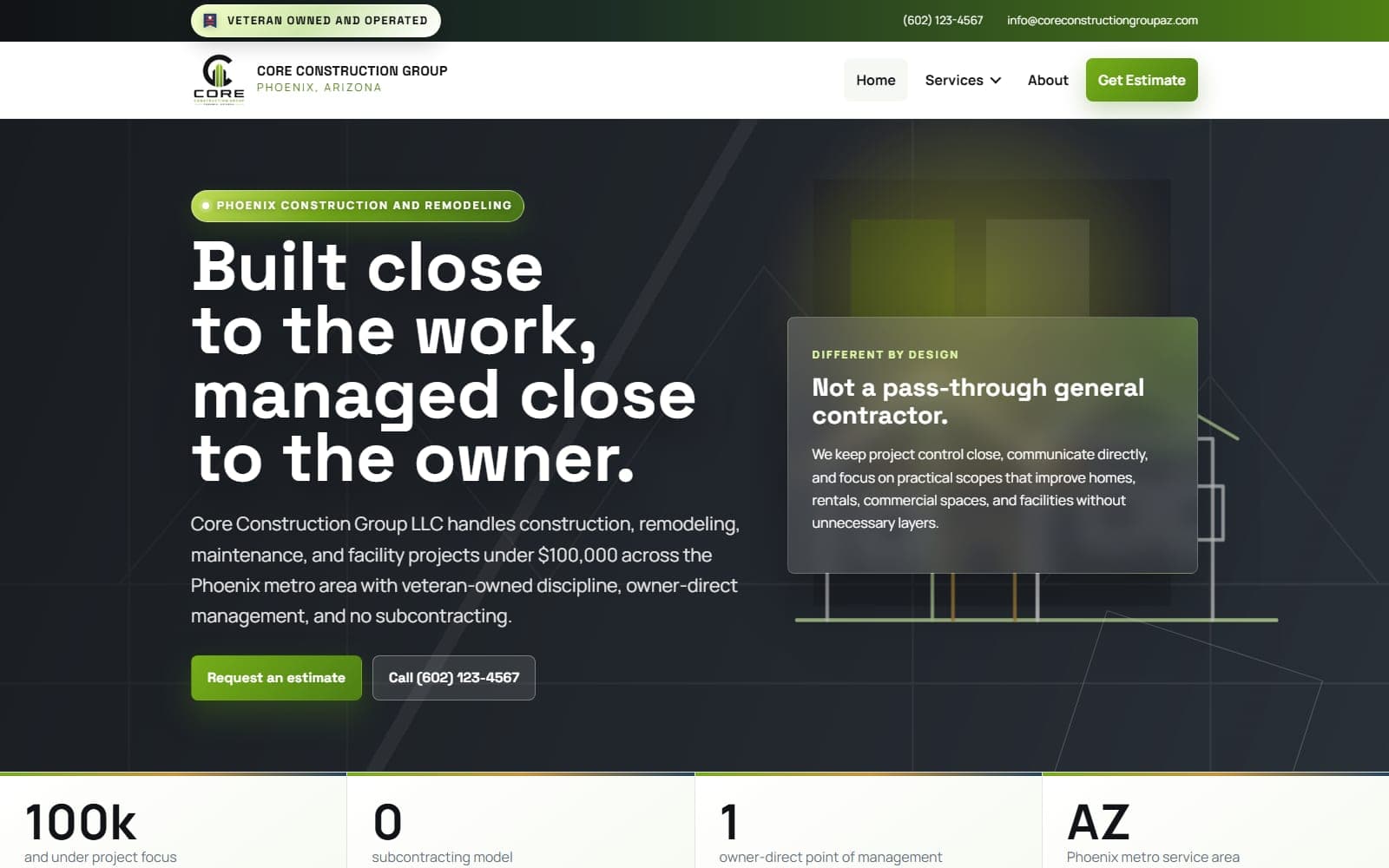
Core Construction Group
Phoenix, AZ · Metro
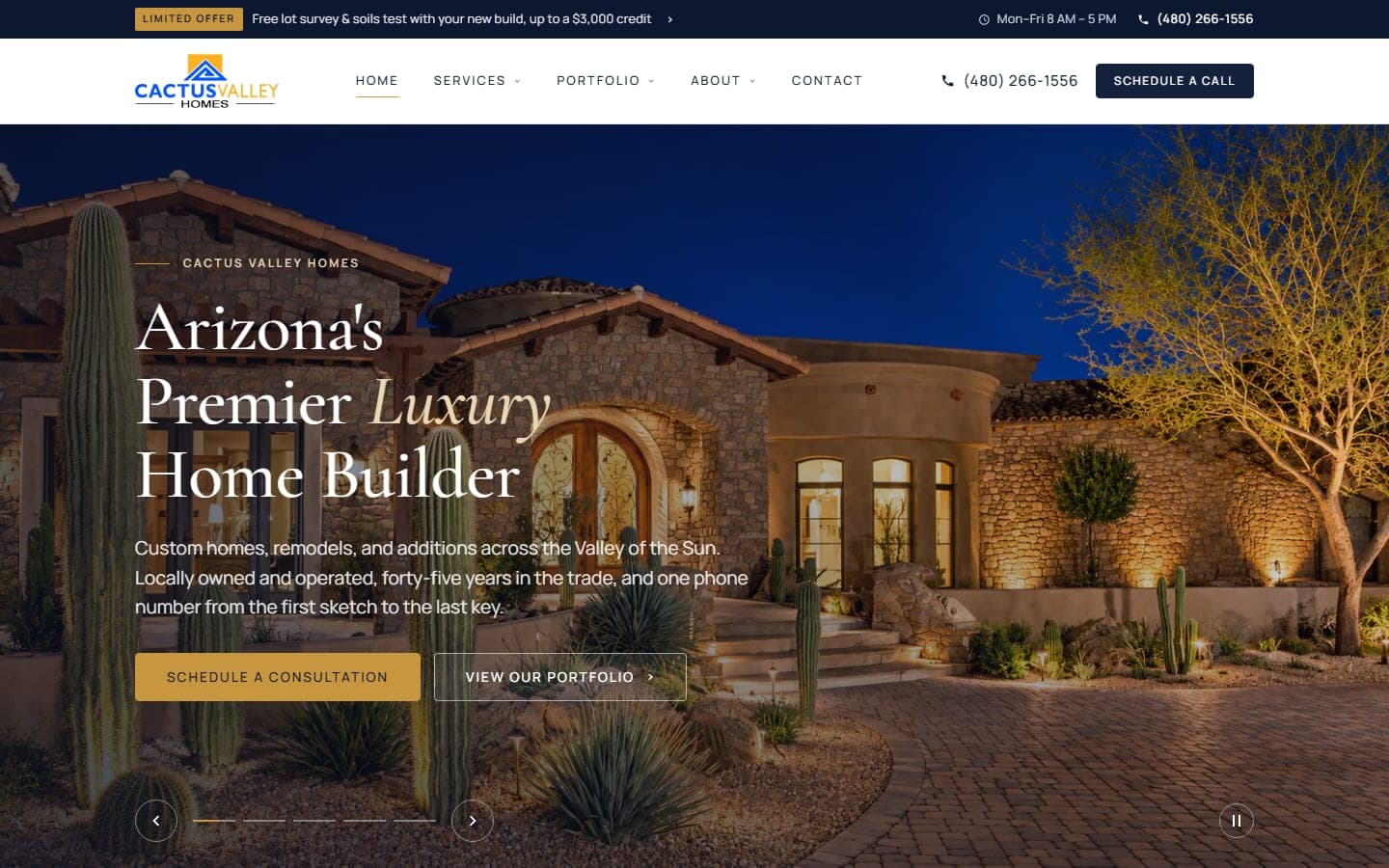
Cactus Valley Homes
Phoenix, AZ · Arizona
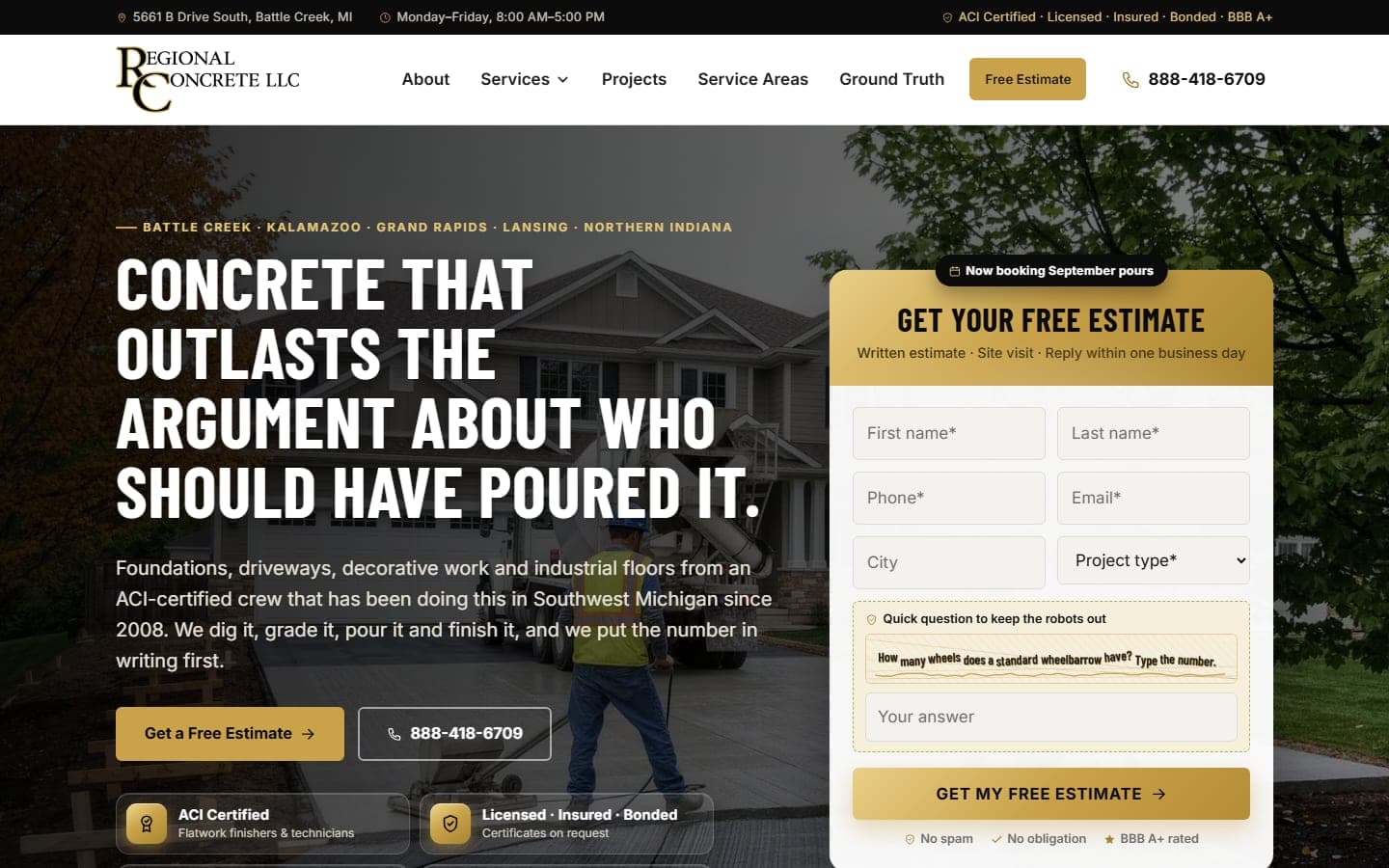
Regional Concrete LLC
Battle Creek, MI · Southwest Michigan
See the full portfolio, including seven complete demo sites.
What it costs
A fixed price, and a monthly number
A contractor website built this way is a fixed price, quoted after a short call, most often between $8,000 and $20,000. The number moves with the count of service and town pages, whether the copy exists, and what the estimate flow has to do. It does not move with the design; the design is the part we are best at and the part that costs the least.
The price includes everything on this page and the offer above it. Local marketing and SEO are monthly, with a defined scope and no long contract, and you can add them later. Any build qualifies for 0% financing with 25% down. The worked example beside this shows what a typical contractor project runs month to month.
A worked example at 0%
$15,000
- 25% down at signing
- $3,750
- Or 12 monthly payments of
- $938
- Or 24 monthly payments of
- $469
- Interest
- $0
Financed projects are hosted on the DataCram platform for the length of the plan. Try your own number.
What happens after you claim it
Claim the offer
Two minutes on the form, or a call. Tell us the trade, the towns and what you have now.
A person looks first
We check your current site, your Google profile and what a customer in your area sees when they search. Then you get a fixed number.
The build, four to eight weeks
Copy written from your jobs, real photos, the estimate flow, the pages for each service and town, tracking installed.
Launch, then the offer kicks in
The included extras go live with the site. From then on one monthly report shows the calls and forms it produced.
Get the Ten-Project Gallery quoted
Tell us what you build and where. A person calls back with a fixed number and the ten project pages written into it.
Which of these sounds like you? (pick any)
Questions, answered
Before you ask
Yes. Send the photos and a few lines per job, or talk us through them on a call, and we write the pages: the problem, the fix, the timeline and the neighborhood. Ten are included; more are added at a per-page rate as you finish jobs.
Ranges, yes. A kitchen remodel that starts at a stated number, with a monthly payment beside it, gets the call from the homeowner who was going to ask anyway and loses only the ones who were never going to pay it. The financing page makes the range easier to accept.
The financing page explains your own financing or third-party options and turns a project size into a monthly number. If you offer financing, the calculator uses your terms; if you use a lender, it links to their application.
Yes. A commercial page speaks to owners and property managers: build-outs, tenant improvements, schedules, references. It sits beside the residential pages and ranks on its own.
Most run between $8,000 and $20,000 as a fixed price, depending on the project pages, service pages and the estimate flow. The build qualifies for 0% financing with 25% down; a $15,000 site is $3,750 down and about $469 a month over 24 months.
Start now. Pay monthly. Add nothing for interest.
Put 25% down at signing and spread the rest in equal monthly payments. The total you pay is the price on the proposal.
- Up to 12 months on any project
- 24 months from $15,000
- 36 months from $20,000
Financed projects are hosted on the DataCram platform for the length of the plan.