Website design for concrete contractors · fixed price · 0% financing
Concrete contractor website design that gets the estimate
A homeowner with a cracked driveway and a plant manager with a failing floor search for different things and land on the same company. This is the site that gives each of them a page, a town and a free estimate before they scroll.
Fixed price · 0% financing with 25% down · reply within hours
Every Town You Pour In
Five service-area pages and a job-type estimate form, built and included, so every town you drive to has a page that ranks.
- Service-area pages for five towns, each with the housing, the soil and the jobs you have poured there
- A free estimate form that asks for the job type, the square footage and a photo, on every page
- A page for every pour: driveways, foundations, patios, decorative, industrial floors, excavation and grading
- A project gallery sorted by job type and town
Included with any concrete website build quoted this quarter. Additional town pages after the first five are added at a per-page rate.
Nineteen ways to put concrete where it belongs
Concrete is a trade with a wide front door. On the same day the phone brings a homeowner who wants a driveway that does not crack this time, a builder who needs a foundation poured on a schedule, a restaurant owner who wants a stamped patio, and a plant manager whose floor is failing under the forklifts. Each searched for something different. Each expects to land on a page about his job, not a page about concrete in general.
Most concrete websites have one Services page that lists everything and ranks for nothing, and a gallery that shows a slab with no caption. The homeowner cannot tell whether you do driveways in his town. The plant manager cannot tell whether you have ever poured an industrial floor. Both go back to the results.
The site on this page gives every kind of pour its own page, every town its own page, and every visitor a free estimate form that asks about his job specifically. It is the structure we built for a concrete contractor in Michigan with nineteen service pages and a gallery across two states, and it is the structure that ranks. The contractor website guide covers the trust side; this is the build.
What your customer does
From the search to the booked job
Every step is a place the site wins the job or loses it. The build is designed around the steps, not around the look.
- 1
The driveway cracks. He searches for a driveway contractor in his town.
A page about driveways, mentioning his town, with photos of driveways and a free estimate form that asks for square footage. He does not have to find you in a list.
- 2
The plant manager searches for industrial floors.
A page about industrial and warehouse floors, with load ratings, joint details and a project from a facility like his. He knows in ten seconds you have done this.
- 3
Both check that you will still be here.
Certifications, insurance, years and a real yard with real trucks. The proof sits at the top, not in the footer.
- 4
Each requests an estimate for his job.
The form asks for the job type, the size and a photo. The request reaches you with enough to quote, and the page promised a reply within a business day.
- 5
The gallery seals it.
Sorted by job type and town, with a line about each pour. A homeowner wants a driveway like his; a builder wants a foundation on a lot like his.
What a concrete contractor website has to have
- A page for every pour: driveways, foundations, patios, sidewalks, decorative and stamped, industrial floors, excavation and grading.
- Residential and commercial separated, because a homeowner and a plant manager read different pages.
- Service-area pages for every town you drive to, each with the soil, the housing and the jobs you have poured there.
- A free estimate form on every page that asks for the job type, the size and a photo.
- Certifications and insurance up front, with the years and the yard.
- A gallery sorted by job type and town, with a caption on every photo.
- Reviews that name the job: the driveway that did not crack, the foundation poured on schedule.
- Tracking that shows which job type and which town produced each estimate.
What is included in the build
A page for every pour
Nineteen service pages if you have nineteen services. Each ranks on its own.
Service-area pages
Five towns included, each written with something true about it.
Job-type estimate form
Job type, size and a photo, on every page, reaching you in seconds.
Commercial and industrial pages
Floors, foundations and site work, written for the manager and the builder.
Proof up front
Certifications, insurance, years and the yard, at the top of every page.
Tracking to the estimate
Which job type and which town produced each request.
Built by us, running today
Work you can click on
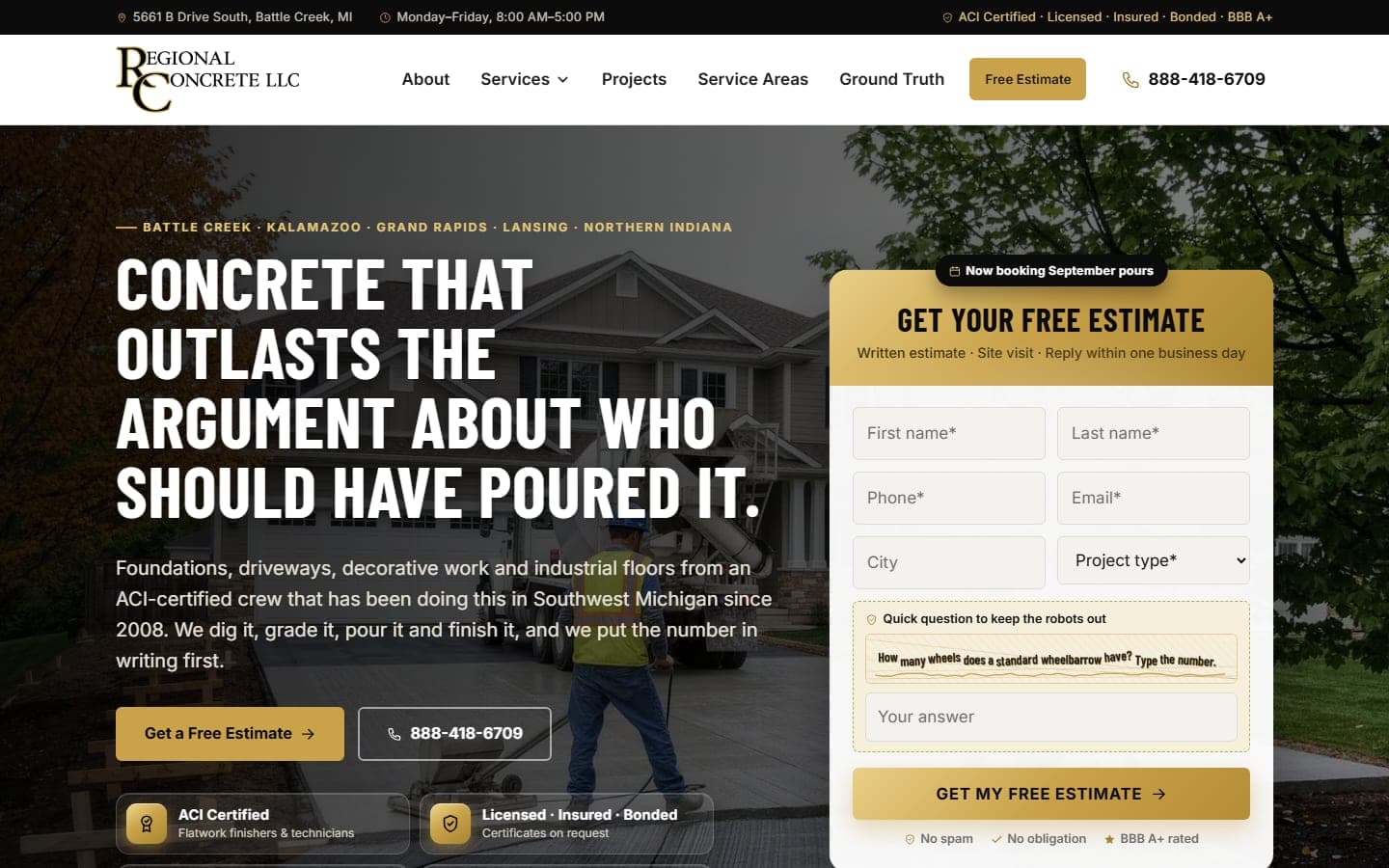
Regional Concrete LLC
Battle Creek, MI · Southwest Michigan
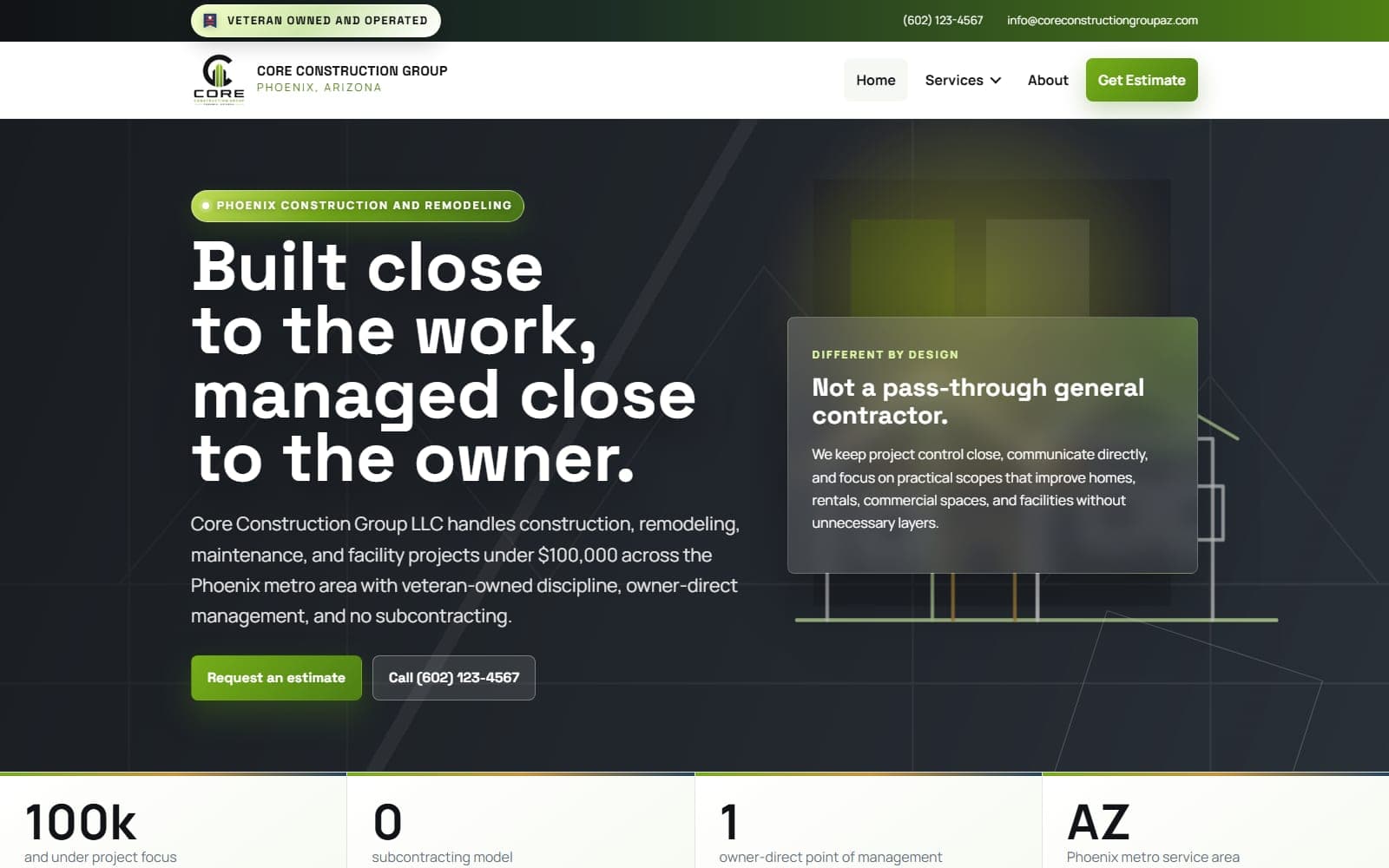
Core Construction Group
Phoenix, AZ · Metro
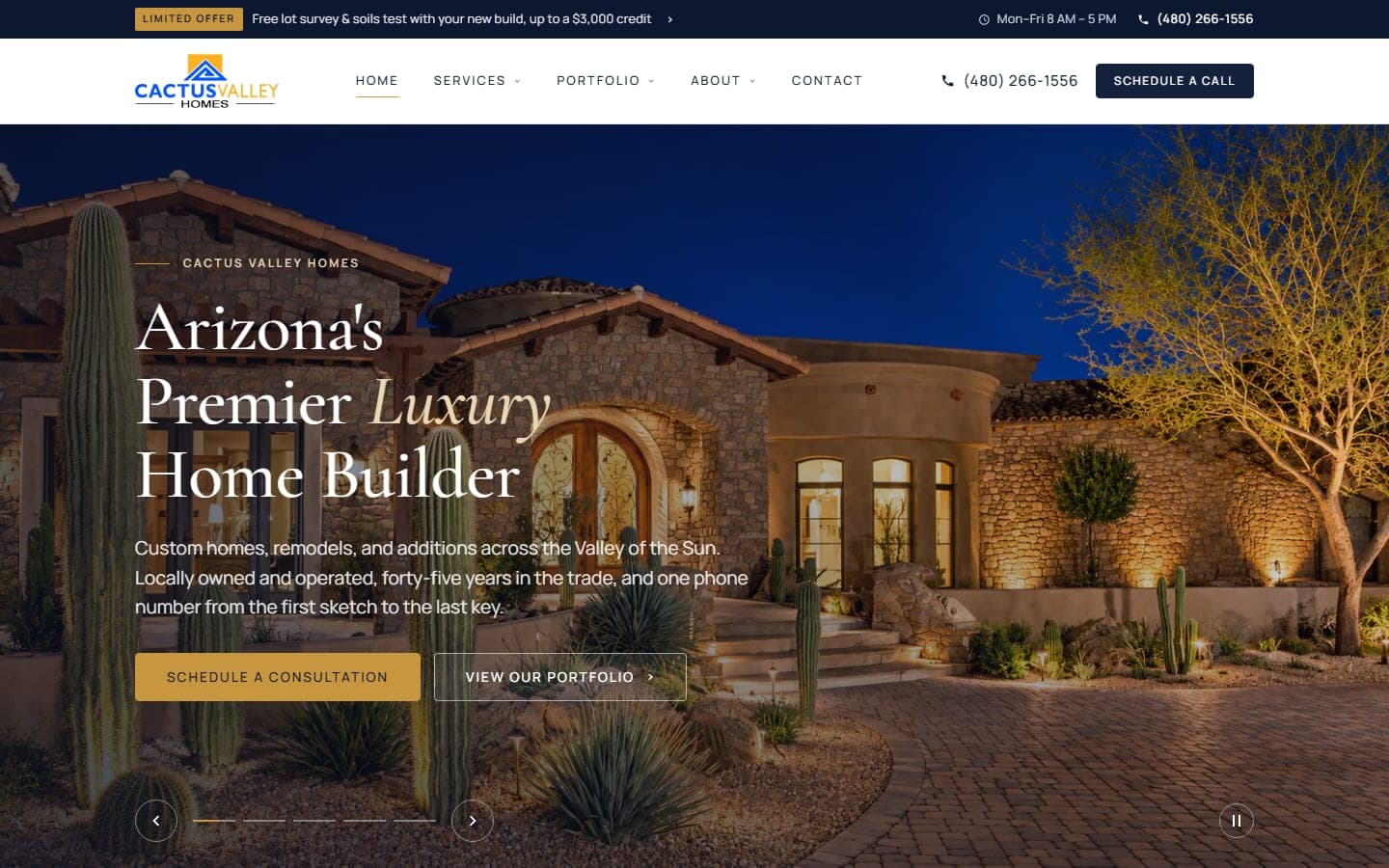
Cactus Valley Homes
Phoenix, AZ · Arizona
See the full portfolio, including seven complete demo sites.
What it costs
A fixed price, and a monthly number
A concrete website built this way is a fixed price, quoted after a short call, most often between $7,000 and $18,000. The number moves with the count of service and town pages, whether the copy exists, and what the estimate flow has to do. It does not move with the design; the design is the part we are best at and the part that costs the least.
The price includes everything on this page and the offer above it. Local marketing and SEO are monthly, with a defined scope and no long contract, and you can add them later. Any build qualifies for 0% financing with 25% down. The worked example beside this shows what a typical concrete project runs month to month.
A worked example at 0%
$12,000
- 25% down at signing
- $3,000
- Or 12 monthly payments of
- $750
- Interest
- $0
Financed projects are hosted on the DataCram platform for the length of the plan. Try your own number.
What happens after you claim it
Claim the offer
Two minutes on the form, or a call. Tell us the trade, the towns and what you have now.
A person looks first
We check your current site, your Google profile and what a customer in your area sees when they search. Then you get a fixed number.
The build, four to eight weeks
Copy written from your jobs, real photos, the estimate flow, the pages for each service and town, tracking installed.
Launch, then the offer kicks in
The included extras go live with the site. From then on one monthly report shows the calls and forms it produced.
Get Every Town You Pour In quoted
Tell us the towns and the kinds of work you want more of. A person calls back with a fixed number and the town pages written into it.
Which of these sounds like you? (pick any)
Questions, answered
Before you ask
For every kind you want to be hired for and that people search for by name, yes. A driveway search and an industrial floor search come from different people with different budgets, and neither is served by a page about concrete in general. A page each is how both rank and how both convert.
One for each town where you want to be the first call and can say something true: the soil, the housing stock, the jobs you have poured there. Five are included with the build; most contractors settle between five and twelve. Forty identical pages with the town name swapped hurt more than they help.
Yes. The form asks for the job type first and adjusts its questions: square footage and a photo for a driveway, load requirements and a site plan for an industrial floor. Both reach you with enough detail to quote.
Yes. Send the photos with a line or two about each job and we write the captions and sort the gallery by job type and town. A photo with a place and a job type is proof; a photo alone is decoration.
Most run between $7,000 and $18,000 as a fixed price, depending on the number of service and town pages. The build qualifies for 0% financing with 25% down, so a $12,000 site is $3,000 down and $750 a month for twelve months.
Read before you decide
Start now. Pay monthly. Add nothing for interest.
Put 25% down at signing and spread the rest in equal monthly payments. The total you pay is the price on the proposal.
- Up to 12 months on any project
- 24 months from $15,000
- 36 months from $20,000
Financed projects are hosted on the DataCram platform for the length of the plan.