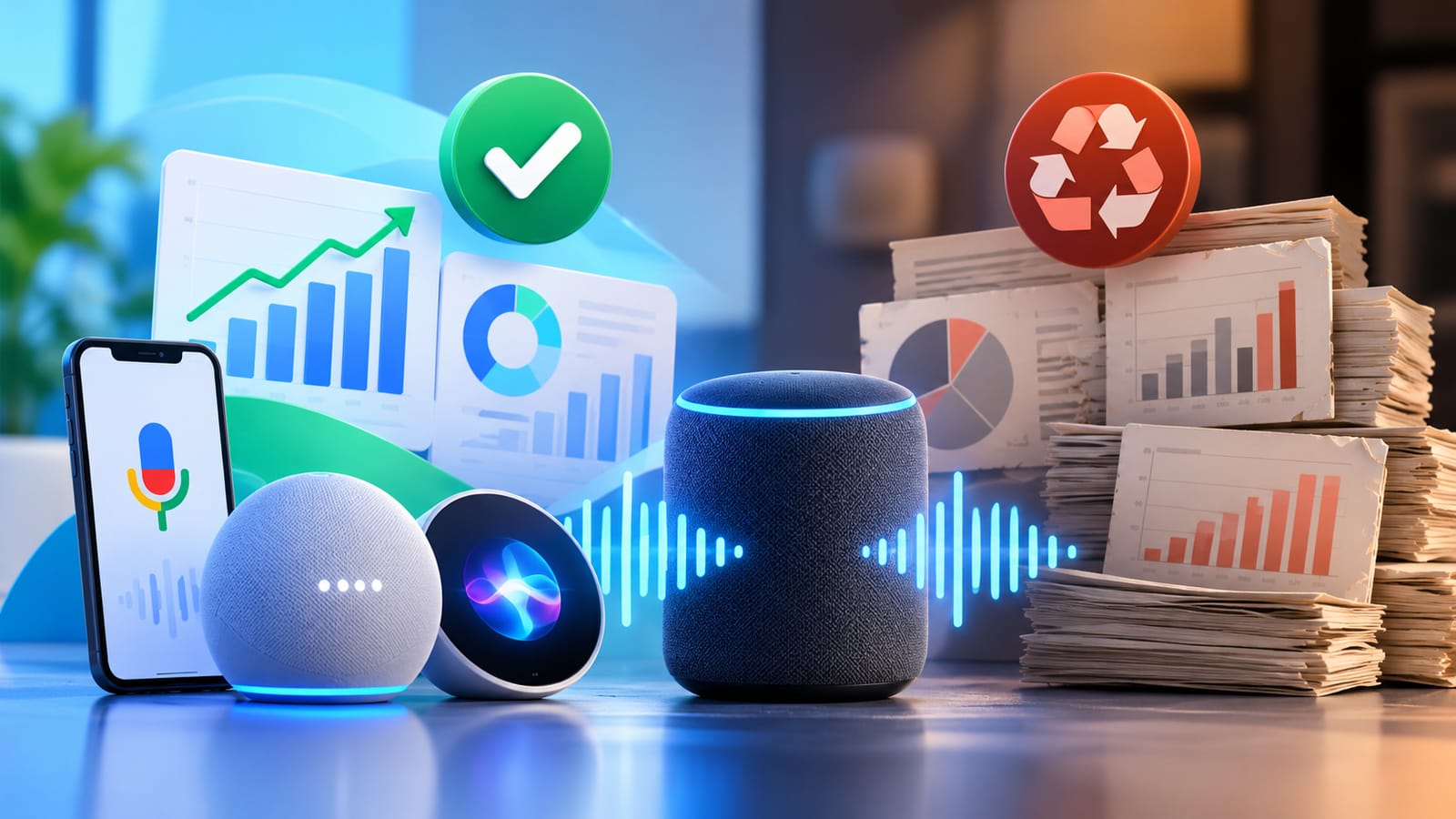
What Is AI SEO?

AI SEO is the practice of making a website easy for AI systems — Google's AI Overviews, ChatGPT, Perplexity, Copilot — to crawl, understand, and cite when they answer a user's question. It runs on the same foundations as traditional SEO (technical health, topical authority, clear writing, credible links), but the goal shifts from earning a click off a list of ten blue links to being the source an AI quotes inside its answer. In practice that means writing pages that answer one question directly, backing claims with named sources and numbers, marking up entities with structured data, and keeping your site fast and crawlable. Success is measured in citation share and branded search lift, not just rank position.
The problem, stated plainly
Your traffic report shows impressions holding steady and clicks sliding. Nothing broke. Your rankings are fine. What changed is that a machine now reads the top of the results page on your behalf and writes a paragraph, and a large share of searchers stop reading there.
That gap between impressions and clicks is the entire reason "AI SEO" exists as a phrase. It is not a new discipline invented by consultants. It is SEO adjusted for a results page where the answer arrives before the links do.
What actually changed
Google launched AI Overviews in the United States in May 2024 and expanded it internationally through that year. Alphabet has since told investors the feature reaches more than 1.5 billion people a month. At the same time, a meaningful slice of question-shaped traffic moved off search engines entirely and into assistants — ChatGPT, Claude, Perplexity, Copilot — where there is no results page at all, just an answer with a handful of footnotes.
The behavioral consequence is measurable. Pew Research Center tracked real browsing behavior in March 2025 and found that users clicked a link on 8% of visits to a search page containing an AI summary, compared with 15% of visits to pages without one. Roughly half the clicks, gone.
So the question every business owner should be asking is not "how do I rank number one." It is "when a machine writes the answer, whose name is in it?"
AI SEO vs. traditional SEO: what carries over
Most of it. This is the part vendors selling a $4,000-a-month "AI visibility package" would rather you didn't know.
Google's own documentation on AI features says there is no special markup, no separate index, and no submission process for AI Overviews. Pages that appear there are drawn from the same web index that powers regular Search. If you cannot rank, you will not be cited. Independent studies of AI Overview sources keep landing on the same finding: the large majority of cited URLs already rank on page one for a related query.
Assistants work differently in the plumbing but not in the outcome. ChatGPT's search, Perplexity, and Copilot all lean on live web retrieval plus a model's pretrained sense of which brands are associated with which topics. Both paths reward the same things: a crawlable site, content that clearly answers something, and enough third-party mentions that a model has seen your name attached to your subject more than once.
What changes is emphasis. Traditional SEO optimized a page to win a click. AI SEO optimizes a passage to be liftable.
How AI systems decide whom to cite
Think of it as a retrieval problem, not a popularity contest.
Chunk-level relevance. Retrieval systems don't evaluate your page. They evaluate passages inside it. A 2,000-word page that meanders will lose to a 400-word section that answers the exact question in the first two sentences. Front-load the answer, then support it.
Extractability. Models prefer text they can quote without editing: declarative sentences, definitions that stand alone, numbered steps, short tables, question-shaped H2s. Marketing prose full of "solutions" and "synergies" is unquotable, which is its own kind of penalty.
Corroboration. An AI will cite a claim it can verify against other sources. Numbers with named origins, dates, and specifics survive that check. Vague superlatives do not.
Entity clarity. Structured data using schema.org vocabulary — Organization, LocalBusiness, Article, FAQPage, Product — tells a machine what your business is, where it operates, and what it sells, without requiring the machine to guess from your homepage carousel. Google supports these types for rich results, and the same disambiguation helps assistants connect a brand name to a service and a service area.
Presence off your own site. Models learn associations from the whole web. Reviews, directory listings, trade publications, forum threads, and local news mentions all feed the association between your company name and your category. A site with perfect technical hygiene and zero external footprint is a stranger to the model.
The four levers that actually move the needle
-
Technical access. If your robots.txt blocks GPTBot, PerplexityBot, or Google-Extended, you have opted out of being quoted. That may be a deliberate choice for a publisher protecting archives. For a service business chasing leads, it is usually an accident. Also check render speed and JavaScript dependency — several AI crawlers execute JavaScript poorly or not at all, so content that only appears after hydration may be invisible to them.
-
Answer architecture. Restructure key pages so each one owns a single question. Put the answer in the first 40–60 words. Follow with the mechanism, the evidence, and the edge cases. This is a rewrite job, not a plugin.
-
Verifiable specificity. Replace every unsupported adjective with a number, a date, a mechanism, or a named source. "Fast hosting" is noise. "Time to first byte under 300 ms on a Texas-region server" is a citable fact.
-
Entity and reputation signals. Consistent NAP data, a complete Google Business Profile, schema markup that matches the visible page, and steady third-party mentions. For a local service business, this lever often outperforms content volume.
Measuring something Search Console won't show you
AI citations don't appear as a tidy metric. Build the picture from four angles:
- Referral traffic by source. Segment sessions from chatgpt.com, perplexity.ai, and copilot.microsoft.com in analytics. Volume is small; intent is high.
- Manual citation audits. Run your 20 most valuable questions through the major assistants monthly and log who gets cited. Tedious, honest, and cheap.
- Impressions-to-clicks divergence in Search Console. Rising impressions with flat clicks on informational queries is the fingerprint of AI Overview absorption.
- Branded search volume. When a model names you inside an answer, many people search your brand rather than clicking the footnote. Branded query growth is often the truest signal that AI visibility is working.
What AI SEO is not
It is not publishing 300 machine-written articles a month. Google's spam policies target scaled content abuse — content produced at volume primarily to manipulate rankings, regardless of whether a human or a model wrote it. The tool isn't the violation. The intent and the quality are.
It is also not a checkbox called llms.txt. The proposed standard is interesting and costs nothing to add, but no major AI system has publicly committed to obeying it as a ranking or retrieval input. Treat it as a low-cost experiment, not a strategy.
And it is not separate from your existing SEO budget. Teams that treat AI visibility as a bolt-on product usually end up paying twice for the same technical audit.
Where to start
Pick your ten highest-value questions — the ones a prospect asks 20 minutes before they call someone. Rewrite one page per question, answer-first, with real numbers. Add schema. Unblock the AI crawlers you want reading you. Then measure citation share for 90 days before you spend another dollar.
That sequence costs less than most agencies' onboarding fee, and it is the same sequence DataCram runs for clients across San Antonio, Boerne, New Braunfels, Kerrville, and Helotes.
Step by step
- Audit crawler access — Check robots.txt for blocks on GPTBot, PerplexityBot, ClaudeBot, and Google-Extended. Confirm your key content renders in raw HTML, not only after JavaScript hydration.
- List your ten money questions — Write down the questions a buyer asks right before they contact a provider in your category. Pull them from sales calls, chat logs, and Search Console queries — not a keyword tool alone.
- Rebuild one page per question, answer-first — Open with a 40–60 word direct answer, then explain the mechanism, then handle edge cases. Use question-shaped H2s so retrieval systems can isolate the relevant passage.
- Replace adjectives with evidence — Every claim gets a number, a date, a named source, or a described mechanism. Unsupported superlatives are the fastest way to be passed over for a competitor who cited a figure.
- Add and validate structured data — Mark up Organization or LocalBusiness, Article, and FAQPage. Make sure the markup matches what a human sees on the page, then run it through Google's Rich Results Test.
- Build the measurement loop — Segment referral traffic from AI assistants, run a monthly manual citation check on your ten questions, and track branded search volume. Give it 90 days before judging results.
Blocking Google-Extended or GPTBot in robots.txt removes you from AI answer consideration on those platforms. Decide deliberately — many sites block them by accident through a copied template or a default plugin setting.
Publishing high-volume AI-generated articles to chase coverage risks a scaled content abuse action under Google's spam policies. Volume without editorial value is the trigger, not the tool.
Be skeptical of any vendor guaranteeing placement in AI Overviews or a specific ChatGPT citation. No platform sells that access, and no one can promise a model's output.
AI citation traffic is small in raw sessions but high in intent. Judging the work on session count alone will lead you to cancel a program that is producing your best-qualified leads.
Frequently asked questions
Is AI SEO different from GEO or AEO?
Not meaningfully. GEO (generative engine optimization) and AEO (answer engine optimization) describe the same work under different labels: structuring content so AI systems can retrieve and cite it. The tactics overlap almost entirely with modern technical and content SEO.
Does traditional SEO still matter if AI answers the question?
Yes, more than ever. Google's documentation confirms AI Overviews draw from the standard Search index, and studies consistently find that cited pages already rank on page one. Weak organic performance means no AI citations.
How long does AI SEO take to show results?
Expect 60 to 120 days for rewritten pages to be recrawled, reindexed, and begin appearing as citations. Assistant answers can shift faster than Google rankings because retrieval happens live, but the underlying authority signals still take months to build.
Should I add an llms.txt file to my site?
You can — it takes minutes and costs nothing. But no major AI provider has publicly committed to using it for retrieval or ranking, so treat it as a cheap experiment rather than a substitute for crawlable content and structured data.
Can I track how often ChatGPT or Perplexity cites my site?
Partially. Segment referral traffic from chatgpt.com, perplexity.ai, and copilot.microsoft.com in your analytics, and run a manual monthly check on your top questions. There is no complete citation report, so a manual log plus branded search volume is the practical benchmark.

 SEO that keeps working