Calculating ROI: How AI Agents Increase Productivity and Cut Costs for US Enterprises
What an AI agent is and why it matters
An AI agent combines language models, retrieval systems, APIs, and workflow automation to complete specific business tasks: draft contract summaries, autonomously triage support tickets, enrich CRM records, or run compliance checks. Unlike one-off scripts, agents persist, learn, and can be orchestrated across systems (CRM, ERP, knowledge bases) to reduce manual effort.
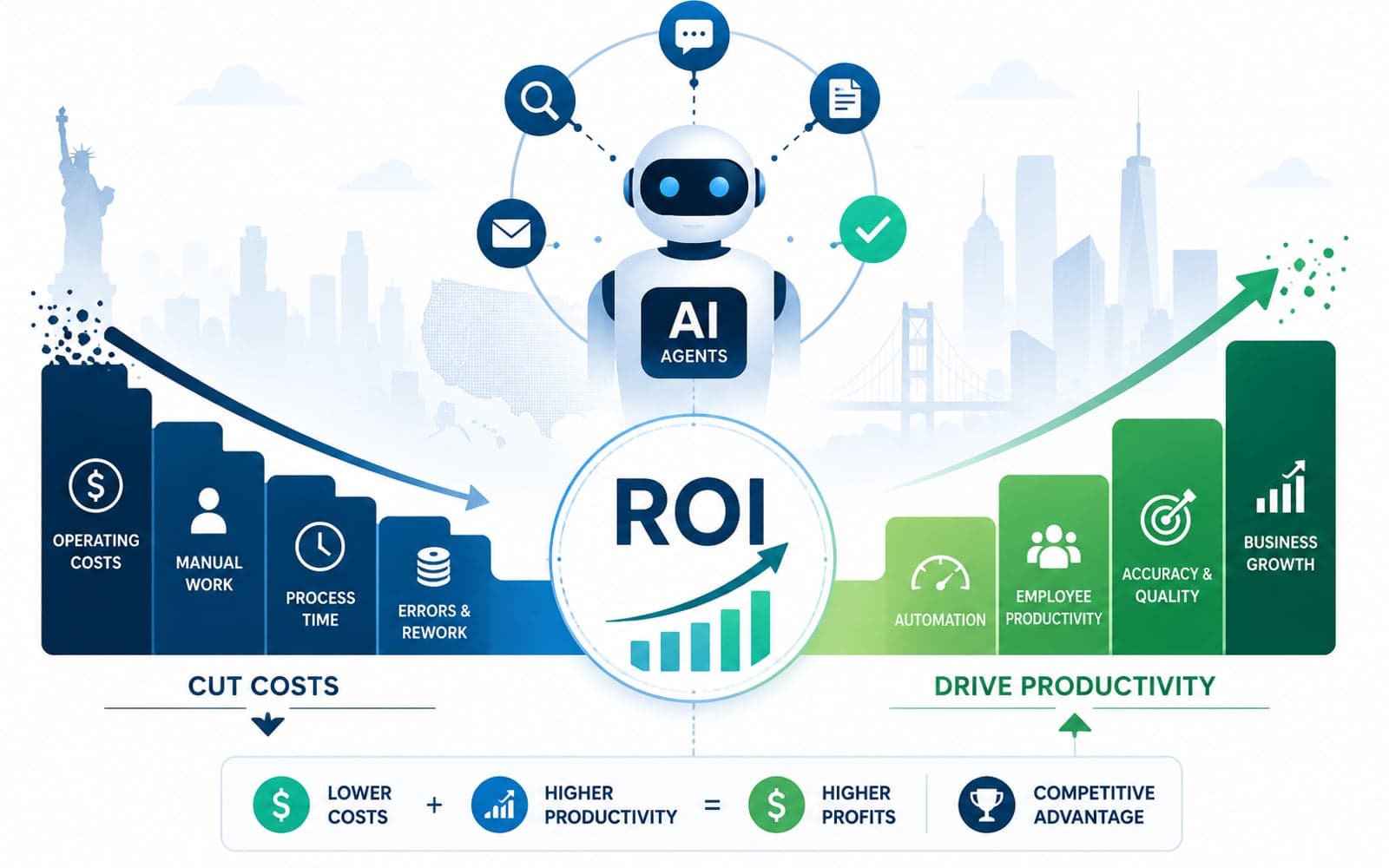
For US enterprises, the business value is concrete: faster cycle times, fewer errors, lower labor costs, improved sales conversion, and higher throughput per employee. Buyers require clarity on these outcomes to justify investment and budget prioritization.
Measuring ROI: a practical formula
ROI for AI agents is measured the same way as other automation investments: net benefit divided by cost. A simple, schema-friendly formula:
ROI (%) = [(Annual Benefits − Annual Costs) / Annual Costs] × 100
Where Annual Benefits include labor savings, revenue uplift, error reduction, and opportunity cost savings. Annual Costs include development, cloud compute, monitoring, and change management.
Example calculation — a typical US enterprise pilot
Scenario: A 1,200-employee company automates invoice triage with an AI agent that reduces manual review by 40%.
Baseline: 4 FTEs spend 100% of their time on triage. Average fully-loaded cost per FTE = $90,000/year.
After automation: effective FTE reduction = 4 × 40% = 1.6 FTEs → annual labor savings ≈ 1.6 × $90,000 = $144,000.
Other benefits: 25% faster payment cycles (improves working capital), and 50% fewer invoice errors (reduces penalties and rework ≈ $20,000/year).
Costs: development and pilot amortized to $60,000/year; cloud and monitoring $24,000/year; vendor/licensing $12,000/year → total annual costs = $96,000.
ROI = [($144,000 + $20,000 − $96,000) / $96,000] × 100 ≈ 72%.
This example is conservative: many implementations realize higher uplifts when agents combine automation with lead-gen enhancements or process redesign.
Top ROI drivers and KPIs to track
- Time saved per task (minutes) and FTE-equivalents recovered
- Error rate reduction and cost per error avoided
- Cycle time reduction (order-to-cash, ticket resolution)
- Revenue uplift from faster lead response or improved qualification
- Operational scalability: cost per transaction after automation
Implementation roadmap for measurable outcomes
Buyers get faster payback when implementation follows a disciplined sequence: identify high-frequency, high-cost tasks; baseline current metrics; run a focused pilot with measurable KPIs; iterate and scale. Integration with existing systems—CRM, ERP, knowledge stores—and governance (access controls, monitoring, explainability) are essential for enterprise deployment.
DataCram's approach combines site-level SEO to capture opportunity signals, AI search optimization to surface relevant knowledge, web development to expose secure endpoints, and AI agent engineering and automations to run production workflows. Content marketing and lead generation round out the business case by tracking demand uplift tied to agent-driven improvements.
Practical outcomes buyers can expect
Enterprises that adopt AI agents responsibly report outcomes such as:
- 20–60% reduction in manual task time for targeted workflows
- 0.5–2.5 FTEs recovered per large process automated
- 15–40% faster customer-facing response times, lifting conversion rates
- Lower per-transaction costs enabling scale without linear headcount growth
Those ranges depend on domain complexity, data quality, and integration effort. Clear baseline measurement and a two-quarter pilot are common best practices.
Why this matters to US enterprises and procurement
Procurement and IT leaders must justify spend to CFOs with concrete numbers. AI agents deliver traceable improvements across finance, sales, and customer service, making them easier to include in digital transformation budgets. They also unlock longer-term strategic benefits: improved knowledge retention, faster onboarding, and new productized services.
FAQ
Q1: How long before an AI agent shows ROI?
A1: Most focused pilots show measurable ROI in 3–6 months. Baseline measurement, data access, and a clear scope (specific task or workflow) shorten the timeline.
Q2: What are typical upfront costs?
A2: Upfront costs vary by scope. Small pilots can start at $25k–$75k for engineering, integrations, and cloud resources; enterprise pilots typically range $75k–$250k. Ongoing costs include hosting, monitoring, and incremental model updates.
Q3: How do you ensure accuracy and compliance?
A3: Governance layers—retrieval-augmented generation, human-in-the-loop validation, access controls, and audit logging—are standard. Integrating with corporate knowledge bases and applying domain-specific validation rules reduces risk and ensures compliance.
Next steps and call to action
Calculating ROI for AI agents is a measurable, repeatable process. For US enterprises ready to move from pilots to production, DataCram offers end-to-end services: AI agent design, automations, AI search optimization, secure web development, SEO and content marketing, and lead generation to capture business value.
Contact DataCram to plan a practical digital system tailored to your workflows and to run a pilot that delivers clear KPIs and a defensible ROI.

 Agents you can hire today